Competition overview
UK Chemistry Olympiad overview
The UK Chemistry Olympiad (UKChO) is the Royal Society of Chemistry’s annual problem-solving competition for secondary students. It begins with a demanding two-hour written paper and, for eligible UK participants, leads towards selection of the four-student UK team for the International Chemistry Olympiad.
Facts reviewed 13 July 2026 · Official organiser information takes precedence.
- Organiser
- Royal Society of Chemistry (RSC)
- Round One
- Two-hour written paper completed at school
- 2026 paper
- Five questions · 84 marks
- Primary source
- RSC Education
Answer first
What is the UK Chemistry Olympiad?
UKChO is an extension competition: students use familiar chemistry, information supplied in the paper and clear written reasoning to solve unfamiliar real-world problems.
The paper is written with students in the final years of secondary education in mind. RSC guidance says institutions teaching students aged 16–19 across the British Isles can enter Round One, although ambitious younger students may also attempt Olympiad-style material. The competition is not a conventional syllabus examination and does not reward recall alone.
Questions can move between organic, inorganic and physical chemistry. A prompt may introduce a new molecule, industrial process or scientific measurement, then ask the student to extract relevant data, construct a model, carry out calculations and justify a conclusion. The surrounding context may be unfamiliar even when the underlying chemistry is accessible.
Source: RSC 2026 Round One results and the published question paper.
Competition pathway
From a school paper to the international team
The three stages form the UK selection pathway. International or regional entrants may be eligible for Round One awards without being eligible for later UK team-selection stages.
Round One
Students sit a written paper at their school. In the British Isles, teachers mark scripts using the released mark scheme and submit scores to the RSC.
Round Two
The RSC invites roughly 25–30 high-scoring eligible students for advanced theoretical and practical training and assessment.
International stage
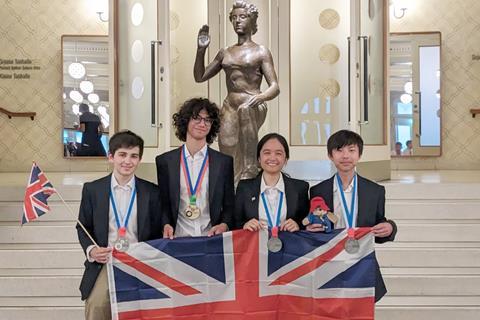
Four students are selected to represent the United Kingdom at the International Chemistry Olympiad.
Academic scope
What knowledge and skills does UKChO test?
- Information decoding
- Students must separate data supplied by the question from facts they are expected to know, identify constraints and decide which relationships are chemically relevant.
- Organic reasoning
- Mechanisms, structure, stereochemistry and synthesis frequently appear. The emphasis is on following electron movement and explaining transformations, not merely naming reactions.
- Quantitative chemistry
- Stoichiometry, equilibrium, energetics, kinetics, spectroscopy and structural calculations can be combined across several linked parts. Units and readable working matter.
- Scientific communication
- A correct final number may not be enough. Mark schemes reward balanced equations, clear structures, stated assumptions and a logical chain that a marker can follow.
- Resilience
- Questions generally become more demanding as they progress. Students benefit from taking accessible marks first, returning to harder sections and attempting every part they can.
Awards and interpretation
Gold, Silver and Bronze are year-specific outcomes
Award thresholds are set after each paper and cohort are reviewed. A score that earned Gold in one year may correspond to a different award in another year.
38–84 marks
8.5% of submitted scores received Gold.
23–37 marks
25.7% of submitted scores received Silver.
13–22 marks
36.5% of submitted scores received Bronze.
For a multi-year comparison, use the UKChO score boundaries guide. Percentages above are national RSC figures, not results from a preparation provider.
Educational value
Why do students and schools take part?
For students, UKChO provides evidence of how they respond when familiar school chemistry is placed inside a new problem. The paper can reveal strengths in interpretation, persistence and scientific communication that are not always visible in a conventional specification-based examination.
For teachers, a paper can start discussion about how chemistry is used in research, medicine, materials, industry and environmental questions. The RSC describes the activity as an opportunity to develop skills students will need at university and beyond.
- Extension
- Strong students encounter chemistry beyond routine exercises without needing a separate closed syllabus.
- Diagnosis
- A marked paper shows whether the main barrier is knowledge, interpretation, calculation, written method or time management.
- Academic evidence
- An award can support a broader academic profile, but it should be described accurately and never presented as a university-admission guarantee.
Evidence register