For many high-achieving chemistry students in China, the UKChO Round 2 eligibility question is critical. Unlike domestic UK students who follow a standardized progression, international participants often face complex administrative pathways. A common misconception is that winning a Gold medal in Round 1 automatically grants access to Round 2. In reality, eligibility is determined by the specific registration route your institution uses, not just your score.
The Myth of Automatic Progression
The Royal Society of Chemistry (RSC) selects approximately 25–30 students from submitted entries for Round 2. However, this selection process is heavily influenced by how the student was registered. For students sitting exams in China, the pathway is rarely identical to that of a student in London. If you are studying at a British International School overseas, there are specific registration criteria that differ from local independent schools. Conversely, if you are participating through an external provider like ASEEDER, your enquiries must be directed to them, as they manage the eligibility interface between the student and the RSC.
Therefore, a high score in Round 1 is a prerequisite for consideration, but it is not a guarantee of entry. The deciding factor is whether your chosen route supports advancement to the second round. Some routes are designed solely for Round 1 participation, serving as a benchmark for university applications rather than a stepping stone to national team selection.
Route-Specific Guidance Matters
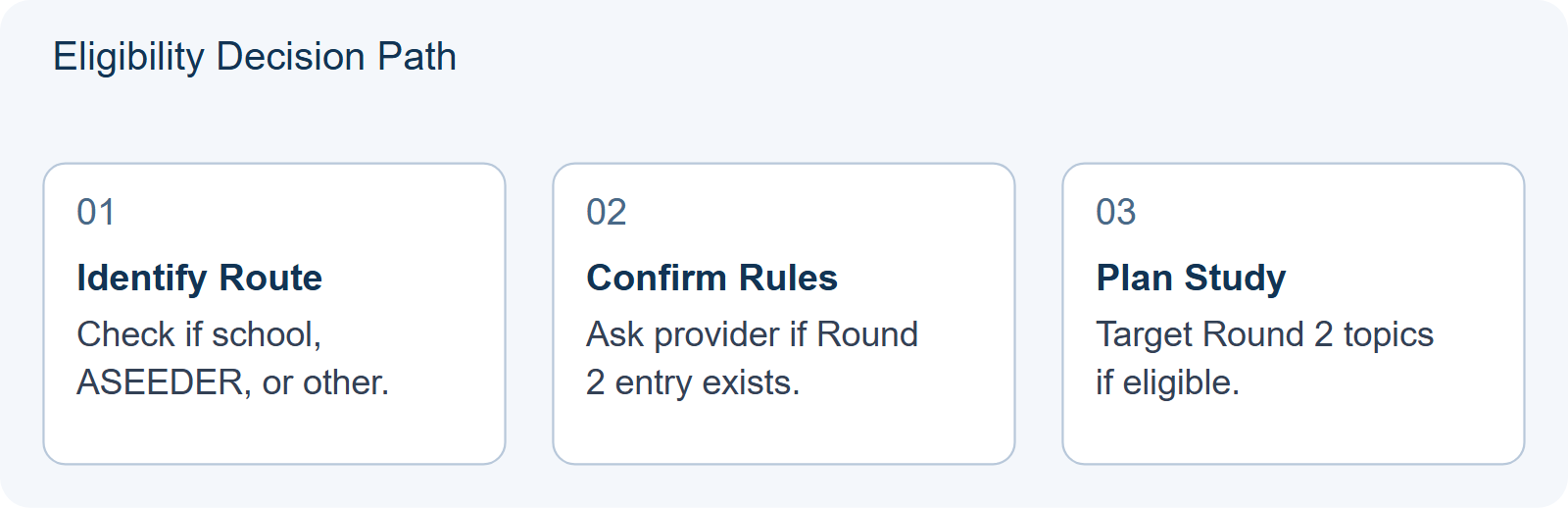
To navigate UKChO Round 2 eligibility, you must first identify your registration category. The RSC’s current guidance emphasizes that overseas schools should use route-specific eligibility advice. This means you cannot simply look at the UK domestic timeline or rules and assume they apply to you. Transplanting UK dates or criteria to China-based sittings leads to confusion and missed opportunities.
| Registration Route | Eligibility Focus | Action Required |
|---|---|---|
| British Int’l Schools | Institutional Criteria | Confirm school’s specific agreement with RSC. |
| ASEEDER Participants | Provider Rules | Contact ASEEDER directly for route details. |
| Direct/Other Overseas | Case-by-Case | Verify if Round 2 entry is supported. |
If you are unsure which category you fall into, ask your exam coordinator or course provider immediately. Do not wait until after Round 1 results are released. By then, administrative windows for Round 2 may have closed for certain routes.
Strategic Preparation Beyond Eligibility
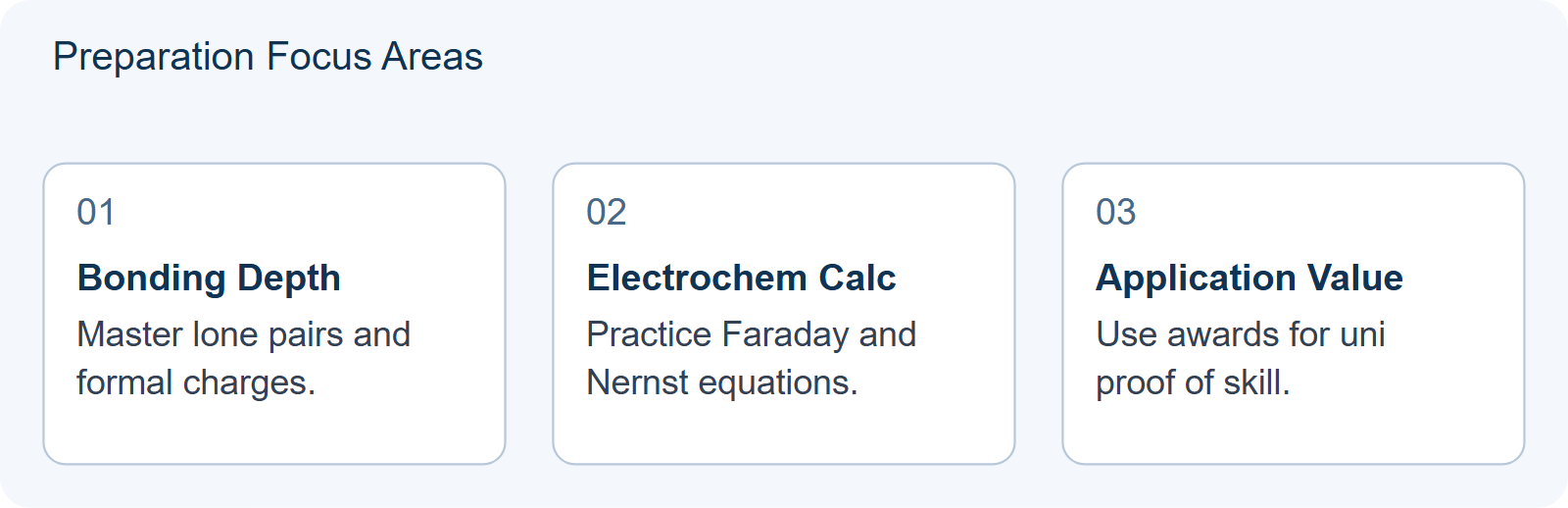
Even if Round 2 remains uncertain, preparing for it offers significant academic benefits. The transition from Round 1 to Round 2 involves a shift from broad syllabus application to deeper mechanistic reasoning. Students aiming for top-tier universities like Cambridge or Oxford benefit from tackling these advanced problems regardless of formal entry status. It demonstrates the “academic intensity” admissions tutors seek.
For those confirmed eligible, focus on areas where Round 1 performance often plateaus. Understanding UKChO Bonding Questions for 2027 is essential, as Round 2 frequently tests nuanced predictions of molecular shapes and formal charges under non-standard conditions. Similarly, mastering UKChO Electrochemistry allows you to handle complex Faraday arithmetic and potential predictions that go beyond simple cell calculations.
Furthermore, consider the broader context of your application. As detailed in What a UKChO Gold Does Inside an Application, the value of the competition lies in its recognition by top institutions. Whether you reach Round 2 or secure a high Round 1 award, the evidence of your chemical proficiency remains valid. However, knowing the exact boundaries of your route ensures you allocate study time efficiently.
Conclusion: Verify Before You Plan
Ultimately, UKChO Round 2 eligibility is not a universal right based on nationality or score alone. It is a procedural outcome dependent on your registration channel. China-based students must proactively confirm their route’s capabilities with their school or provider. Avoid assuming that UK domestic timelines apply to you. By clarifying your status early, you can tailor your preparation strategy—whether aiming for Round 2 advancement or maximizing the impact of a Round 1 achievement on your university portfolio.
HYPOTHETICAL/ILLUSTRATIVE: The “Dual-Track” Preparation Decision
To illustrate how to apply route-specific verification to actual study planning, consider the case of “Li Wei,” a Year 12 student at a British International School in Shanghai. Li Wei has consistently scored in the top percentile for Round 1 but is uncertain whether his school’s specific registration agreement with the Royal Society of Chemistry (RSC) supports advancement to Round 2. He faces a critical decision on how to allocate his remaining three months of preparation time before the administrative deadline passes.
Li Wei compares two plausible strategies. Option A assumes automatic progression based on high mock scores. He dedicates 80% of his study time to advanced mechanistic organic chemistry and complex electrochemical calculations, topics typical of Round 2 papers. He neglects broader syllabus review, assuming his Round 1 performance is already secure. Option B adopts a “verify-first” approach. Before committing to deep-dive Round 2 content, he spends one week confirming his eligibility status with his exam coordinator. Upon learning that his school’s current agreement limits participation to Round 1 only, he pivots his strategy. He reallocates 50% of his time to mastering nuanced bonding questions and formal charge predictions—topics that appear in both rounds but are often under-prepared by students focusing solely on advanced synthesis. He uses the remaining time to refine his problem-solving presentation, ensuring his Round 1 script demonstrates the academic intensity required for university applications.
The deciding factor in this scenario is not Li Wei’s ability, but the administrative reality of his registration route. Option A risks leaving gaps in foundational knowledge if Round 2 entry is denied, resulting in a mediocre Round 1 score due to neglected basics. Option B ensures that regardless of the outcome, his preparation yields tangible benefits. If eligible, he can later add advanced topics; if not, he maximizes his Round 1 potential. This illustrates why verifying the route precedes selecting the content.
| Decision Factor | Assumption-Based Planning (Option A) | Verification-Led Planning (Option B) |
|---|---|---|
| Primary Focus | Advanced Round 2 topics only | Core competencies + conditional advanced topics |
| Risk Exposure | High: Wasted effort if ineligible; weak Round 1 foundation | Low: Adaptable to either outcome; strong baseline |
| Action Trigger | Self-assessed score prediction | Confirmed institutional agreement details |
For China-based students, the reusable self-check is simple: Do not buy or schedule advanced Round 2 resources until you have written confirmation from your provider or school coordinator regarding your route’s eligibility interface. Ask specifically: “Does our current registration code support Round 2 submission?” If the answer is no, shift focus immediately to optimizing Round 1 breadth and depth. If yes, then integrate advanced mechanistic reasoning into your plan. This prevents the common error of preparing for a competition stage that may be administratively inaccessible, ensuring every hour spent studying contributes directly to a recognized achievement, whether it is a Round 2 qualification or a standout Round 1 Gold medal.
Frequently Asked Questions
Does a Gold medal in Round 1 guarantee Round 2 entry?
No. Entry depends on your specific registration route. Some overseas pathways do not support advancement to Round 2 regardless of score.
Can Chinese nationals participate in UKChO Round 2?
Participation is not barred by nationality alone. It depends on whether your school or provider has a route that allows Round 2 entry for international students.
Who should I contact about my eligibility?
Contact your school’s exam coordinator or your course provider (e.g., ASEEDER). They manage the interface with the RSC for your specific region.