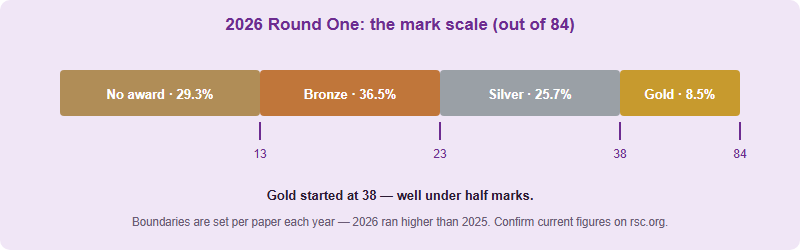
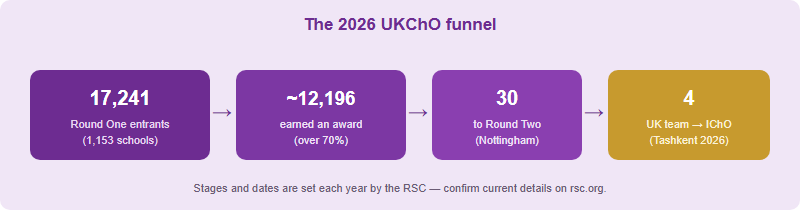
The 2026 UK Chemistry Olympiad (UKChO) Round One was sat on 28 January 2026 by a record 17,241 students from 1,153 schools. The paper was marked out of 84, and the Royal Society of Chemistry (RSC) set the award boundaries at Gold 38+, Silver 23–37, and Bronze 13–22. Just over 70% of entrants earned an award. Below is what those numbers actually tell you — and, just as importantly, what they do not.
The official 2026 boundaries and distribution
An award boundary is the minimum mark for a given award on one specific paper and cohort. The RSC published the 2026 Round One outcome as follows:
| Award | 2026 mark (out of 84) | Share of entrants |
|---|---|---|
| Gold | 38 and above | 8.5% |
| Silver | 23 – 37 | 25.7% |
| Bronze | 13 – 22 | 36.5% |
| No award | 0 – 12 | ~29.3% |
In total, about 12,196 students — over 70% of entrants — received a Gold, Silver or Bronze. The RSC also noted that both the average scores and the grade boundaries were higher in 2026 than in 2025, which is the single most important reason not to copy this year's numbers onto next year's target.
What a boundary really tells you
Three readings are useful, and one is a trap:
- Gold is well under half marks. At 38 out of 84, a Gold in 2026 needed roughly 45% of the paper. UKChO is written to be hard and open-ended; a strong result does not mean finishing everything.
- The boundaries move with the paper. Because 2026 ran higher than 2025, treating “38 = Gold” as a fixed law would set the wrong target in another year. Use it as a sense of scale, not a promise.
- Most entrants get an award. With ~70% earning Bronze or better, a first award is an achievable early goal; the meaningful stretch is moving up a band, not simply “placing.”
- ⚠ The trap: chasing a specific future-year boundary. You cannot know next year's number, and the RSC sets it after marking. Aim at a mark you can build toward, not a band you assume will hold.
From Round One to Round Two — and the IChO
Round One is where almost everyone's UKChO ends, and that is by design: it is a national enrichment paper, not a cut. Beyond it, the funnel is narrow. For 2026 the RSC invited the top 30 Round One performers to Round Two, a residential round at the University of Nottingham on 9–12 April 2026. From Round Two, four finalists were selected to represent the UK at the International Chemistry Olympiad (IChO), held in 2026 in Tashkent, Uzbekistan (10–19 July).
How to use the 2026 numbers if you are preparing
If you are a chemistry student — in the UK or preparing with UKChO papers elsewhere — the practical move is to convert a band into a mark target, then work backwards:
- First goal: clear the award line. On a Round One paper, aim to secure the questions you can fully justify before reaching for the hardest parts. A Bronze-to-Silver jump is usually about completeness under time, not exotic knowledge.
- Second goal: a Silver-to-Gold jump is where the real chemistry lives — multi-step calculations, mechanisms, and unfamiliar-context reasoning. That is a preparation problem, not a talent verdict.
- Use the papers as diagnostics, not as a score to inflate by re-sitting. Our guide on using UKChO past papers without memorising answers walks through the loop, and the current score boundaries page tracks year-on-year figures.
Frequently asked questions
What were the 2026 UKChO gold/silver/bronze boundaries?
Out of 84: Gold 38+, Silver 23–37, Bronze 13–22. Gold went to 8.5% of entrants, Silver 25.7%, Bronze 36.5%.
How many students took the 2026 UKChO?
A record 17,241 students from 1,153 schools sat Round One on 28 January 2026, and over 70% earned an award.
Do these boundaries carry over to next year?
No. Boundaries are set per paper; 2026 ran higher than 2025. Use them as a sense of scale and confirm the current year on rsc.org.
What happens after Round One?
The top 30 were invited to Round Two at the University of Nottingham (9–12 April 2026); four finalists formed the UK team for the IChO.
This is an independent guide to the UK Chemistry Olympiad for China-based international-school students, operated by Hanlin Education. It is not affiliated with, endorsed by, or sponsored by the Royal Society of Chemistry (RSC), which runs the UKChO and sets all official rules, dates and score boundaries — always confirm current details on rsc.org / edu.rsc.org. Confirmed errors are corrected within 7 working days.