If you are looking ahead to the 2027 UK Chemistry Olympiad (UKChO), the most useful thing this page can do is be honest about a distinction most “2027 guide” pages blur: the exam structure is stable and known; the exact 2027 dates are not yet officially announced. Below we separate what you can rely on from what is only an estimate, and — because you do not need a confirmed date to start — how to prepare now. For every specific date, the authority is the Royal Society of Chemistry (RSC) at rsc.org, not this page.
What is stable (safe to plan around)
The shape of the UKChO changes little year to year, so these are reasonable to build a plan on — while still confirming them for your year:
- Round One is a two-hour written paper, sat in participating schools, marked out of 84, with Gold / Silver / Bronze set by score bands.
- It rewards applied reasoning — familiar chemistry (energetics, equilibrium, bonding, organic mechanisms, multi-step calculations) inside unfamiliar, real-world contexts — not recall.
- Round Two follows for a small group of top Round One performers (30 were invited in 2026), held residentially at a UK university, from which the UK team for the International Chemistry Olympiad (IChO) is selected.
None of that is likely to be reinvented for 2027, which is why a preparation plan built on the format is robust even before a calendar exists.
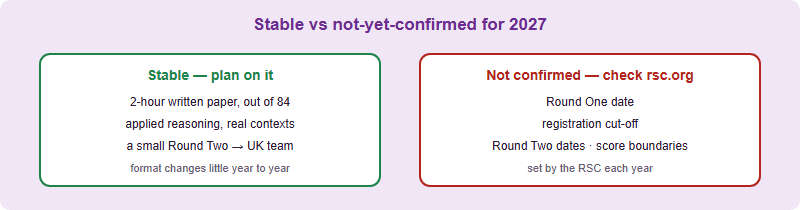
What is only an estimate (do not treat as fixed)
These are the things to confirm on rsc.org once the 2027 cycle is published — and not to write into a fixed plan before then:
| Detail | Status for 2027 | Rough pattern (from 2026) |
|---|---|---|
| Round One date | Not yet confirmed | 2026 was 28 January; recent papers sit late January / early February |
| Registration cut-off | Not yet confirmed | Schools register candidates in the weeks before the sitting |
| Round Two dates | Not yet confirmed | 2026 was 9–12 April, at the University of Nottingham |
| Score boundaries | Set after marking | 2026: Gold 38, Silver 23, Bronze 13 (out of 84) — higher than 2025 |
The “rough pattern” column is a planning aid, not a promise. Boundaries in particular are set after each paper is marked and moved up in 2026, so no future boundary can be known in advance.
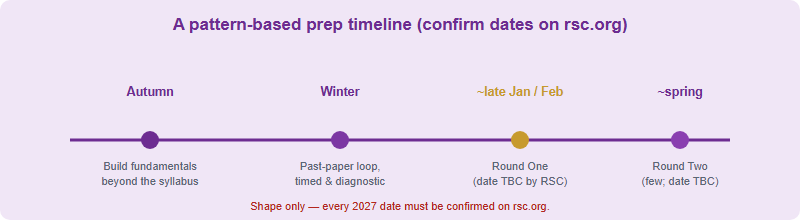
How to prepare now — before any date is announced
Because the format is stable, none of this waits on a 2027 calendar:
- Close the gap from your school course to olympiad depth. Whether you study A-Level, IB or AP chemistry, the content overlaps; the difficulty is in application. Push each core topic — energetics, kinetics, equilibrium, bonding, organic mechanisms — past exam-board level.
- Run the past-paper loop. Sit older papers unseen and timed, mark them honestly, and log the chemistry ideas that fail. Our method guide covers using UKChO past papers without memorising answers.
- Read the 2026 outcome for calibration, not as a target — see the 2026 Round One results to understand what a Gold-level performance looked like.
- Sort out entry early. Entry runs through a school, so confirm your route and who enters candidates well ahead — see our registration checks.
New to the competition? Start from what the UK Chemistry Olympiad is, then come back to build your 2027 plan once the RSC publishes the dates.
Frequently asked questions
When is the UKChO 2027 Round One?
Not yet officially confirmed. Recent Round One papers have sat in late January / early February (2026 was 28 January), but treat that as a pattern and confirm the 2027 date on rsc.org.
Is the 2027 exam structure changing?
The format has been stable — a two-hour written paper out of 84, then a Round Two for top performers. Any changes would be announced by the RSC, so check rsc.org rather than assuming.
Can I start preparing before the 2027 dates are out?
Yes. The format is stable, so build fundamentals and run the past-paper loop now; slot in the exact dates once the RSC publishes them.
Where do the 2027 dates and boundaries come from?
Only from the RSC. Boundaries are set after marking each year and cannot be known in advance; ignore any page that states a fixed future boundary.
This is an independent guide to the UK Chemistry Olympiad for China-based international-school students, operated by Hanlin Education. It is not affiliated with, endorsed by, or sponsored by the Royal Society of Chemistry (RSC), which runs the UKChO and sets all official dates, structure and boundaries — 2027 details are not confirmed here and must be checked on rsc.org / edu.rsc.org. Confirmed errors are corrected within 7 working days.