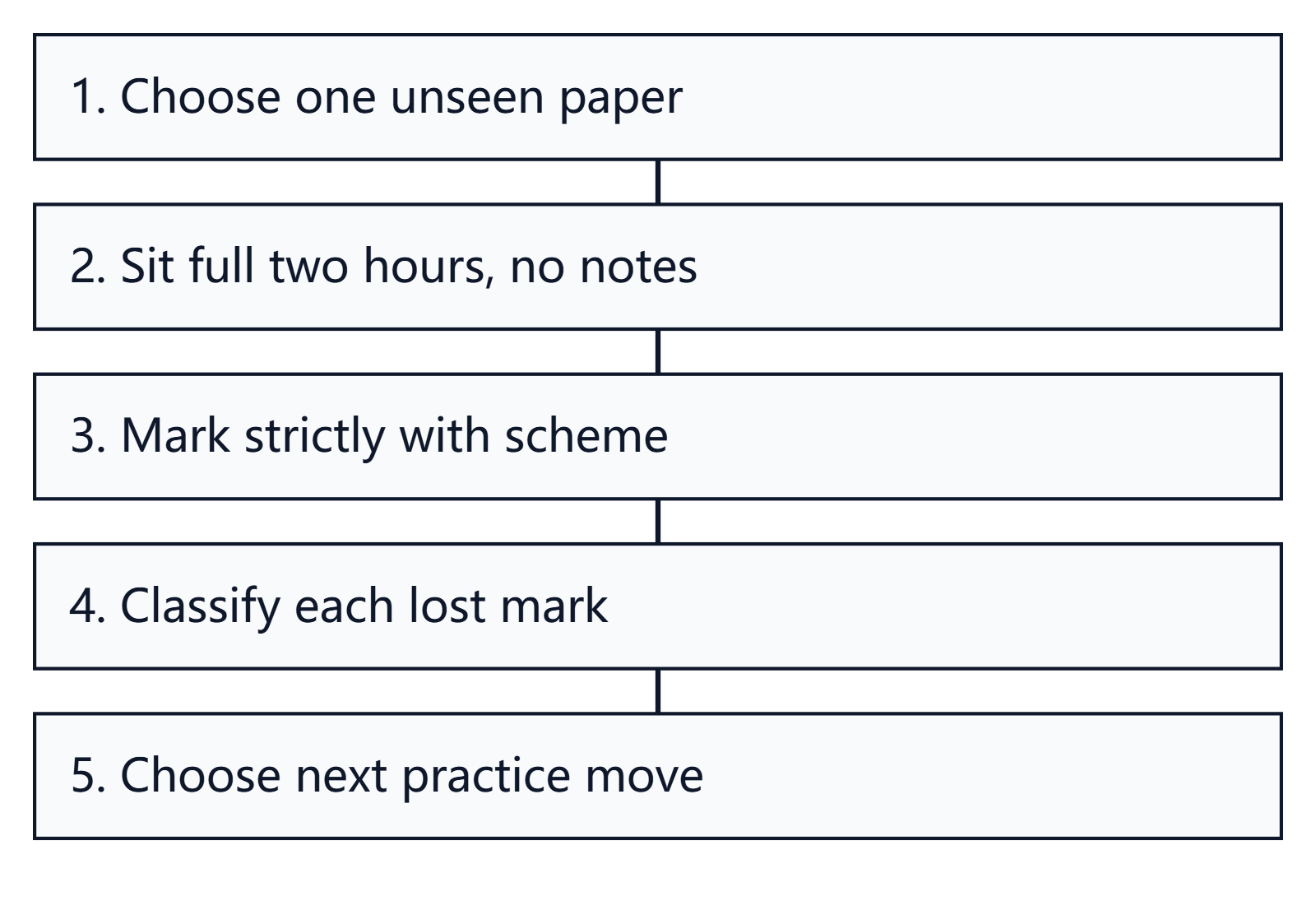
Use a UKChO past paper as a diagnostic, not a score target. Choose one unseen paper, sit it for the full two hours, mark it strictly with the official mark scheme, then sort every lost mark into chemistry gap, technique or notation, or time management. Use the examiner report and mark allocation to decide what to practise next, saving recent papers for clean tests.
Past papers are easy to misuse. The most common error is to repeat a paper until the answers feel familiar, then treat the higher score as progress. A better approach is to use each paper to expose decisions under exam conditions. The 2026 Round 1 materials are especially useful for this because the paper, mark scheme and examiner report are all available. They give you a complete evidence set: the mark allocation, the marking conventions, and the cohort-level context. Use them to build a repeatable diagnostic habit, not to memorise 2026 answers.
The student decisions come first
The value of a past paper is created by the way it is attempted, not by the year printed on the front. Before worrying about topics or thresholds, make five deliberate decisions.
- Choose the paper. Use a recent paper only when you can keep it genuinely unseen. If a paper has been discussed in class, seen in a revision session, or read through a solution bank, it is no longer a clean diagnostic. Older papers can be used for topic drilling, while recent papers should be reserved for full simulation.
- Sit it unseen. Set a two-hour clock and work without notes, phone breaks, or look-ups. The 2026 Round 1 paper was a two-hour paper, so this mirrors the time environment. If you stop to check a textbook, you are no longer measuring exam reasoning; you are measuring supported study.
- Mark with the scheme. Mark strictly and do not award generous credit for a vague intention. The scheme is the evidence of what counted. If the scheme would not have accepted the response, do not count it.
- Separate the cause. For every lost mark, decide whether the cause was a chemistry gap, a technique or notation problem, or a time-management problem. These require different practice. A missing concept needs teaching and drill. A sloppy unit or ambiguous structure needs answer discipline. A blank final page needs pacing strategy.
- Choose the next exercise. Do not automatically sit another full paper. If the main problem is equilibrium reasoning, practise equilibrium ideas in fresh contexts. If the main problem is timing, practise a timed cluster of questions. If the main problem is notation, do short answer precision drills.
What the 2026 mark allocation teaches about time
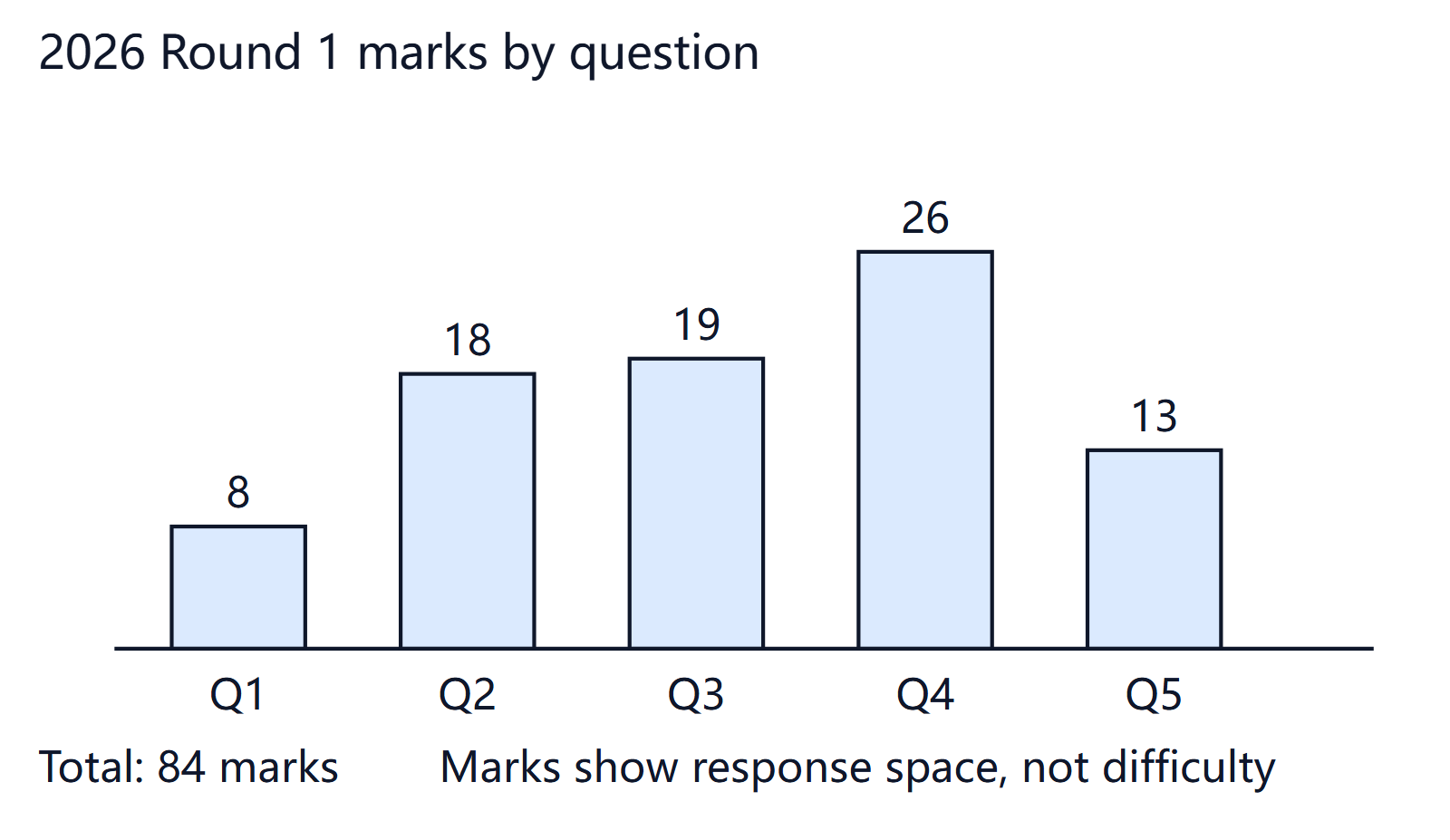
The 2026 Round 1 paper contained five questions worth 8, 18, 19, 26 and 13 marks, giving 84 marks in total. This allocation is a planning signal. It does not mean that Question 4 was the hardest topic, nor does it mean that Question 1 was a warm-up. Mark allocation shows how much response space the paper gave to each question. A question with more marks can contain many accessible subparts, while a shorter question can be conceptually dense.
Question 4 deserved attention because 26 marks is about one third of the whole paper. In proportional terms, 26 out of 84 marks suggests about 37 minutes of a 120-minute sitting, but this should be treated only as a planning reference, not a rigid rule, with checking time reserved by budgeting the whole paper. However, giving Q4 time attention does not guarantee a grade-band outcome. A student can perform strongly on Q4 and still miss marks elsewhere, or struggle on Q4 and recover across the remaining paper. The 2026 thresholds were Gold 38/84, Silver 23/84 and Bronze 13/84, but those are historical results for that paper and cohort, not a promise that any single question controls the award.
The 2026 contexts included chlorine chemistry in swimming pools, isocyanides and multicomponent reactions, ketones and equilibria, carotenes with molecular orbitals and spectroscopy, and analysis including unit cells. These contexts are useful reminders that UKChO wraps core ideas inside unfamiliar applications. The diagnostic question is not whether the pool chemistry or carotene context was familiar. It is whether the underlying idea, such as equilibrium reasoning, quantitative analysis, orbital interpretation, or structural clarity, held up when the context was new.
How to mark with the 2026 scheme
The 2026 mark scheme gives several details that should change how students review their work. These details are specific to 2026 unless a future scheme repeats them, so they should not be treated as permanent rules. First, error carried forward could generally apply where indicated. That means an early mistake did not necessarily cancel every later mark if the later method was correct. Second, missing or incorrect units lost one mark on the first occurrence per question, rather than repeatedly inside the same question. Third, significant-figure errors were not penalised under the 2026 scheme. Fourth, there were no half marks. Fifth, ambiguous organic structures were not accepted, although unambiguous displayed formulae could be accepted.
Those rules make the marking stage more precise. When a mark is lost, ask what the scheme actually rewarded. If the method was correct but the final unit was omitted, the loss may be a notation penalty rather than a chemistry failure. If an organic structure was ambiguous, the problem may be drawing discipline. If the student never reached a part because time ran out, the scheme can show how many accessible marks were left unattempted. This is why marking should produce categories, not just a raw score.
A compact diagnostic map
The following examples are illustrative. They show how to connect a symptom, evidence from the paper or scheme, and the next practice move. They are not question-specific failure statistics.
| Diagnostic symptom | Evidence to check | Next practice move |
|---|---|---|
| Correct method but lost final marks. | 2026 scheme allowed error carried forward where indicated and penalised missing or incorrect units once per question. | Practise calculation chains: write units, keep intermediate values labelled, and check the final line. |
| Organic answer marked wrong despite knowing the reaction. | Ambiguous organic structures were not accepted; clear displayed formulae could be accepted. | Redraw mechanisms and structures slowly until every bond and atom is unambiguous. |
| Ran out of time before later questions. | Q4 carried 26 marks and Q5 carried 13 marks in the 2026 allocation. | Practise timed question clusters and set a hard move-on time for each mark block. |
| Context felt unfamiliar, but the idea was taught. | 2026 topics included pools chemistry, ketones and equilibria, carotenes and spectroscopy, and unit cells. | Drill the underlying idea in two or three new contexts before returning to a full paper. |
| Work was correct but too vague to earn marks. | The 2026 RSC mark scheme states that half marks are not used, but whole marks can still be awarded for correctly answered subparts. | Write final answers as complete statements or values with units, conditions, and direction where relevant. |
Use the examiner report without chasing thresholds
The 2026 examiner report recorded 17,241 scores from 1,153 schools. It also reported historical thresholds of Gold 38/84, Silver 23/84 and Bronze 13/84. These figures are useful for understanding the scale of the paper and the position of the boundaries in that year. They are not targets or predictions for 2027. The report also noted that the RSC deliberately increased accessible marks for Year 12, and that the 2026 average and boundaries were higher than in 2025. That should not be read as the exam becoming permanently easier. Paper design, cohort size, and cohort performance can all shift boundaries. For more on how boundaries work, see our score boundaries guide.
Choosing the next exercise
After marking one paper, the next task should be chosen from the dominant pattern. If chemistry gaps dominate, pause full papers and rebuild the concept from a reliable source, then practise that idea in a different context. If technique dominates, use short drills: units, final-answer lines, displayed formulae, and clear reasoning. If time management dominates, use mark allocation to build timed blocks. For example, practise a 26-mark question in 35 minutes, then review what was rushed.
Older papers can help, but not every older year has supporting materials or an examiner report. That matters because a mark scheme alone tells you what was awarded, while an examiner report can add context about how responses were received. For Hanlin’s collected set, see our past papers page. For wider preparation advice, see our UKChO preparation guide. The official organizer reference is the Royal Society of Chemistry’s UK Chemistry Olympiad page.
Frequently asked questions
How should I start a UKChO past paper?
Choose one unseen paper, set a two-hour clock, and complete it without notes. Then mark it strictly against the official mark scheme before looking at any model answer or commentary.
How do I use a mark scheme without memorising answers?
Use it to identify why marks were lost: missing chemistry, unclear notation, missing units, or poor time allocation. Then practise the underlying idea in a new context rather than rewriting the same answer.
What does a question’s mark allocation tell me?
It tells you how much time a question deserves, not how hard its topic is. A large question can contain several accessible parts, while a small question can be conceptually dense.
Should I use 2026 award thresholds as my target?
Treat 2026 thresholds as historical information only. Boundaries change with cohort performance and paper design, so use them to understand scale, not as a guaranteed target for a future year.
This independent guide is not affiliated with, endorsed by, or sponsored by the Royal Society of Chemistry. The RSC runs the UK Chemistry Olympiad. Always confirm current rules, equipment, dates and award arrangements with the organizer before competing.