Most UKChO preparation runs on two documents: the past paper and the mark scheme. There is a third, and it is the one almost nobody reads. The examiners’ report tells you where the entire field went wrong — not what the right answer was, but which mistakes 17,241 students actually made. On the 2026 paper, the pattern is not hard chemistry. It is bookkeeping.
Why the report beats the mark scheme
A mark scheme answers a question you already asked: what should I have written? It is silent on the more useful question, which is why capable students did not write it.
The examiners’ report answers that second question at cohort scale. Published by the RSC after each Round 1 — the organiser’s own account of how the paper performed, and the version of record on rsc.org — it records which parts proved harder than the setters expected, which errors recurred across thousands of scripts, and which topics were poorly answered despite having appeared in earlier years. That is diagnostic information you cannot extract from your own script, because your own script only contains your own mistakes.
It also gives you something a mark scheme never does: a sense of what is normal. If a part defeated most of the field, discovering you could not do it is information about the question, not about you. In 2026 the mean score was 20 out of 84 and the median 18 — a paper where the typical entrant across the whole field leaves most of the marks on the table. Our decode of those 2026 Round 1 figures and boundaries sets out the full distribution.
The 2026 paper, question by question
The 2026 Round 1 paper ran five questions, each set in an applied context. Here is what the examiners recorded about each.
| Question | Context | Handled well | Where marks were lost |
|---|---|---|---|
| Q1 | Contaminants in swimming pools | Described as an effective entry point and generally well answered. Oxidation numbers, disproportionation and molecular shapes were applied confidently even to unfamiliar species. | Balancing equations. Incomplete dot-and-cross diagrams, with chlorine frequently drawn without a full octet. On the Henry’s law part, unit analysis and powers of ten. |
| Q2 | Isocyanides | Structural drawing overall. Manipulating pV = nRT. Stronger candidates identified the amide functionality. | Counting and locating lone pairs, suggesting resonance and delocalisation are not secure. Some drew tautomers instead of the amide. Balancing errors again. Aniline identified less often than the primary aliphatic amine. Combinatorial stereochemistry answered by only a small number. |
| Q3 | Compounds in henna | Structure recognition, with cyclohexanone spotted more often than methyl vinyl ketone. Intramolecular hydrogen bonding was well identified. Most recognised the process as oxidation. | Reversing concentrations in the equilibrium expression. Misplaced double bonds. The nitro group analysed less successfully. On the energy parts: transcription errors, missing minus signs, joules confused with kilojoules, and Gibbs terms summed incompletely. |
| Q4 | Rice, spice and mice | The opening part was completed successfully by most. The orbitals section differentiated well. An unusual equation later on was well attempted. | Miscounted double bond equivalents. Reversed order in sequences. Structures drawn that did not match the given molecular formulae. Diazonium salt bonding and charge placement. Colour of a species guessed rather than deduced from the wavelength data. |
| Q5 | Minerals, referencing the 2026 IChO host country | One of the more demanding questions, but many candidates attempted substantial parts. Elemental analysis was confident and unit cell familiarity was stronger than in previous years. | Calculated values of clearly unrealistic magnitude — the report cites distances expressed in kilometres and densities exceeding that of a black hole. Working not shown clearly enough to credit. |
Read the right-hand column as a whole and something becomes obvious. Almost nothing in it is a gap in chemical knowledge. Balancing, units, signs, octets, reading the stem, checking whether an answer is physically possible — this is material every entrant has already been taught.
The seven recurring mark-losers
Collapsing the question-level notes into cross-cutting failure modes gives a short, drillable list. Balancing errors alone recurred across two questions on the same paper; the others each surfaced once.
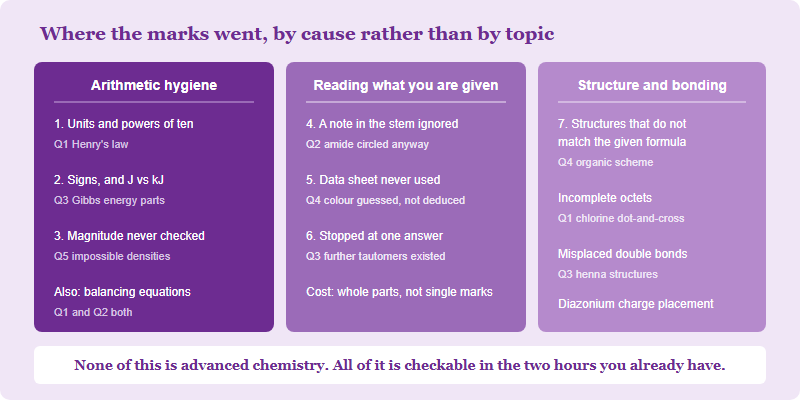
One item on that list deserves separating out. The report notes that diazonium salts were poorly answered in 2026 and had appeared in earlier papers. That is the clearest possible argument for working through past papers by topic rather than only as timed mocks: the examiners are telling you that a known weak spot went unaddressed for years. The past-paper collection we send students is our own compiled set, with worked solutions available for many of the years rather than for every one.
The marking mechanics that decide whether your chemistry scores
The report is unusually direct about how the paper is credited, and three mechanics are worth internalising because each one converts knowledge you already have into marks you currently do not get.
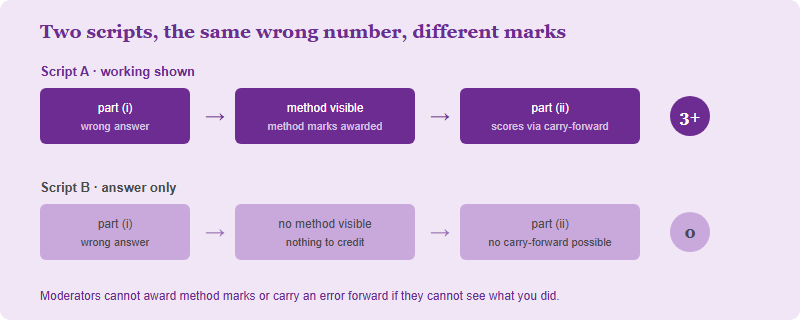
Error carried forward is real, and it rescues whole questions. The examiners record that on one demanding part of Q4, many candidates who got the first stage wrong still scored on the second stage through correct error-carried-forward reasoning. A wrong number early does not have to cost you the rest of the question — provided the moderator can see that your subsequent method was sound.
That protection only exists if your working is visible. The report states the consequence plainly: where reasoning is not shown, moderators cannot award method marks or apply error-carried-forward credit, because it is not clear what the candidate did. An answer-only script forfeits both. This is the single highest-return behavioural change available to most entrants.
Presentation affects moderation. Round 1 is marked in schools and then moderated. The examiners note that moderation was helped where answers were clearly underlined or highlighted, and that clear annotation particularly assists when error-carried-forward marking is being applied. Making your final answer easy to find is not cosmetic.
How to order your two hours
The report gives explicit advice on navigating the paper, and it is worth following precisely because it comes from the people who wrote it. Candidates are encouraged to attempt every part, because later sections often still contain accessible marks even when they look forbidding. And students are advised to work first through the sections they feel confident with, returning afterwards to the more demanding material.
That second instruction is not obvious. The default instinct is to work front to back, which means spending your freshest thirty minutes wherever question one happens to sit rather than wherever your strengths sit. On a paper where the median score is 18 out of 84, finishing every question was never the plan — harvesting is. Q5 in 2026 was one of the more demanding questions and still drew substantial attempts, which is exactly the behaviour the examiners were praising.
Turning the report into a two-week drill
Reading the report changes nothing on its own. Converting it into checks does. A workable version:
- Build a personal error log with the seven categories above as its columns. After each timed paper, classify every lost mark by cause rather than by topic. Most students discover two categories account for the majority of their losses.
- Add a thirty-second magnitude check to every numerical answer. Ask whether the value is physically possible before moving on. The 2026 report’s examples — distances in kilometres, densities beyond a black hole’s — were produced by capable students who never asked.
- Underline your final answer as you write it, not at the end. It costs nothing and it is what the moderators asked for.
- Re-read every stem for restrictions before answering. The Q2 note stating that amides do not react was in the question, and the amide was still frequently circled.
- When a question does not say how many answers it wants, assume more than one. The tautomer part cost marks precisely because candidates produced one valid structure and stopped.
- Check that every structure you draw matches the molecular formula you were given. A ten-second atom count on Q4 would have saved marks across the field.
The full method for running that loop across a set of papers — timing, classification and re-testing — is in our guide to using UKChO past papers as a diagnostic. If you are new to the competition’s structure, start instead with our overview of what UKChO is and how Round 1 works.
Frequently asked questions
What is the UKChO examiners’ report?
A document the RSC publishes after each Round 1, describing how the field performed question by question and where marks were commonly lost.
Does UKChO give method marks if my final answer is wrong?
Yes, where your working is visible. The 2026 report notes moderators cannot credit method or carry errors forward without shown reasoning.
Which topic was answered worst in 2026?
Diazonium salts were flagged as poorly answered, and the examiners noted the topic had appeared in earlier papers too.
Should I attempt questions I expect to fail?
Yes. The examiners encourage attempting all parts, since later sections often still hold accessible marks.
This is an independent guide operated by Hanlin Education for China-based international-school students. We are not affiliated with, endorsed by, or sponsored by the Royal Society of Chemistry (RSC). Paper structure, marking conventions and published reports are the organiser’s and change from season to season — confirm current details on rsc.org before acting on anything here. Any factual error brought to our attention is corrected within 7 working days.