Ask experienced UK Chemistry Olympiad (UKChO) students where marks quietly disappear, and three areas come up again and again: thermodynamics, equilibrium, and organic mechanisms. None is unfamiliar — they sit inside every A-Level, IB and AP course — but each punishes shallow understanding under time pressure in a way school exams rarely do. This guide explains why each is hard on an olympiad paper and, more usefully, how to build reasoning in it that holds when the context is unfamiliar. (Which specific topics dominate any given paper varies year to year; treat this as where difficulty commonly concentrates, not a syllabus weighting.)
1 · Thermodynamics: signs, cycles and what “spontaneous” means
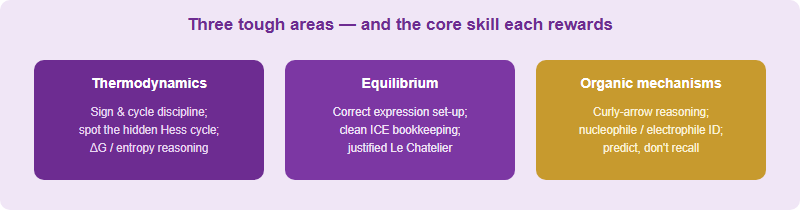
Thermodynamics is hard on UKChO because it rewards students who treat it as a system of relationships, not a set of formulae to plug into. The recurring failure points are predictable:
- Sign conventions. A dropped or flipped sign in an enthalpy cycle turns a correct method into a wrong answer — and olympiad marking is unforgiving of it. Fix it at the source: always define your system and direction before you compute.
- Hess-cycle construction in unfamiliar contexts. The chemistry is standard; the difficulty is recognising that a messy, real-world scenario is a Hess-cycle problem in disguise. Practise spotting the cycle, not just executing one you are handed.
- Entropy and free energy reasoning. “Will this happen?” questions need ΔG, temperature dependence, and a feel for entropy change — not a memorised rule. Build the intuition: more gas particles, more disorder; lower temperature, entropy matters less.
How to build it: work enthalpy and free-energy problems until you can set up the cycle and define signs without thinking, then deliberately seek problems where the thermodynamics is hidden inside an applied context.
2 · Equilibrium: setting up the expression is the whole battle
Equilibrium questions are where careful students lose time and careless students lose marks. The concept is not the obstacle; the set-up is:
- Building the expression correctly from a described system — the right species, the right powers, the right state symbols — is where most errors begin. An error here propagates through every later line.
- ICE-style bookkeeping under pressure. Tracking initial, change and equilibrium amounts is mechanical but error-prone when rushed; a small arithmetic slip sinks the question.
- Le Chatelier reasoning that goes beyond the slogan. UKChO asks you to predict and justify the direction of shift for combined changes (pressure and temperature at once, say), which needs genuine reasoning, not a memorised phrase.
How to build it: drill the set-up step in isolation — take twenty described systems and write only the equilibrium expression for each, checking every power and species — before doing full calculations. Reliability in the set-up is worth more than speed in the algebra.
3 · Organic mechanisms: reasoning with electrons, not memory
Organic is the area where memorisation fails most visibly. A student who has learned named reactions can answer a familiar question and stall completely on an unfamiliar one; a student who reasons with electron movement can attempt almost anything. The demands:
- Curly-arrow reasoning. UKChO expects you to show where electrons go, not just name a product. Arrows are the language of the mark scheme.
- Identifying the nucleophile and electrophile in an unfamiliar molecule — the single decision that unlocks most mechanism questions.
- Predicting a plausible mechanism for a reaction you have never seen, by analogy to ones you have. This is the olympiad skill, and it is learnable.
How to build it: stop revising organic as a list of reactions and start revising it as a set of electron-movement principles. For every mechanism you study, cover the product and try to derive it from the arrows; then find an unfamiliar substrate and reason by analogy.

Turning “hard topics” into a plan
These three are not the only hard parts of UKChO, but they are where preparation pays back fastest, because each hides a single transferable skill: sign-and-cycle discipline, expression set-up, and electron-arrow reasoning. Fold them into a diagnostic loop rather than studying them in the abstract — sit a paper, see which of the three cost you marks, and drill that skill before the next paper. The loop itself is in our guide to using UKChO past papers without memorising answers, and if you are coming from a school course, closing the gap from A-Level, IB or AP sets the wider plan. For the big picture, start from what the UK Chemistry Olympiad is.
Frequently asked questions
What is the hardest topic on the UKChO?
It varies by paper, but students most often lose ground in thermodynamics, equilibrium and organic mechanisms — each rewards reasoning over memorised rules.
Why is thermodynamics so error-prone?
Sign conventions and Hess-cycle set-up are unforgiving: one flipped sign turns a correct method into a wrong answer. Define your system and direction before computing.
How do I get better at organic mechanisms?
Reason with electron movement (curly arrows) rather than memorising named reactions. Practise deriving products from arrows and predicting mechanisms for unfamiliar substrates by analogy.
Do I need to memorise lots of equilibrium formulae?
No — the battle is setting up the correct expression and tracking amounts cleanly. Drill the set-up step in isolation until it is reliable.
This is an independent guide to the UK Chemistry Olympiad for China-based international-school students, operated by Hanlin Education. It is not affiliated with, endorsed by, or sponsored by the Royal Society of Chemistry (RSC), which runs the UKChO and sets all official content — always confirm current details on rsc.org / edu.rsc.org. Confirmed errors are corrected within 7 working days.