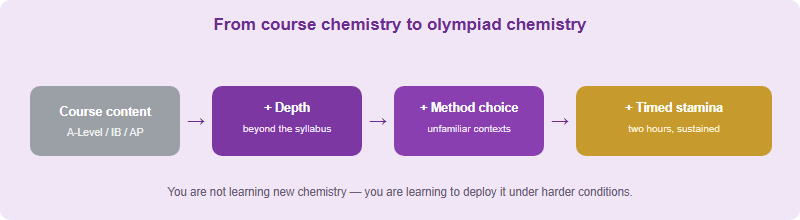
The most reassuring fact about preparing for the UK Chemistry Olympiad (UKChO) is that you probably already know most of the chemistry. A-Level, IB and AP chemistry between them cover almost all the content a UKChO Round 1 paper draws on. What separates a school exam from an olympiad paper is not a secret topic list — it is depth, speed, and the demand to apply familiar ideas in unfamiliar, real-world contexts. This guide is about closing that specific gap, whichever course you study.
Same content, different demand
School chemistry and olympiad chemistry ask different things of the same knowledge. A school question tends to be signposted (“use Hess's law to find…”); a UKChO question hands you an unfamiliar scenario and expects you to decide that a Hess-cycle argument is what it needs. The knowledge is identical; the retrieval is harder. Seeing that clearly is half the battle:
| Dimension | School exam (A-Level / IB / AP) | UKChO Round 1 |
|---|---|---|
| Question framing | Signposted, method often implied | Unfamiliar context; you choose the method |
| Steps per question | Usually few, guided | Often multi-step, lightly guided |
| What is tested | Recall + standard application | Reasoning + application under time |
| Content level | Course syllabus | Course syllabus + a stretch beyond |
Where each course leaves a gap
No single course maps perfectly onto UKChO, so know your own starting point:
- From A-Level chemistry: your organic mechanisms and physical chemistry foundation are strong; the stretch is usually in more demanding thermodynamics and in the unfamiliar-context calculations UKChO favours.
- From IB chemistry (HL): broad and conceptually solid; the stretch is often mathematical fluency in multi-step quantitative problems and depth in mechanisms.
- From AP Chemistry: excellent on equilibrium, thermodynamics and quantitative reasoning; the stretch is typically the depth of organic chemistry and mechanism-heavy questions.
These are tendencies, not rules — your real gaps come from diagnosis, not a generalisation. That is what past papers are for.
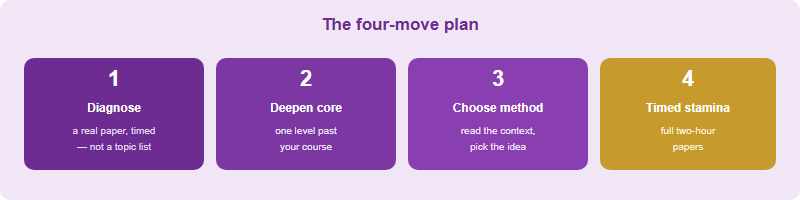
A four-move plan to close the gap
1 · Diagnose with a real paper, not a topic list
Sit one UKChO past paper unseen and timed before you plan anything. It will show you exactly where your course knowledge stops transferring — and that, not a generic syllabus, is your real to-do list. The method is in our guide to using UKChO past papers without memorising answers.
2 · Deepen each core topic one level past your course
Take the topics your diagnosis flags — commonly energetics/thermodynamics, kinetics, equilibrium, bonding, and organic mechanisms — and push each just beyond exam-board treatment: more steps, fewer prompts, harder numbers. A university-level introductory text or your teacher's extension notes is the right source; UKChO does not require exotic content, only a firmer grip on the core.
3 · Practise choosing the method
The distinctive UKChO skill is reading an unfamiliar context and deciding which known idea applies. Build it deliberately: after each practice question, articulate “the clue that told me to use X was…” That habit turns a bank of solved questions into transferable pattern-recognition.
4 · Build two-hour stamina
UKChO Round 1 is a sustained two-hour paper, and pacing is a real part of the difficulty. Sit full papers to time, not question sets in fragments, so that fatigue and time management stop being surprises on the day.
A realistic runway
You do not need a year, but you do need more than a weekend. A sensible shape is a few weeks of topic-deepening, layered with a weekly timed paper and a growing idea-log, tapering into denser paper practice as the sitting approaches. Because the content overlaps with other chemistry olympiads, the same work also strengthens options such as the US USNCO. New to the competition? Start from what the UK Chemistry Olympiad is.
Frequently asked questions
Is UKChO content beyond A-Level / IB / AP?
Mostly no — it draws on the same core chemistry, but demands more depth and applies it in unfamiliar contexts. The gap is difficulty and application, not a new syllabus.
Which course prepares you best for UKChO?
All three cover most of the content. A-Level and AP are strong on physical chemistry; A-Level and IB HL help with mechanisms. Your real gaps come from a diagnostic paper, not the course label.
How long does it take to prepare?
A few focused weeks is realistic for a first strong attempt: deepen core topics, sit a weekly timed paper, and keep an idea-log of what fails.
Do I need university-level material?
Only a stretch beyond your course on core topics — not exotic content. An introductory university text or extension notes is enough.
This is an independent guide to the UK Chemistry Olympiad for China-based international-school students, operated by Hanlin Education. It is not affiliated with, endorsed by, or sponsored by the Royal Society of Chemistry (RSC), which runs the UKChO and sets all official rules and content — always confirm current details on rsc.org / edu.rsc.org. Confirmed errors are corrected within 7 working days.