Does UKChO help with Oxbridge? Yes, as a recognised signal: Oxford lists the UK Chemistry Olympiad among its recommended chemistry activities, and Cambridge names it on its site (confirm the current wording on each university's own pages). But “recommended” is not “guaranteed” — a UKChO award strengthens a chemistry-focused application; it never buys an offer. Here is what the signal actually says, and how to use it without over-claiming.
This is an independent guide maintained by Hanlin Education. We are not affiliated with the Royal Society of Chemistry (RSC), and we are not affiliated with, or speaking for, any university. If you are new to the competition, start with what the UK Chemistry Olympiad is, then come back to this admissions question.
What Oxford and Cambridge actually say
Both universities publish guidance on “super-curricular” activities — the reading, problem-solving and competitions you do beyond the classroom that show genuine engagement with a subject. In chemistry, this is exactly where olympiads live. Oxford's chemistry guidance lists the UK Chemistry Olympiad among recommended activities, and Cambridge names it on its site as one of the ways applicants deepen and demonstrate subject interest.
Why does that matter more than a third-party ranking? Because the institutions themselves are pointing to it. When an admissions page written by the department you are applying to mentions a competition by name, that competition is, by definition, a credible thing to have done. It signals that the university sees UKChO as a legitimate way to test yourself in chemistry.
Two honest caveats. First, wording and lists are updated year to year, so treat each university's current page (ox.ac.uk, cam.ac.uk and the relevant department pages) as the single source of truth — not this article, and not a screenshot from a previous cycle. Second, being “listed” or “recommended” means the activity is respected; it does not make it an entry requirement, and no super-curricular is compulsory.
It is worth being precise about the word super-curricular, because it is easy to confuse with extra-curricular. Extra-curricular activities — sport, music, clubs — show that you are a rounded person. Super-curricular activities extend the actual subject you want to study: they are what you do because you find chemistry interesting, not because it looks good. That distinction is exactly why a chemistry olympiad reads more strongly on a chemistry application than a generic list of achievements. It is on-topic evidence, and admissions tutors are looking for on-topic evidence above almost anything else.
What a strong UKChO result signals — and what it does not
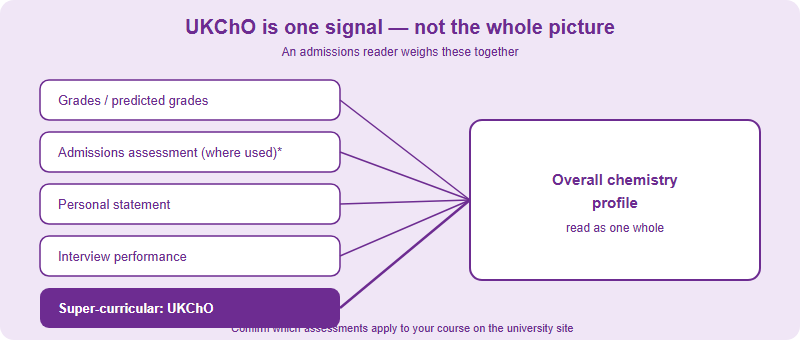
It helps to separate the two things an admissions reader is doing: building a picture of your chemistry, and checking that the picture is real. UKChO contributes to the first and survives the second — but only up to a point. The table below is the honest split.
| Application component | What it primarily evidences | Where UKChO fits |
|---|---|---|
| Grades / predicted grades | Sustained academic performance | Does not replace this |
| Admissions assessment (where used) | Reasoning under standardised conditions | Separate step — confirm which applies on the university site |
| Personal statement | Motivation and reflection | A concrete thing to reflect on |
| Interview | Live thinking with a tutor | Invites follow-up chemistry questions |
| Super-curricular (UKChO) | Genuine, tested subject depth | One strong data point among several |
Recognition is not a guarantee — the honest maths
Oxbridge chemistry (and Cambridge Natural Sciences, the usual route into chemistry there) is heavily oversubscribed. Most applicants have strong predicted grades, so a competition award is a way to stand out on depth — not a way to skip the queue. A UKChO Gold sits alongside your predicted grades, any admissions assessment, your personal statement and, if you are shortlisted, your interview. It is one data point in a bundle that is read together.
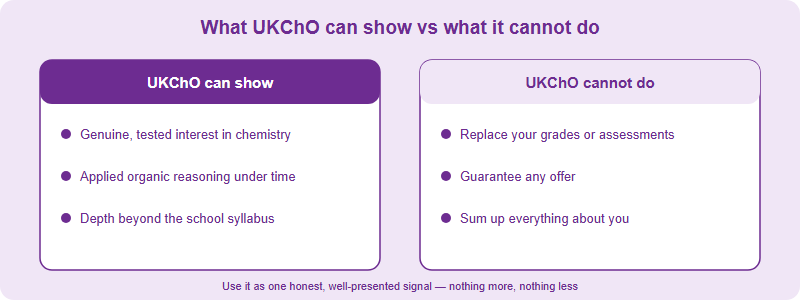
So be wary of anyone — a tutor, an agency, an advert — who frames UKChO as a shortcut to an offer. It is not. What it can honestly do is give a tutor a reason to believe your interest is real and tested, and give you something concrete and personal to talk about. That is valuable, and it is enough of a reason to do it well. It is simply not a promise.
One more point that China-based students often miss: the value of UKChO is not confined to Oxford and Cambridge. Many competitive UK chemistry departments — and chemistry-adjacent courses such as natural sciences, biochemistry and chemical engineering — weigh super-curricular evidence when applications are otherwise similar on grades. UKChO is a recognisable, national contest that any UK admissions reader will understand, so a strong result can strengthen your whole UK shortlist, not just your top choice. As always, confirm how each specific department frames super-curriculars on its own admissions pages rather than assuming a single policy applies everywhere.
How to present UKChO in a statement and interview
The most common mistake is to write “I achieved Gold in the UK Chemistry Olympiad” and stop. A bare award line does very little work. Admissions tutors read reflection, not trophies. Pick one problem that changed how you think and write about the thinking, not the result.
- Do describe a specific moment — for example, a multi-step organic synthesis question that forced you to reason from a mechanism rather than recall a fact, and what that taught you about how chemistry actually works.
- Do connect it forward: what did it make you want to read or study next?
- Do not inflate the result or imply the competition is something it is not.
- Do not claim skills you cannot defend live — a named olympiad on your form is an open invitation for the interviewer to test it.
That last point is the quiet reason UKChO helps at interview: it seeds questions you have actually prepared for. If you can pick up a problem you first met while training and reason through it out loud, the claim on your statement becomes evidence in the room.
Timing is the other thing students get wrong. For a result to appear on an application, you need to have sat the paper before you write your personal statement. UKChO Round 1 falls in January (it was sat on 28 January 2026; confirm the 2027 date on rsc.org), and UK applications are prepared the following autumn. In practice that means a sitting in the January of Year 12 gives you a result you can write about when you apply in Year 13 — whereas leaving it until the January of Year 13 produces the award after your statement has already gone in. Plan the sitting around the application cycle, not the other way round.
A realistic path to a result worth writing about
You do not need a record score for UKChO to earn its place on your application. The 2026 Round 1 paper was marked out of 84, and the Gold boundary was 38 — under half marks (you can see the full 2026 boundaries and distribution here). Consistency on the organic-heavy sections matters far more than chasing perfection.
To show what is reachable with disciplined preparation: one student we supported (we will call them Z), then at an international school in Shenzhen, scored 77 in 2026 — the highest mark that year, well above the 38 Gold line (per Hanlin; individual results vary and are not guaranteed). We share that not as a target for everyone — the sensible target is Gold, not the top mark — but as evidence that a genuinely strong result is achievable when practice is structured and honest.
The path itself is unglamorous: work through timed past-paper sections, weight your practice toward organic reasoning because that is where most marks sit, keep an error log, and review it. Whoever you prepare with, insist on structured practice over passive reading. The award follows the habit, not the other way round.
Frequently asked questions
Does UKChO guarantee an Oxbridge offer?
No. It is a recognised, recommended signal, not a guarantee. Offers depend on grades, any admissions assessment, your statement and interview.
Do Oxford and Cambridge really recognise UKChO?
Oxford lists it among recommended chemistry activities and Cambridge names it on its site. Confirm the current wording on ox.ac.uk and cam.ac.uk.
What UKChO result actually counts?
Any genuine result shows engagement; a high mark or Gold is a stronger data point. But thoughtful reflection on what you learned matters more than the medal.
How high did students score in 2026?
The 2026 Gold line was 38 out of 84; one student we supported scored 77, the top mark that year. Results vary and are not guaranteed.
This is an independent guide operated by Hanlin Education for China-based international-school students. It is NOT affiliated with, endorsed by, or sponsored by the Royal Society of Chemistry (RSC), and it does not represent the University of Oxford or the University of Cambridge. Please confirm current details on rsc.org and each university's official website. Any error will be corrected within 7 working days.