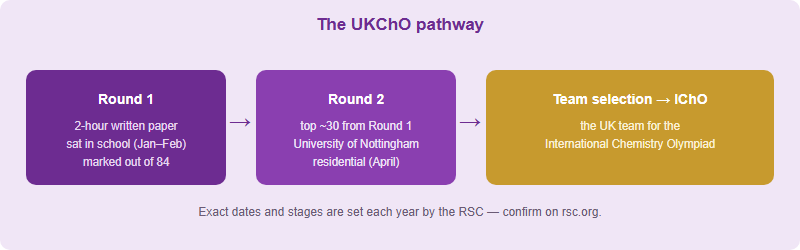
The UK Chemistry Olympiad (UKChO) is the United Kingdom's national chemistry competition for secondary-school students, run by the Royal Society of Chemistry (RSC). It starts with a two-hour written paper (Round 1) sat in school early in the year, invites the top scorers to a residential Round 2, and ultimately selects the UK team for the International Chemistry Olympiad (IChO). For a chemistry student in China, its biggest value is not necessarily entering — it is a world-class bank of past papers and a syllabus you can use to push your chemistry far beyond the classroom.
Who runs the UKChO — and what it is not
The UKChO is organised by the Royal Society of Chemistry, the UK's professional body for chemical sciences. It is a genuine olympiad-style competition: real-world chemistry problems that reward reasoning, not memorisation. Two things are worth being clear about from the start:
- This site is an independent guide. We are not the RSC and not an official UKChO channel — for entry, rules and current dates, the RSC's own pages (rsc.org / edu.rsc.org) are always the authority.
- Round 1 is sat in participating schools. Whether and how a student outside the UK can take part is set by the RSC, so treat eligibility as “confirm on the official site,” not something to assume. For most China-based readers the practical entry point is the preparation value, which we come back to below.
Round 1: the two-hour paper
Round 1 is a two-hour written paper taken at a student's own school early in the spring term (typically January to February). It is not a multiple-choice quiz: the questions wrap core chemistry — energetics, equilibrium, organic mechanisms, bonding, calculations — inside unfamiliar, real-world contexts, and reward students who can apply what they know rather than recall it. In the 2026 cycle, Round 1 took place on 28 January 2026 and drew a record entry of 17,241 students.
The paper is marked out of 84, and awards are set by score bands each year. For 2026 the published boundaries were:
| Award | 2026 Round 1 mark (out of 84) |
|---|---|
| Gold | 38 and above |
| Silver | 23 – 37 |
| Bronze | 13 – 22 |
Those bands move a little from year to year, so use them as a sense of scale rather than a fixed target — the current-year boundaries are published by the RSC. The useful takeaway is that gold is well under half marks: the paper is designed to be hard, and a strong result does not require finishing everything.
Round 2 and the road to the IChO
After Round 1, the RSC invites the highest-scoring ~30 students to Round 2 — a residential round held at the University of Nottingham (in 2026, 9–12 April). Round 2 adds practical and more demanding theoretical work, and from it the RSC selects and trains the UK team for the International Chemistry Olympiad (IChO), the global competition. For the vast majority of entrants the journey stops at a Round 1 award — which is exactly why the Round 1 paper, not the far end of the funnel, is where preparation should focus.
Why the UKChO matters for a China-based chemistry student
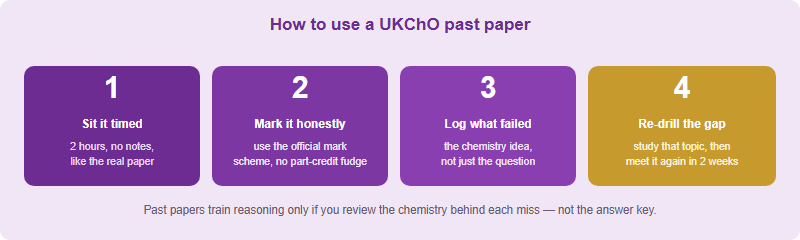
Even where direct entry is a question for the RSC, the UKChO is one of the best free chemistry-stretching resources available, because its past papers are public and its problems are unusually well-written. Used properly, they do three things a textbook cannot:
- They bridge the gap from A-Level / IB / AP chemistry to olympiad thinking — same core content, much harder application.
- They build exam stamina and reasoning under real time pressure, which transfers to school exams and to other chemistry olympiads.
- They pair naturally with the US chemistry olympiad (USNCO) — the two syllabuses overlap heavily, so one focused block of chemistry preparation can serve both. We cover that overlap in a dedicated UKChO-vs-USNCO comparison.
If you want the practice route, start from our guide to using UKChO past papers without memorising answers, check the current score boundaries, and read the registration overview for how entry works.
Frequently asked questions
Who runs the UK Chemistry Olympiad?
The Royal Society of Chemistry (RSC), the UK's professional body for chemical sciences. This site is an independent guide, not the RSC.
What is UKChO Round 1?
A two-hour written paper sat in school early in the year, marked out of 84, with gold/silver/bronze set by score bands. In 2026 it was on 28 January.
What score do you need for a UKChO gold?
In 2026, gold was 38 and above out of 84 (silver 23–37, bronze 13–22). Boundaries change yearly — check the current figures on rsc.org.
Can a student in China take the UKChO?
Round 1 is sat in participating schools, and eligibility is set by the RSC, so confirm current arrangements on rsc.org. Either way, its public past papers are an excellent way to prepare in chemistry.
This is an independent guide to the UK Chemistry Olympiad for China-based international-school students, operated by Hanlin Education. It is not affiliated with, endorsed by, or sponsored by the Royal Society of Chemistry (RSC), which runs the UKChO and sets all official rules, eligibility, dates and score boundaries — always confirm current details on rsc.org / edu.rsc.org. Confirmed errors are corrected within 7 working days.