UKChO 2027 Round 1 is expected in late January 2027, with registration closing around mid-January — both to be confirmed on rsc.org, not here. That timing has one practical consequence almost every planning page skips: the work happens in the autumn term, not in January, and the entry window closes in the weeks students are least likely to be watching. What follows is a September-to-January back-plan built around those two facts.
The calendar problem nobody plans for
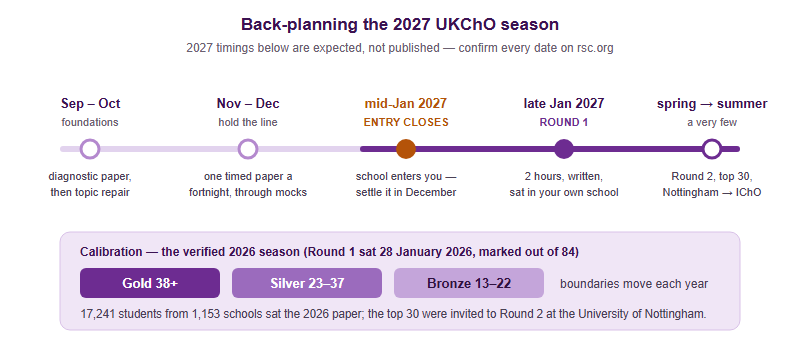
The UK Chemistry Olympiad reads like a January event, so students file it under “next term”. It is not a January event. Round 1 is a two-hour written paper sat in your own school; in 2026 it fell on 28 January and was marked out of 84. The 2026 pattern points to the same shape for 2027 — entry closing around mid-January, the paper in late January — but the Royal Society of Chemistry publishes the real dates, and you should confirm both on rsc.org before you diary anything.
Now work backwards from a late-January paper and the shape gets uncomfortable:
- The run-up is broken by the winter holiday. The teaching time that remains is the unsettled start of a new term — the worst available window in which to try to understand thermodynamics properly for the first time.
- The entry deadline lands in the first fortnight back. A student who only decides in the new year to “have a go” is racing the administration, because the decision has to reach a teacher and the teacher has to enter candidates before the cut-off.
- That leaves roughly September to early December — one crowded term, which is also mock-exam season and, for Year 13 and DP2 students, university-application season — as the only real training window.
So the honest planning statement is not “prepare for a January exam”. It is: you have about fourteen teaching weeks in the autumn, and a piece of paperwork to finish before the holiday.
The entry window is an administrative deadline, not a personal one
Entry to Round 1 is arranged through a school rather than by an individual student. That means there are always two deadlines and only one of them is published: the RSC’s cut-off, and your school’s internal cut-off, which is earlier and frequently unwritten. A chemistry department that has to collect names, confirm numbers and handle any fees will want them well before the external date — and a department that has never entered anyone will want them earlier still.
The fix costs one email in the autumn term. Ask, before the winter break:
- Who in the school registers candidates for the UK Chemistry Olympiad, and by what internal date do they need names?
- Is our school already registered for the coming cycle, or does that registration itself need doing?
- Where and when will the paper be invigilated, and are there any entry fees or numerical limits?
Our UKChO registration guide sets out the route and what schools are normally asked for. One more point to settle early rather than late: eligibility rules for students studying outside the UK are set by the RSC, and they are not something to infer from how other olympiads work. Do not assume a route in either direction — confirm your school’s position with the RSC before you build a season around it.
The back-plan: September to January, month by month
The plan below assumes a late-January paper and a school that breaks up in mid-December. Adjust the calendar, keep the sequence — the sequence is the part that matters, because topic repair is only possible while teachers are still in the building.
| When | What school is doing to you | Your UKChO block | Load |
|---|---|---|---|
| September | Timetable settles; little assessed yet | Diagnostic. Sit one full past paper cold, unseen and timed. Mark it honestly and place yourself against the 2026 boundaries. Do not revise first — the point is a true baseline | 2–3 h/week |
| October | First internal assessments | Topic repair. Take the three or four areas the diagnostic destroyed and push them past exam-board depth — energetics, equilibrium, mechanisms, multi-step calculation | 3 h/week |
| November | Mock season; applications | Hold one fixed slot. One paper a fortnight, same time each week, plus review. No new topics started — this month is about not losing ground | 2–3 h/week |
| Early December | Mocks, reports, fatigue | Maintenance only. Short problem sets on already-repaired topics. Confirm your name is on the school’s entry list this month | 1–2 h/week |
| Winter holiday | School closed — you are unsupervised | The real block. Three full timed papers with proper review between them; rebuild exam stamina after mocks | 8–10 h total |
| Mid-January | Back in class a fortnight; first assessments loom | Entry closes (expected). Verify with the department that you are entered. Chemistry work drops to light revision | 30 min admin |
| Late January | — | Round 1. Two hours, written, in your own school | — |
Two design decisions in that table are worth stating out loud. First, the diagnostic comes before any revision, because a baseline taken after a month of preparation tells you nothing about where you actually leak marks. Second, November and early December are deliberately low-ambition. Trying to run a serious olympiad build through mock season is how students end up doing neither well.
The 2026 numbers, used as a target rather than a trophy
A back-plan needs a destination, and the 2026 season gives an unusually clear one. A record 17,241 students from 1,153 schools sat the paper. It was marked out of 84, and the boundaries came out at Gold from 38, Silver 23–37 and Bronze 13–22.
Convert those to percentages and the psychology changes completely:
- Gold sat at just under half the paper (38 of 84 is about 45%).
- Silver began a little over a quarter (23 of 84, about 27%).
- Bronze began at about one mark in six (13 of 84, about 15%).
Students who are used to school papers where 45% is a poor grade routinely misjudge this, decide the competition is hopeless, and never enter. The correct reading is the opposite: a certificate is reachable on partial credit, and the plan above is designed to bank marks across many questions rather than to solve everything. Boundaries are set after marking each cycle and do move, so treat 2026 as calibration and nothing more — the full distribution is in our 2026 Round 1 results breakdown, and the running record is on our score boundaries page.
What seven seasons of one cohort actually show
Here is the argument for treating this as an annual habit rather than a one-year gamble, drawn from our own teaching cohort. Across the 2026 UKChO cycle, Hanlin-prepared students earned 72 Gold, 37 Silver and 6 Bronze certificates. Season by season, the Gold counts ran 9, 11, 20, 22, 48, 65 and 72 — 247 across the seven seasons from 2020 to 2026.
One warning about that last figure, because it is the number most often misread. You will sometimes see a headline of roughly 249 Golds attached to this cohort; whichever version you meet, it is seven seasons added together, not a single year. Anyone quoting a cumulative total as an annual one is either careless or selling something.
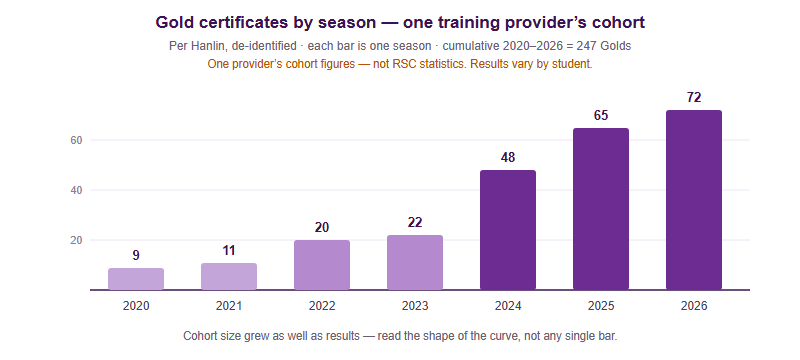
Read that curve carefully, because it can be over-sold. A large part of the rise is simply that more students prepared each year — a bigger cohort produces more certificates regardless of teaching quality. What the curve does show is the thing relevant to a planning article: the numbers climbed across seasons, as material, past-paper coverage and a repeatable autumn routine accumulated. Nothing in that shape came from a January sprint. If you are starting this year, the honest expectation is that your first season is a calibration season and your second is the one that pays.
Sprint versus back-plan, side by side
| What it decides | January-only sprint | September back-plan |
|---|---|---|
| Timed papers finished before Round 1 | One or two, both rushed, neither properly reviewed | Six to eight, spread out, each one reviewed |
| Weak topics you can still repair | Almost none — there is no teaching time left | All of them, in term time, with a teacher still available |
| Entry risk | High — you meet the deadline in the same week you decide | Low — your name went in before the winter break |
| What exam day feels like | Your first encounter with olympiad-style context questions | Your eighth |
| Effect across seasons | One attempt, one outcome, nothing carried forward | Compounds — the pattern in the chart above |
The past-paper loop, and where to get the material
Every block in the plan runs on past papers, and the method matters more than the volume. Sit the paper unseen and timed; mark it against the scheme without arguing with yourself; then log the chemistry idea that failed rather than the question number. Three papers reviewed properly beat ten skimmed, and the log is what turns October’s topic repair into something specific.
We keep a UKChO preparation pack that our own teachers have gathered and worked through — past papers, mark schemes and, for many of the years, full worked solutions written out step by step, plus the topic notes we use with our own cohort. Solution coverage varies by year and we are still extending it, so ask us for the current edition rather than assuming every paper is covered. Our past papers and mark schemes page explains what is in the set, and the method for running the loop is in our guide to using UKChO past papers without memorising answers. If you would rather have the autumn structured for you, that is what our UKChO preparation courses are built around.
What to do in the next fortnight
- Send the entry email. One message to your chemistry teacher with the three questions above. This is the highest-value thirty minutes in the whole plan.
- Sit one paper cold. Two hours, no notes, no pausing. Score it and write the number down — you will want the baseline in January.
- Pick three topics, not ten. From that script, name the three areas that cost you most marks, and make those the whole of October.
- Book the weekly slot now, in the timetable, before mock season fills it. A fixed hour that survives November is worth more than an ambitious plan that does not.
- Diary the December check. One reminder in early December to confirm you are on the school’s entry list, while there is still time to fix it.
The competition itself is two hours long. The season is five months. Almost everything that decides the first is settled in the second, and the piece of it that is pure administration — being entered at all — is also the piece with the hardest deadline and the least warning. If you are new to the competition, start from what the UK Chemistry Olympiad is and then come back to build the calendar.
Frequently asked questions
When does UKChO 2027 registration close?
The 2026 pattern points to registration closing around mid-January 2027, with Round 1 sat in late January 2027. Neither is published as official on this page — confirm both on rsc.org, and remember your school’s internal deadline for collecting names will be earlier.
When should I start preparing for a late-January paper?
September. The run-up to the paper is broken by the winter holiday, and the teaching time that remains is the unsettled start of a new term, so topic repair has to happen in the autumn while teachers are still available. December and early January are for timed practice, not new content.
What score should I be aiming for?
Use 2026 as calibration: the paper was marked out of 84, with Gold from 38, Silver 23–37 and Bronze 13–22 — so Gold sat at just under half the paper. Boundaries are set after marking each cycle and move, so no future boundary can be known in advance.
Can a student based in China enter Round 1?
Entry is arranged through a school rather than by an individual student, and eligibility is set by the Royal Society of Chemistry. Do not assume a route from how other olympiads work — confirm your school’s position on rsc.org before planning a season around it.
This is an independent guide to the UK Chemistry Olympiad, operated by Hanlin Education for international-school students in Greater China. It is not affiliated with, endorsed by, or sponsored by the Royal Society of Chemistry (RSC), which runs the UKChO and sets all official rules, dates, eligibility and boundaries — entry and the authoritative calendar are on rsc.org / edu.rsc.org, and the 2027 timings referred to here are expected rather than confirmed. Student results quoted on this page are de-identified Hanlin cohort data and vary from student to student; they are not RSC statistics and imply no benefit for admission to schools in China. Confirmed errors are corrected within 7 working days.