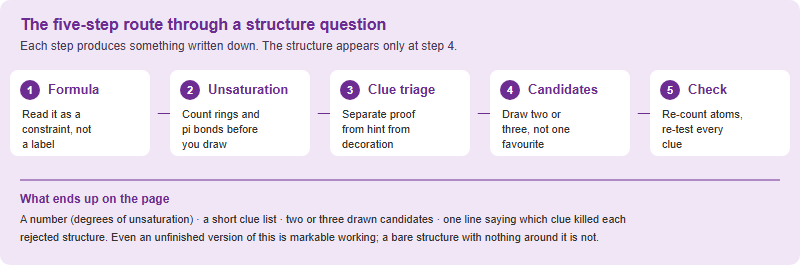
Structure questions are won by working forwards from the molecular formula, not backwards from a guess. Count the degrees of unsaturation, sort the clues by what each one can and cannot prove, use the data the paper supplies rather than a number you half-remember, then draw two or three candidates and eliminate them one clue at a time. The structure is the last step, not the first.
Why guessing a structure costs more than it looks
Most students meet structure determination as a puzzle: stare at the clues, recognise something, write it down. That works in a textbook exercise where the answer is a compound you have seen before. It fails on an olympiad-style paper, for two reasons that have nothing to do with how much chemistry you know.
The first is that a guessed structure carries no working. If you write a structure and nothing else, everything you understood on the way there is invisible. The second is structural: these questions are usually built in parts, and the later parts assume you have a structure to reason from. A structure you cannot justify is a structure you cannot use two parts later, when the question asks you to explain why it reacts a certain way or to name the product of the next step.
So the working method is not decoration. It is the thing that keeps you in the question. UKChO Round 1 is a two-hour paper marked out of 84, and in the 2026 sitting the Gold boundary sat at 38 and above — awarded to 8.5% of entrants. Those marks are not won by a handful of flashes of recognition. They are won by candidates who convert partial information into partial credit, repeatedly. If you have not seen how the boundaries and the distribution actually fell, the 2026 Round 1 results, decoded is the place to calibrate.
Step 1 · Make the formula do work before you draw anything
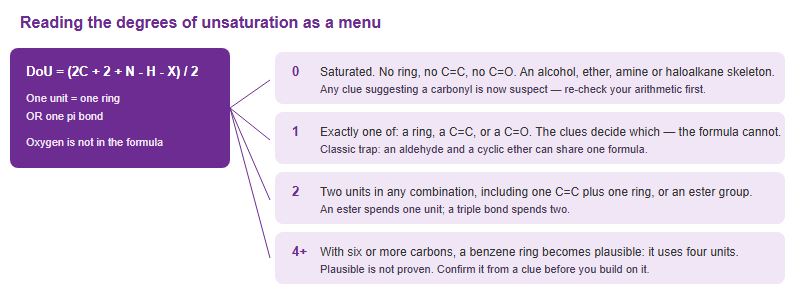
A molecular formula is not a name waiting to be recognised. It is an arithmetic constraint, and the single most useful thing you can extract from it is the degree of unsaturation — the number of rings plus pi bonds in the molecule.
For a compound containing carbon, hydrogen, nitrogen, oxygen and halogens:
Degrees of unsaturation = (2C + 2 + N – H – X) / 2, where C, H, N and X are the numbers of carbon, hydrogen, nitrogen and halogen atoms. Oxygen does not appear, because inserting an oxygen into a chain does not change the hydrogen count.
Two habits make this pay. First, do it every single time, before you look at any other clue — it takes ten seconds and it constrains everything that follows. Second, read the result as a menu of possibilities rather than an answer.
Step 2 · Triage the clues: proof, hint, decoration
Olympiad-style questions supply more information than you need, and they supply it in a mixture of strengths. Students lose time treating a weak hint as if it settled the matter, and lose marks ignoring the one clue that actually pins the structure down. Before drawing, put every clue into one of three buckets.
| Clue in the stem | What it constrains | What it does not prove | Strength |
|---|---|---|---|
| Molecular formula | Atom counts, and the degrees of unsaturation | Which isomer, and where any group sits | Proof (of the count) |
| Reacts with sodium carbonate to give a gas | An acidic group is present | The rest of the carbon skeleton | Proof (of a group) |
| Forms a precipitate with 2,4-DNP but no silver mirror | A carbonyl that is a ketone rather than an aldehyde | Chain length or branching | Proof (of a group) |
| Number of distinct environments quoted for a spectrum | Molecular symmetry — a strong constraint on branching | Which functional group is present | Proof (of symmetry) |
| Product of a subsequent reaction | The group that reacted, working backwards | Anything untouched by that reaction | Proof (partial) |
| Physical description: an oily liquid, a sharp smell | Very little on its own | Essentially everything | Decoration |
| Industrial or historical context in the stem | Often nothing chemical; it frames the question | The structure | Decoration |
Two disciplines follow from the table. Write the proof-grade clues in a short list down the margin, in your own words. And treat symmetry as the underrated one: a statement about how many distinct environments a molecule has does more to eliminate isomers than almost any other single line in the stem, because it converts a drawing problem into a counting problem.
Step 3 · Read supplied data as data, never as recall
When a paper hands you spectroscopic information, you may or may not be given the values needed to interpret it — RSC states only that the papers come with a periodic table and a list of useful constants and quantities. Check what your paper supplies and use it. Do not assume a value will be printed for you; confirm on rsc.org what your paper provides, and be fluent both at recalling the common values and at reading any table that is supplied.
The interpretive rules that are worth owning are the structural ones, because they do not change between data tables:
- Mass spectrum. The molecular ion peak gives the relative molecular mass, which cross-checks the formula you were given. Differences between peaks are more informative than the peaks themselves: a loss of 15 points to a methyl group, a loss of 17 to a hydroxyl, a loss of 29 to an ethyl or a CHO fragment. Distinctive isotope patterns — roughly 3:1 for one chlorine, roughly 1:1 for one bromine — announce a halogen before any other clue does.
- Infrared. Use a correlation table for the wavenumber ranges if your paper supplies one, and check on rsc.org what is provided. The skill is knowing which absorptions carry information: a broad band in the O–H region and a strong band in the carbonyl region between them separate alcohols, aldehydes and ketones, and acids from esters, faster than anything else on the page.
- Nuclear magnetic resonance. Three questions, in this order. How many signals? That is the number of chemically distinct environments, and it is a symmetry statement. What is the ratio of the integrations? That is the ratio of hydrogens in each environment, not the absolute number. What is the splitting? A signal split into n + 1 lines has n hydrogens on the neighbouring atoms, which reconstructs connectivity.
Notice that each of the three answers a different question — mass gives composition, infrared gives functional groups, NMR gives connectivity and symmetry. If you find yourself asking a technique for something it cannot tell you, you are about to waste four minutes.
Steps 4 and 5 · Draw candidates, eliminate them, then check
The single most effective change most students can make is to stop drawing one structure. Draw the two or three that survive your constraints, then write the clue that eliminates each rejected one. This is faster than it sounds, and it changes what happens when you are wrong: a candidate who rejects two structures for stated reasons and picks the third has shown a chain of reasoning even if the final choice is mistaken.
Take an illustrative case — not reproduced from any paper. A compound of formula C₄H₈O has one degree of unsaturation. That single unit could be a ring or a double bond, so the candidates include butanal, butanone, a butenol and a cyclic ether. Suppose the stem adds that the compound gives an orange precipitate with 2,4-DNP but does not reduce Tollens’ reagent. The carbonyl is confirmed and the ring and alkene candidates are gone; the aldehyde is gone too. Butanone is left, and you have written down why the other three died. That paragraph of elimination is the answer, and the structure is its conclusion.
When two candidates survive everything, say so explicitly and state the one experiment or spectrum that would distinguish them. That is a chemist’s answer, and it is much stronger than a silent coin-flip.
Then, before committing, run three checks that take under a minute. Re-count the atoms in your drawn structure against the given formula — hydrogens are where errors hide, particularly around rings and branch points. Re-test every proof-grade clue against the final structure, not just the one that convinced you. And glance at the next part of the question: if it asks you to explain a reaction your structure cannot undergo, you have found your own mistake for free.
To train this, work in a loop rather than in a heap of papers. Take one structure question at a time, give yourself the realistic minutes it would get in a two-hour, 84-mark paper, and write out all five steps even when you think you can see the answer. Then compare your written reasoning — not just your final structure — against a worked solution where one is available. Our own gathered past-paper pack has worked solutions for some years but not for every year, so where none exists, mark yourself against your own clue list: did every proof-grade clue get used? The broader method for extracting learning from papers, rather than memorising them, is set out in how to use UKChO past papers without memorising answers. If the competition itself is new to you, start with what the UK Chemistry Olympiad is and come back to the technique.
One last point on scope. How much structure determination appears in any given year varies, and neither the emphasis nor the format is something to assume from a single paper — RSC states there is no published syllabus for the Chemistry Olympiad, so check any format details on rsc.org and look across several papers in your pack before deciding how much of your preparation to spend here. What does not vary is the underlying skill: turning supplied information into a written chain of deduction. That skill pays in every section of the paper, and it is the same skill Round 2 candidates are asked to use on unfamiliar material.
Frequently asked questions
Do I need to memorise infrared wavenumbers for UKChO?
Do not assume so — RSC states only that papers come with a periodic table and a list of useful constants and quantities. Confirm what your paper provides on rsc.org, and practise reading a supplied table quickly instead.
What is the fastest first move on a structure question?
Calculate the degrees of unsaturation from the molecular formula. It takes ten seconds and constrains every candidate structure you draw afterwards.
Is a wrong structure worth any marks?
Your written deduction is what a marker can follow. A stated clue list and reasoned elimination show chemistry that a bare, unexplained structure does not.
How much organic structure work does UKChO Round 1 contain?
It varies by year. Look across several past papers in your practice pack and note that RSC states there is no published syllabus for the Chemistry Olympiad, so judge coverage from the papers rather than from one year.
This is an independent guide operated by Hanlin Education for China-based international-school students. We are NOT affiliated with, endorsed by, or sponsored by the Royal Society of Chemistry (RSC). Competition dates, formats, eligibility and score boundaries change from year to year — confirm current details on rsc.org. Errors reported to us are corrected within 7 working days.