Equilibrium and acid-base questions on a UKChO paper are won at the setup stage. Almost every mark sits in three moves: decide which constant governs the system, write the expression with the right species in it, and account for what changes when the system is disturbed. The arithmetic that follows is school-level. Students who lose marks here rarely lose them to the algebra.
Why these questions feel harder than they are
UKChO Round 1 is a written paper sat in school — in 2026 it ran for two hours and was marked out of 84, though the current format should always be confirmed on rsc.org — and it is built on school chemistry dressed in unfamiliar clothes. An equilibrium question will not say “here is a Kc problem”. It will hand you an industrial process, a lake, a blood buffer or a drug formulation, and expect you to notice that the chemistry underneath is a system you have already met. If you have not read our overview of what the UK Chemistry Olympiad is, that framing is the single most useful thing to know before you start drilling topics.
The consequence is practical. The stem always gives you what you need to write the equilibrium down: either a balanced equation, or enough information to build one. The failure mode is trying to recall a worked example that matches the wrapper, instead of constructing the expression from the equation in front of you. Recall does not scale to an unseen context. Construction does.
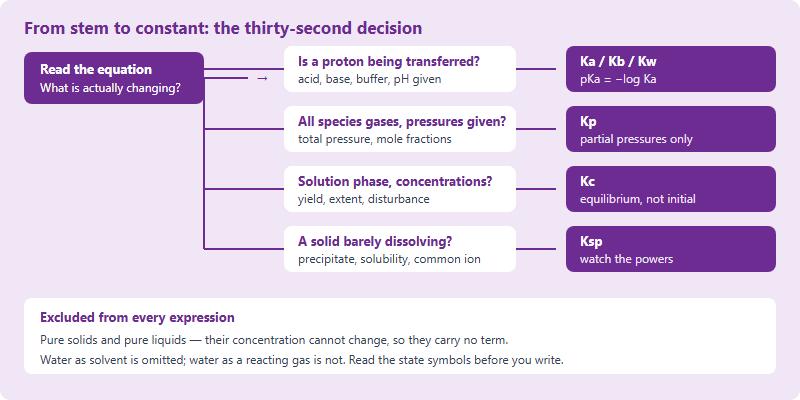
So the drill is not “revise equilibrium”. The drill is: given any stem, produce the correct expression within thirty seconds, and be able to say which species are excluded and why.
The five constants, and what each one actually asks of you
These five cover the overwhelming majority of equilibrium work at this level. The point of the table below is not the definitions, which you have; it is the third column, which is where marks are actually lost.
| Constant | What must appear in the expression | The mistake that costs marks | Typical wrapper |
|---|---|---|---|
| Kc | Equilibrium concentrations, each raised to its stoichiometric coefficient | Using initial concentrations, or dropping the powers. An ICE table is not optional bookkeeping — it is the answer | Esterification, industrial synthesis, dissolved gases |
| Kp | Partial pressures of gaseous species only | Forgetting that partial pressure = mole fraction × total pressure, and including a liquid or solid | Gas-phase industrial processes, atmospheric chemistry |
| Ka (and Kb, pKa) | [H+][A−] / [HA] for the dissociation as written | Treating a weak acid as fully dissociated, i.e. pH = −log c. That single slip can invalidate a whole part | Buffers in biology, environmental acidity, drug ionisation |
| Kw | [H+][OH−], equal to 1.00 × 10⁻¹⁴ at 298 K | Assuming pH 7 is neutral at every temperature. Kw is temperature-dependent, so neutral pH moves with it | Anything linking pH and pOH, or a non-standard temperature |
| Ksp | Ion concentrations with the powers from the dissolution equation | Missing the square on a 2:1 salt. For AB2, Ksp = 4s3, not s2. Also forgetting the common-ion effect | Precipitation, water treatment, selective separation |
Two habits follow from that table. First, write the dissolution or dissociation equation before the expression, every time, even when you think you know it — the powers come from the equation, and copying a remembered expression is how the 4s3 error happens. Second, say out loud which species you are excluding and why. Examiners cannot credit reasoning you did not write down, and “solid, so omitted” is one clause.
When you may neglect x, and how to say so
One approximation dominates acid-base work: assuming that the amount dissociated is small enough that the initial concentration is effectively unchanged. It is usually valid, occasionally catastrophic, and the difference is testable in about fifteen seconds.
Take 0.100 mol dm−3 ethanoic acid, Ka = 1.8 × 10⁻⁵. Assuming 0.100 − x ≈ 0.100 gives x = √(1.8 × 10⁻⁶) = 1.3 × 10⁻³ mol dm−3, so pH = 2.87. That x is about 1.3% of the initial concentration — comfortably inside the convention that the approximation holds when x is a small fraction of c, commonly taken as under about 5%.
Now change two numbers. For an acid with Ka = 1.8 × 10⁻² at 0.0100 mol dm−3, the same shortcut gives x = 1.3 × 10⁻², which is larger than the concentration you started with — a physical impossibility. Solving the quadratic properly gives x = 7.2 × 10⁻³, meaning the acid is about 72% dissociated. The shortcut was not slightly wrong; it was meaningless. Stronger weak acids and dilute solutions are exactly where it breaks.
The working habit: state the assumption in one clause, use it, then check it against the answer you obtained and write the check. An assumption that is stated and tested is is far easier for a marker to follow than a number that appears from nowhere — and if the assumption turns out to be invalid, you have shown you knew to look.
Reading a titration curve as data, not decoration
A titration curve is one of the highest-value objects in the whole topic, because a single graph can be interrogated for a dissociation constant, a concentration and an indicator choice. Four regions, four different pieces of chemistry.
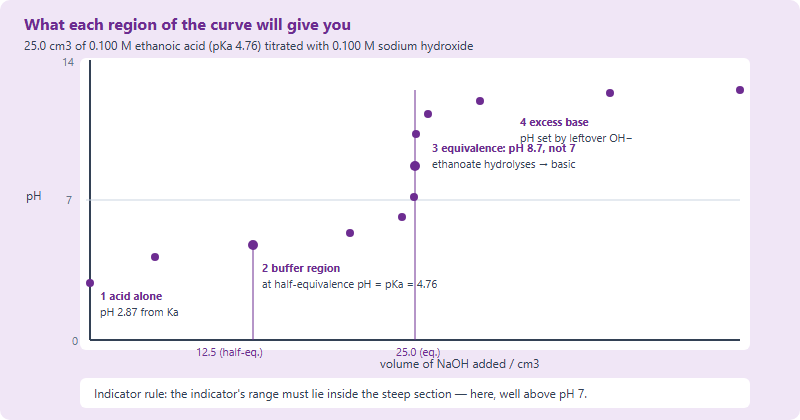
The half-equivalence point deserves special attention. When exactly half the acid has been neutralised, [HA] equals [A−], the ratio term in the Henderson-Hasselbalch relationship becomes log 1 = 0, and pH = pKa. That is the fastest legitimate way to extract a dissociation constant from a graph, and it works without knowing the concentrations at all.
Three refinements that separate confident answers from adequate ones:
- The equivalence point is not pH 7 unless both partners are strong. A weak acid with a strong base leaves the conjugate base in solution, which hydrolyses and pushes pH above 7 — about 8.7 in the system above.
- Indicator choice is a data question. The indicator must change colour within the steep part of the curve. Quoting a familiar indicator without checking its range against the graph is guessing.
- Polyprotic acids give you two gifts. Two buffer regions mean two half-equivalence points, and therefore two pKa values readable straight off the axis.
Le Chatelier answers that actually score
Qualitative equilibrium parts look like free marks and frequently are not, because students give the conclusion without the mechanism of reasoning. A complete answer has three components: the direction of the shift, the quantity that has to stay constant, and the physical change that forces it.
The distinctions worth having automatic:
- A catalyst changes rate, never position. It speeds both directions equally, so equilibrium arrives sooner at the same place.
- Pressure only matters when the gas mole counts differ between the two sides. If they are equal, raising the pressure shifts nothing.
- Adding an inert gas at constant volume changes nothing, because the partial pressures of the reacting species are untouched. At constant pressure, it does.
- Temperature is the only one of these that changes K itself. Everything else moves the position of equilibrium within a fixed K; temperature moves the target. The sign of the enthalpy change tells you which way.
That last point is where a specific, common error lives: writing that “the equilibrium shifts right, so K increases” after a concentration change. It does not. K is fixed at fixed temperature; the system moves to restore it. Saying so explicitly is a stronger answer than the shift alone.
A four-session drill you can run before term gets busy
Equilibrium rewards separated practice, because the skill that fails under time pressure is setup, and full questions bury setup inside everything else. Split it:
- Session 1 — expressions only. Take twenty equilibrium stems from past papers and write nothing but the constant expression and the excluded species for each. No arithmetic at all. Twenty in forty minutes.
- Session 2 — approximations. Ten acid or base calculations, and for every single one, perform and write the validity check. Find at least one where the shortcut fails.
- Session 3 — curves. Three titration graphs; extract pKa from each via the half-equivalence point, then justify an indicator from the steep region.
- Session 4 — full questions, timed. Only now do complete multi-part questions under something like exam conditions.
Run that against real papers rather than textbook exercises, using the diagnostic method for past papers we set out separately — the point is to find your failure mode, not to accumulate completed questions. We keep our own gathered set of past papers, with worked solutions for many though not all years, which is what these sessions are built around.
One planning caution. Students routinely ask how many of the 84 marks are equilibrium. No topic weighting is published on rsc.org, and we will not invent one. If the answer matters to how you spend a term, count it yourself across three recent papers and work from your own tally. For context on what those 84 marks convert into — in 2026 the Gold boundary sat at 38 and Silver ran from 23 to 37 — see our breakdown of the 2026 Round 1 results.
Questions students ask about this topic
Does pH = pKa at the half-equivalence point always hold?
It holds whenever the usual weak-acid approximations hold. In very dilute solutions, or with a strong weak acid, solve the full expression instead.
Do solids appear in a Kc or Ksp expression?
No. Pure solids and pure liquids are omitted, because their concentration cannot change. Only species whose concentration can vary carry a term.
Is pH 7 always neutral?
No. Neutral means [H+] equals [OH-], which is pH 7 only where Kw is 1.0 x 10⁻¹⁴, at 298 K. Kw rises with temperature.
How much of a UKChO paper is equilibrium?
No topic weighting is published, so we will not guess one. Count the marks yourself across three recent past papers before planning revision around it.
This is an independent guide operated by Hanlin Education for China-based international-school students. We are NOT affiliated with, endorsed by, or sponsored by the Royal Society of Chemistry (RSC). Competition dates, formats, eligibility, award boundaries and the availability of published materials change from year to year — confirm current details on rsc.org. Errors reported to us are corrected within 7 working days.