If nobody at your school has entered UKChO, your first problem is eligibility, and only after that is it administrative rather than chemical. Round 1 is sat in schools, which means the unit of entry is an institution with a named member of staff behind it, not an individual student. That is inconvenient. It is also why the ask is smaller than it looks: in 2026, 1,153 schools entered 17,241 students between them.
The number that makes the ask easy
Divide those two published totals and you get roughly fifteen students per entering school. That single piece of arithmetic reframes the whole conversation you are about to have with your chemistry department.
You are not asking your school to build a bespoke programme around one ambitious student. You are asking it to do what a thousand-plus schools already do at ordinary scale: open a room, for a group, on one morning. Departments say no to bespoke. They say yes far more readily to a cohort with a named list attached.
The other thing the 2026 figures tell you is direction of travel. That entry was a record for the competition — the largest field it had seen. A teacher weighing up whether this is a fading curiosity or a growing fixture has a defensible answer, and it is not the one they may be assuming.
So before you write a single email, do the recruiting. Get eight to fifteen classmates who will actually sit a two-hour paper, in writing, with names. A student asking for an opportunity is a favour request. A student arriving with a signed list is a logistics problem — and logistics problems get solved.
Confirm eligibility before you promise anything
This is the section students skip, and it is the one that wrecks these conversations most often.
Do not assume that a school outside the UK can enter, and above all do not tell your teacher that it can. Who may enter, from where, and under what conditions are matters set by the Royal Society of Chemistry, and they are not inferable from how other competitions work or from what a forum post says. The only safe source is rsc.org, or the RSC directly.
The practical version of this advice: when you approach your department, send them the official page, not our summary of it and not a screenshot from a group chat. If a teacher spends an afternoon on an internal approval and then discovers the entry conditions do not fit your school, you will not get a second hearing next year. Verified first, promised second.
We take the same discipline in this article. You will notice below that we print no entry fee, no deadline and no registration URL. Those change from season to season, and a guide that guesses them is worse than a guide that sends you to the source.
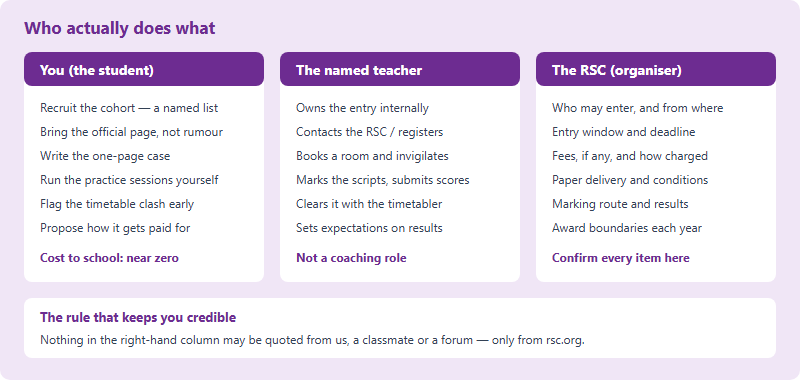
The five questions that have to be settled
Every unsuccessful first attempt we have seen failed on one of these five, usually because nobody asked it until it was too late in the term to fix.
| # | The question | Why it decides the outcome | Where the answer comes from |
|---|---|---|---|
| 1 | Who may enter, and from which countries and school types? | Determines whether any of the rest is possible. Ask it first, not fourth | rsc.org, or the RSC directly — nowhere else |
| 2 | Who is the named staff contact, and what do they take on? | An entry with no internal owner quietly dies between departments | Your chemistry department; RSC guidance on the school's role |
| 3 | When does entry open and close? | The whole plan hangs on it, and it sits before the sitting by some margin | rsc.org. Dates move each season |
| 4 | What does entry cost, and is it charged per school or per student? | Decides which budget it comes from, which decides who has to approve it | rsc.org, or the RSC directly |
| 5 | How are papers delivered, sat, marked and returned? | Drives invigilation, room booking and the results conversation | rsc.org, and the entry guidance issued to schools |
You will notice we have not answered any of them. That is deliberate, and you should adopt the same posture: your value to the teacher is that you have identified exactly what needs confirming and where, not that you have a set of numbers of uncertain provenance.
The one-page case, and the objections it has to survive
Write one page. Not three. Departments approve things they can read standing up. The structure that works: what it is, who wants to do it, what the school has to do, what it costs, what could go wrong.
Then pre-empt the objections, because they are predictable and they are all answerable.
| What you will hear | What to say | What you can point to |
|---|---|---|
| “There is no room in the timetable” | It is one two-hour written paper sat in school, not a series or a season | The 2026 paper was sat on a single day, 28 January 2026 |
| “Our students are not strong enough” | The award bands are broad and most entrants finish with something | In 2026, Bronze started at 13 marks out of 84 and covered 36.5% of the field |
| “It is not on our syllabus” | It builds on school chemistry placed in unfamiliar contexts — enrichment, not an extra course | Our overview of what UKChO is and who it is for |
| “Nobody here can prepare them” | Preparation is student-led from past papers; the staff role is entry, invigilation and marking the scripts in school to the mark scheme the RSC supplies | Our past-paper method, which needs no teacher input |
| “What if they all do badly?” | Results are a diagnostic, and the distribution is published, so expectations can be set in advance | Our decode of the 2026 boundaries and band percentages |
| “Who pays for it?” | Arrive with a proposed route rather than an open question | Society or club budget, department enrichment fund, or student contribution — subject to school policy |
The band data is the quiet workhorse here. A head of department's real fear is not cost; it is a group of students being publicly discouraged. Being able to say, with published percentages, that roughly seven in ten entrants in 2026 finished inside an award band changes the risk calculation entirely. Set that expectation before entry, not after results.
Working backwards from a late-January paper
Round 1 2026 was sat on 28 January 2026. Treat that as an anchor for shape rather than a date to diarise — this season's date must be confirmed on rsc.org — and plan backwards from it.
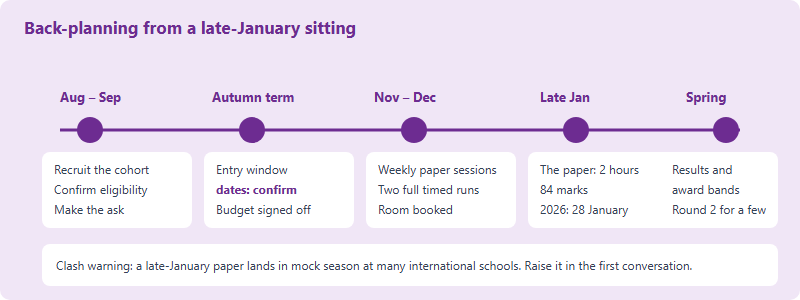
That clash warning deserves emphasis, because in our experience it is what actually kills entries at international schools — not cost and not enthusiasm. Late January is when IB mock examinations and January assessment series tend to sit. If you surface the conflict in your first conversation and propose a solution, you look like someone who has thought it through. If the timetabler discovers it in week two of the spring term, the entry gets dropped and nobody blames the paper.
If the answer is no this year
Sometimes it is no, and the reason is legitimate: the eligibility conditions do not fit your school, the budget cycle has closed, or there is genuinely no member of staff free to own it. Three responses are worth more than arguing.
- Train anyway. Past papers do not require an entry. A term spent working through them with a group builds exactly the same chemistry, and you will be measurably better placed if an entry opens next cycle.
- Build the group so next year's ask is a formality. A club that has been meeting weekly since September, with attendance, is a far easier yes than a proposal.
- Ask again in the next cycle, earlier. Most refusals we hear about are timing refusals dressed as policy refusals. Ask in August, not December.
One thing not to do: do not look for workarounds that misdescribe your school, your year group or where you are studying. The entry conditions belong to the organiser, and a place obtained by misrepresentation is not a place. If the honest answer is that your circumstances do not currently fit, that is information about this season, not a verdict on your chemistry.
And the chemistry itself is never wasted. The work you do preparing for a paper you do not end up sitting is the same work that raises your school grades and gives you something real to talk about when someone asks why you are interested in chemistry.
Questions students and teachers ask
Can I enter UKChO as an individual?
Round 1 is sat in schools. Whether any individual route exists is a question for the RSC, so check rsc.org before assuming either way.
How many students does an entering school usually put in?
About fifteen on average in 2026, by our own arithmetic on the published totals of 17,241 students across 1,153 schools.
Does my school need a teacher who knows olympiad chemistry?
No olympiad specialism is needed, but per rsc.org the staff role is entry, invigilation and marking the scripts in school to the RSC mark scheme. Preparation itself can be student-led from past papers with a weekly session.
When is the paper sat?
Round 1 2026 was sat on 28 January 2026. The date changes each season, so confirm the current one on rsc.org before planning.
This is an independent guide operated by Hanlin Education for China-based international-school students. We are NOT affiliated with, endorsed by, or sponsored by the Royal Society of Chemistry (RSC). Competition dates, formats, eligibility, award boundaries and the availability of published materials change from year to year — confirm current details on rsc.org. Errors reported to us are corrected within 7 working days.