UKChO has four rungs: a two-hour written Round 1 sat in schools, published award bands, a Round 2 at the University of Nottingham for roughly the top thirty, and onward selection towards the International Chemistry Olympiad. The number of places falls much faster than most students expect, and the upper rungs carry eligibility conditions set by the Royal Society of Chemistry — check those on rsc.org before you build two years of work around them.
The funnel in numbers
The 2026 season gives us the clearest picture the competition has produced, because it was the largest field on record. Round 1 was sat on 28 January 2026 by 17,241 students across 1,153 schools, marked out of 84. The published bands were Gold from 38 marks (8.5% of entrants), Silver from 23 to 37 (25.7%) and Bronze from 13 to 22 (36.5%).
Apply those percentages to the entry and the shape becomes concrete. By our own arithmetic on the published figures, that is roughly 1,465 Gold awards, 4,431 Silver, 6,293 Bronze, and about 5,052 candidates finishing below the Bronze boundary. Round 2 took the top 30, at the University of Nottingham.
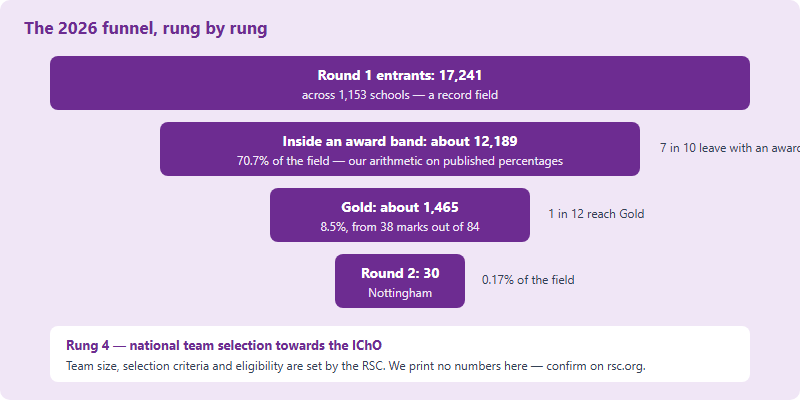
Two ratios are worth carrying in your head. Round 2 places represent about 0.17% of the field. And even among Gold awards, only about one in forty-nine converts into a Round 2 invitation. That second number is the one students find surprising, and it leads directly to the most common misconception about this competition.
| Rung | Who is there (2026) | Format | What it adds to the demand | What to confirm |
|---|---|---|---|---|
| 1. Round 1 | 17,241 students in 1,153 schools | Two-hour written paper sat in school, 84 marks | Familiar chemistry in unfamiliar contexts, read at speed | This season's date and entry route, on rsc.org |
| 2. Award bands | Gold ≈1,465 / Silver ≈4,431 / Bronze ≈6,293 | Boundaries published after marking | Nothing — a band is a measurement, not a stage | Boundaries move every year; do not target last year's |
| 3. Round 2 | The top 30 | At the University of Nottingham; format and content to be confirmed on rsc.org | Whatever the published Round 2 format asks for in a given year | Selection criteria, on rsc.org |
| 4. International team | Not published by us | Selection towards the International Chemistry Olympiad | Set by the RSC and the IChO organisers — confirm on rsc.org | Eligibility and selection rules — ask the RSC directly |
A Gold award is not a Round 2 ticket
This is the single most useful thing to understand about the ladder, and the arithmetic above makes it unavoidable. Gold covered roughly 1,465 students in 2026. Round 2 took thirty. The band and the invitation are simply not the same object: one is a description of where your paper landed against a national field, the other is a place at a selection event with a fixed capacity.
Students who conflate the two set themselves an unfalsifiable goal and then read a genuinely excellent result as a failure. A Gold at 38 or 45 marks out of 84 is a strong national performance in a record field. Treating it as a near-miss because no invitation followed is a misreading of what the competition publishes. Our fuller breakdown of the 2026 boundaries and what each band represents goes through this in detail.
The practical consequence for planning: aim at a mark, not at a rung. A mark is something your preparation can move. An invitation depends on where several thousand other papers land in the same season, which it cannot.
What each rung actually adds
The jump between rungs is not mainly a jump in content. It is a jump in the kind of work being asked for, and that matters for how you prepare.
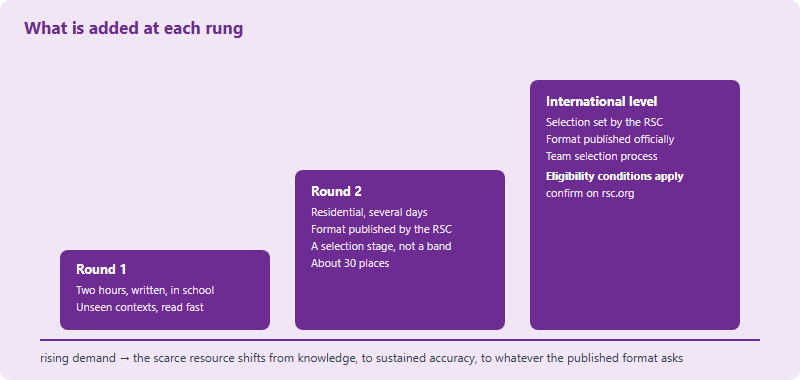
Round 1 asks for speed of comprehension. Two hours, 84 marks, and chemistry you have met wrapped in a context you have not. Most of the preparation that works here is paper-based and can be done alone, which is why our diagnostic approach to past papers is the highest-return activity available to a self-studying student.
Round 2 changes the format, not just the difficulty. A selection event at the University of Nottingham is a different animal from a single morning in your own school hall, and its format is published by the RSC rather than by us. If a given year's Round 2 does include laboratory work, bench technique is the one component that cannot be revised the night before, and students at international schools with limited practical time would have least room to close that gap — which is a reason to read the published format early rather than to assume it.
International level is described by the organisers, not by us. We are not going to describe that stage in detail, for a simple reason: its syllabus, format and selection sit with the organisers, and second-hand summaries of it circulate widely and inaccurately. Read the official material rather than a guide's paraphrase — including ours.
Where eligibility actually bites
Here is the part that matters most to readers at schools in China, and the part where we will give you a method rather than an answer.
Representing a country at an international olympiad is a national-selection question. It typically involves conditions of nationality, residence and school registration — and those conditions are set by the organising body, not inferable from how any other competition works. We will not print a rule we cannot cite, and you should be sceptical of any site that does.
What we can tell you is exactly what to ask, and to ask it in writing before it becomes the organising goal of two years of work:
- Can a student at a school outside the UK enter Round 1 at all, and under what conditions?
- Are Round 2 invitations open to those students, on the same basis as everyone else?
- What conditions govern selection towards the international team — nationality, residence, school registration, or a combination?
Send those three questions to the RSC and work from the reply you receive. Note the order carefully: the answer to the first governs whether the other two are even live questions. Students routinely research rung four for weeks without confirming rung one.
And be clear about what a restrictive answer does and does not mean. A condition that closes rung four does not retroactively devalue rungs one to three. It changes the goal — from a place on a team to a mark on a paper — and a mark on a paper was always the more controllable target anyway.
What the ladder is worth if you stop at rung two
Most entrants stop at a band, and that is the normal outcome rather than a disappointing one. It is worth being precise about what you actually hold at that point.
You hold an externally set, nationally benchmarked measurement of your chemistry against a national field of over seventeen thousand students — not a school prize, not a certificate of attendance. You hold evidence of having chosen to work on hard problems without being made to. And you hold the training effect itself, which is the part that persists: reading unfamiliar chemistry quickly and reasoning under time pressure transfers directly to school examinations and to the kind of thinking that university interviews probe.
What it is not is a guarantee of anything in admissions. No competition result guarantees an offer at any university, and any claim to the contrary should make you distrust the source. Where UKChO helps, it helps as one credible signal among many. If you want the fuller picture of what the competition is and where it sits, our introduction to UKChO for China-based students covers it.
Planning a term around the rung you can actually reach
Once the funnel is clear, revision planning gets easier, because different positions on it call for genuinely different work.
- Targeting a first award. Breadth and accuracy beat exotic topics. The Bronze boundary in 2026 sat at 13 marks out of 84; that is reached by answering ordinary chemistry cleanly, not by mastering anything unusual.
- Sitting in Silver, aiming at Gold. In 2026 that gap was from 23 to 38 — fifteen marks, which on an 84-mark paper is a handful of question parts rather than a rebuild of your chemistry. Find which parts you consistently abandon and work on those specifically.
- Already near the top of the field. The marginal marks live in the longest, most technical questions, and increasingly in whether you can hold accuracy across the full two hours. More papers of the same difficulty will not move you; harder single questions and better checking will.
In every case the plan is anchored to a number you control, which is the quiet argument of this whole article. The rungs above you are set by other people's papers and other people's rules. Your mark out of 84 is set by you.
Questions students ask about progression
How many students reach UKChO Round 2?
About 30. In 2026 the top 30 went to the University of Nottingham, which is roughly 0.17% of the 17,241 candidates.
Does a Gold award mean I go to Round 2?
No. Gold covered about 8.5% of the 2026 field, roughly 1,465 students by our arithmetic, while Round 2 took about 30.
Can a student outside the UK be selected for the international team?
That is set by the RSC and we will not guess it. Ask in writing and confirm on rsc.org before planning around it.
Is Round 1 worth entering if I cannot go further?
Yes. It is an externally set, nationally benchmarked measurement of your chemistry against a national field, and a training target, whatever follows it.
This is an independent guide operated by Hanlin Education for China-based international-school students. We are NOT affiliated with, endorsed by, or sponsored by the Royal Society of Chemistry (RSC). Competition dates, formats, eligibility, award boundaries and the availability of published materials change from year to year — confirm current details on rsc.org. Errors reported to us are corrected within 7 working days.