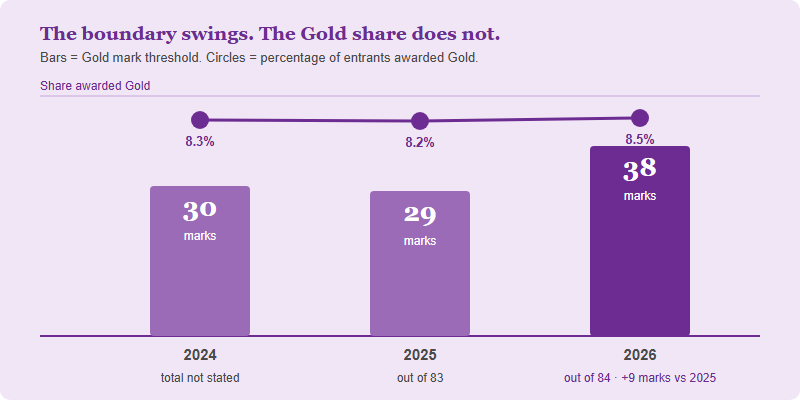
The Gold boundary for UK Chemistry Olympiad Round 1 was 30 marks in 2024, 29 in 2025, and 38 in 2026 — a jump of nine marks in a single season. Our own reading is that the chemistry did not get harder. The share of entrants awarded Gold stayed almost perfectly flat across all three years, which tells you exactly what the boundary is measuring, and why copying last year’s number as your target is a mistake.
The three-year series, and the number that refused to move
Set the boundaries and the award shares side by side and the pattern is hard to miss. The thresholds swing. The percentages do not.
| Season | Paper sat | Marked out of | Bronze | Silver | Gold | % Gold | % Silver | % Bronze | Students |
|---|---|---|---|---|---|---|---|---|---|
| 2024 | 25 January 2024 | not stated in the release | 10–17 | 18–29 | 30+ | 8.3% | 25.0% | 36.8% | 14,915 |
| 2025 | 23 January 2025 | 83 | 9–15 | 16–28 | 29+ | 8.2% | 25.2% | 32.1% | 16,216 |
| 2026 | 28 January 2026 | 84 | 13–22 | 23–37 | 38+ | 8.5% | 25.7% | 36.5% | 17,241 |
From 2025 to 2026 the Gold threshold rose by nine marks, from 29 to 38, an increase of roughly 31% in raw terms. Over the same step, the proportion of entrants receiving Gold moved from 8.2% to 8.5%. That is three tenths of a percentage point. Silver moved 25.2% to 25.7%. Bronze moved 32.1% to 36.5%.
A threshold that leaps while the outcome it gates stays still is not describing difficulty. It is describing arithmetic.
What the RSC published, and the reading we draw from it
The examiners’ report published for the 2026 Round 1 paper says two things which, taken together, settle the question. First, the boundaries were set to produce approximately the same share of each award as in previous years. Second, the writers had been deliberately increasing the proportion of accessible marks in the paper, drawing more on A-level material that students meet earlier in the course, and they record that both the averages and the boundaries came out significantly higher than in 2025 as a result.
So the causal chain runs in the opposite direction to the one most students assume:
- The paper is written with more reachable marks in it.
- The cohort therefore scores higher across the board.
- The boundary is then placed wherever it needs to sit to keep roughly 8–9% of entrants on Gold.
The boundary is an output of that process, not an input to it. It is a readout of how everyone else did. On our reading a rising boundary points to a more accessible paper, though the RSC commented only on 2026 against 2025. If you have not read our overview of what the UK Chemistry Olympiad is and how Round 1 works, that framing is worth having before you set any target at all.
What a rising boundary does to the student on the margin
Convert the thresholds into a share of the paper and the practical consequence appears. In 2025, Gold needed 29 out of 83 — about 35% of the available marks. In 2026, Gold needed 38 out of 84 — about 45%. That is a materially different exam to prepare for, even though it is the same competition.
At 35% of a paper, a candidate can plausibly assemble a Gold score out of scattered strength: solid work on two questions, a few marks harvested elsewhere, one hard part cracked. At 45%, that route closes. You cannot reach 38 marks by being brilliant on the difficult material while leaking marks on the routine material, because there is not enough difficult material to carry you there. The extra accessible marks the writers added are precisely the marks a Gold candidate is now expected to bank without error.
So the competitive edge has moved. It used to sit with the student who could crack something unusual. On a more accessible paper it sits with the student who does not drop anything ordinary — who balances every equation, keeps every unit straight, and does not lose a mark to a missing minus sign. That reading is our own analysis rather than an RSC statement about how to prepare, but the arithmetic underneath it is not really disputable.
Where the 2026 field actually sat
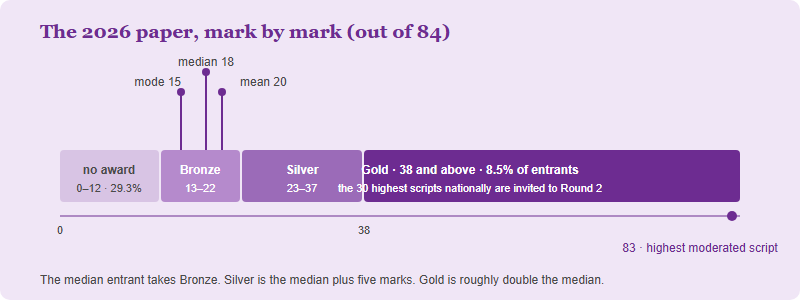
The examiners’ report also gives the distribution, and it is a useful corrective to the impression students form from the boundary alone. Across 17,241 entrants the mean score was 20 out of 84, the median was 18, and the mode was 15. Roughly 29.3% of candidates finished in the 0–12 band and received no award. The highest moderated script in the country scored 83 out of 84.
Read that against the thresholds and the shape of the challenge becomes concrete:
- The median entrant earns Bronze. A median of 18 sits inside the 13–22 Bronze band. Turning up reasonably prepared puts you in the awards.
- Silver is the median plus five marks. Twenty-three is not a different order of ability. It is five recovered mistakes.
- Gold is roughly double the median. Getting from 18 to 38 is the real jump in this competition, and it is the one that demands systematic accuracy rather than occasional brilliance.
Target a percentile, not a mark
Because the thresholds are placed after marking to hold the shares steady, the stable quantity across seasons is the percentage, not the number of marks. Roughly 8–9% of entrants take Gold, roughly a quarter take Silver, and somewhere around a third take Bronze. Those figures have held while the raw thresholds moved by nine marks.
The practical version of that, for a student planning a season:
- Do not set 38 as your 2027 target. If the 2027 paper runs harder than 2026, 38 could sit comfortably above the Gold line. If it runs more accessible again, 38 might not be enough. The number is not a standard you can lock onto.
- Set the target as a position in the field — top tenth for Gold, top third for Silver — then work backwards to the behaviour that puts you there, which is accuracy density rather than any particular score.
- Use recent boundaries as a sense of scale only. Across these three seasons the Gold region has sat somewhere between roughly a third and a half of the paper. That range is the honest planning envelope, and each season’s actual figure should be confirmed on rsc.org when it is released.
Our full decode of the published 2026 figures, including the band arithmetic, sits in our write-up of the 2026 Round 1 results.
What this actually changes in your preparation
If the paper is being deliberately stocked with more reachable marks, then the highest-yield preparation is no longer exotic. It is the unglamorous work of not leaking.
The 2026 examiners’ report is blunt about where the field leaked: balancing errors, unit analysis and powers of ten, missing minus signs, confusion between joules and kilojoules, and calculated values whose magnitude was never sense-checked. None of that is advanced chemistry. All of it is the difference between 30 and 38 on a paper where the accessible marks are the contested ground.
Two structural habits are worth taking from the same report. The examiners encourage candidates to attempt every part, because later sections usually still contain reachable marks, and to work through the sections they feel confident about first before returning to the demanding material. On a paper engineered to carry more accessible marks, both instructions are worth more than they used to be.
The way to find your own leak pattern is to work timed past papers and classify every lost mark by cause rather than by topic. We set out that loop in our guide to using UKChO past papers as a diagnostic rather than as an answer bank. The past-paper set we send students is our own compiled collection, and worked solutions are available for many of the years in it rather than for every year.
Frequently asked questions
Why did the UKChO Gold boundary rise from 29 to 38?
The 2026 paper carried more accessible marks, so scores rose. Boundaries are then set to keep award shares roughly constant.
Does a higher boundary mean the competition got harder?
No, the opposite. A rising boundary shows the cohort scored higher, which points to a more accessible paper that season.
Should I aim for 38 marks in 2027?
No. Boundaries are set per paper after marking. Aim for a position in the field and confirm the season’s figures on rsc.org.
What was the average UKChO Round 1 score in 2026?
The mean was 20 out of 84, the median 18 and the mode 15, across 17,241 entrants.
This is an independent guide operated by Hanlin Education for China-based international-school students. We are not affiliated with, endorsed by, or sponsored by the Royal Society of Chemistry (RSC). Score boundaries, entry arrangements and competition dates are set by the organiser and change from season to season — confirm current details on rsc.org before acting on anything here. Any factual error brought to our attention is corrected within 7 working days.