Spotting a stereocentre is the easy half of a UKChO stereochemistry question; counting what it produces is the half that separates scripts. The RSC’s examiners’ report on the 2026 paper notes that many candidates could identify a stereocentre, but only a small number worked out how many stereochemical combinations were possible — and many stopped at one tautomer when the question left the number open. The fix is a written counting method with a built-in proof that nothing is missing.
What the 2026 paper rewarded: counting, not spotting
Round 1 in 2026 was marked out of 84 and sat by a record 17,241 students, with Gold from 38, Silver from 23 and Bronze from 13; our decode of the 2026 results sets out how the field was distributed. Against boundaries that close together, a question type that most of the field gets wrong is a question type worth owning.
The examiners’ notes point at exactly that. In the isocyanide question, combinatorial reasoning proved more discriminating than recognising a stereocentre, and three of its later parts were answered correctly by only a small number of students. In the henna question, one part deliberately did not say how many tautomeric structures were required; many students drew one correct structure and stopped, and the examiners advise always asking whether further valid alternatives exist. Elsewhere on the paper, structures were drawn that did not match the given molecular formula, double bond equivalents were miscounted, and double bonds were misplaced.
Read together, those notes describe one habit. Strong candidates treat “how many?” as a question with a provable answer. Everyone else treats it as a drawing exercise and stops when they run out of ideas. The five steps below turn the first habit into a procedure.
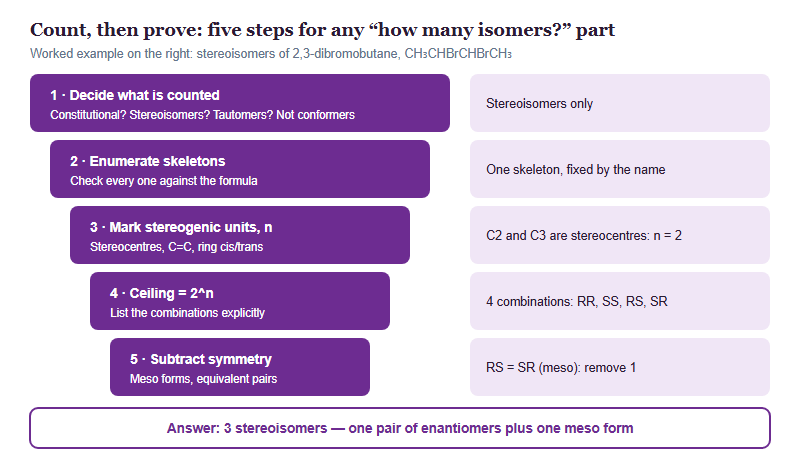
Step 1: decide exactly what is being counted
Most wrong counts are wrong before any drawing starts, because the student has silently counted something the question did not ask for — or left out something it did. Before you draw, write down which kinds of isomer are in scope.
| Kind | What differs | Counted as separate? | Example |
|---|---|---|---|
| Constitutional (structural) | Which atoms are bonded to which | Yes | Butan-1-ol and butan-2-ol |
| Tautomers | Constitutional isomers that interconvert, typically by moving a hydrogen and a double bond | Yes, when the question asks for tautomers | Propanone and prop-1-en-2-ol |
| Conformers | Rotation about single bonds | Normally no | Staggered and eclipsed ethane |
| Enantiomers | Non-superimposable mirror images | Yes: a pair counts as two | The two forms of butan-2-ol |
| Diastereomers | Stereoisomers that are not mirror images | Yes | (E)- and (Z)-but-2-ene; cis- and trans-1,2-dimethylcyclohexane |
| Meso compounds | Contain stereocentres but are superimposable on their mirror image | Yes, but once, not as a pair | The meso form of 2,3-dibromobutane |
Two scope traps are worth naming. An amine nitrogen carrying three different groups looks like a stereocentre, but it inverts rapidly at room temperature, so its two forms are not normally counted as separate isomers. And a question that asks for “isomers” without qualification may intend constitutional and stereoisomers together — if the wording is genuinely ambiguous, say which interpretation you are counting, then count it completely.
Step 2: enumerate constitutional isomers so none are missed
Start from the molecular formula and calculate the double bond equivalents — the number of rings plus pi bonds. The 2026 report records that this was miscounted surprisingly often, and every later step depends on it.
Then enumerate in a fixed order rather than by inspiration. Draw the longest possible carbon chain first. Shorten it by one carbon and place that carbon as a branch at each distinct position, never at an end, where it would simply rebuild the longer chain. Shorten again and repeat. For each functional-group family that the formula allows, work through the positions the same way. Finally, name every structure: two drawings with the same name are duplicates, which is the fastest reliable way to catch the same molecule drawn twice from different angles.
Three worked counts show the method at different scales:
- C4H10O has no double bond equivalents. Four alcohols (butan-1-ol, butan-2-ol, 2-methylpropan-1-ol, 2-methylpropan-2-ol) and three ethers (1-methoxypropane, 2-methoxypropane, ethoxyethane) give seven constitutional isomers. Butan-2-ol is chiral, so counting stereoisomers the total is eight.
- C4H8 has one double bond equivalent: one double bond or one ring. But-1-ene, but-2-ene and 2-methylpropene, plus cyclobutane and methylcyclopropane, give five constitutional isomers. But-2-ene has E and Z forms, so the full count is six.
- C7H16 has nine constitutional isomers. Two of them, 3-methylhexane and 2,3-dimethylpentane, contain a stereocentre and exist as pairs of enantiomers, so the count including stereoisomers is eleven.
Close every enumeration with the check the examiners asked for: recount the atoms in each structure against the given formula. Hydrogens around branch points and rings are where the mismatches hide.
Steps 3 to 5: stereogenic units, the 2n ceiling, then symmetry
Step 3 — mark every stereogenic unit. There are three common kinds. A tetrahedral stereocentre carries four different groups. A carbon–carbon double bond is stereogenic when each of its carbons carries two different groups. And two substituted ring carbons can be cis or trans to each other even when neither is a stereocentre — 1,4-dimethylcyclohexane has no stereocentre at all, yet exists as cis and trans diastereomers, both achiral.
Step 4 — take the ceiling. With n independent units, each with two possible arrangements, there are at most 2n stereoisomers. Write the combinations out as labels rather than drawings; it is quicker, and it makes the next step mechanical.
Step 5 — subtract symmetry. If the molecule has internal symmetry, some combinations describe the same compound. Two situations account for almost every reduction. A meso form arises when a combination is its own mirror image, as (R,S) is for 2,3-dibromobutane. And equivalent combinations arise when the molecule reads the same from either end, as in hexa-2,4-diene, where (E,Z) and (Z,E) are the same molecule.
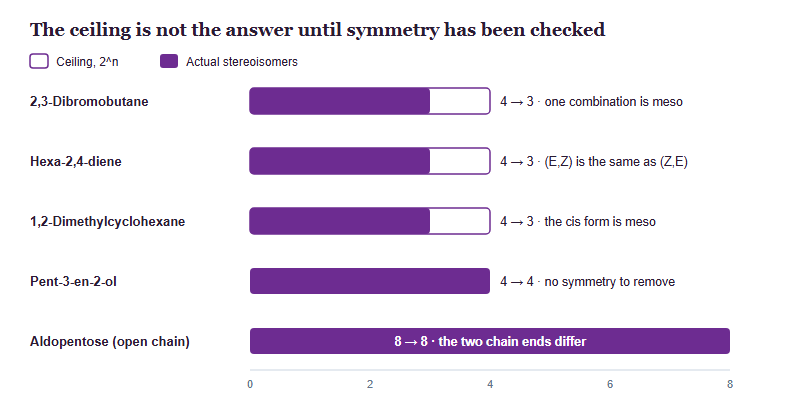
Pent-3-en-2-ol is a useful contrast because it mixes unit types: one stereocentre and one stereogenic double bond give four stereoisomers, two pairs of enantiomers, with no symmetry to remove. Mixed molecules are where students most often count only the stereocentres and forget the double bond.
Finish every count with the pair check, which catches both over- and under-counting: the total must equal twice the number of enantiomeric pairs plus the number of achiral stereoisomers. For 2,3-dibromobutane that is 2 × 1 + 1 = 3. If your list does not satisfy it, one of your “pairs” is really a meso form, or one of your meso forms is really chiral.
Metal complexes and tautomers: where 2n does not apply
Two families on olympiad-style papers need a different counting approach, and both are places where a formula applied by reflex gives the wrong answer.
Metal complexes are counted by arrangement. Fix one ligand, place the others by whether they are cis or trans to it, and then test every arrangement for a non-superimposable mirror image. The results depend on geometry as much as on the ligands:
- Square planar [MA2B2]: two isomers, cis and trans. A tetrahedral complex with the same formula has only one.
- Octahedral [MA4B2]: two, cis and trans. Octahedral [MA3B3]: two, fac and mer.
- Octahedral [M(AA)3] with three bidentate ligands: two, a pair of enantiomers.
- Octahedral [M(AA)2B2]: three — an achiral trans form and a chiral cis form that exists as a pair.
- Octahedral [MA2B2C2]: five geometric arrangements, of which only the all-cis one is chiral, giving six stereoisomers in total.
Tautomers are counted by position. For keto–enol tautomerism, list every carbon next to the carbonyl that carries a hydrogen; each can become an enol. Propanone has one such enol. Butanone has two: but-1-en-2-ol, and but-2-en-2-ol, which itself exists as E and Z forms. When a question does not state how many tautomers it wants, write all of them, state the total, and add one sentence explaining why there are no more — for butanone, that only the two carbons adjacent to the carbonyl carry hydrogens that can move. That sentence is exactly the consideration of further alternatives the 2026 examiners asked for.
A two-week counting drill. In week one, run constitutional enumerations of formulas with four to seven carbons, naming every structure and checking every formula. In week two, count stereoisomers for molecules mixing stereocentres, double bonds, rings and symmetry, then complexes and tautomers, closing each with the pair check. Then return to real papers: work the stereochemistry and isomer parts in the pack of past papers we have gathered ourselves, which has worked solutions for some years and not for every year. Where no solution exists, the pair check and the formula check let you verify your own count. Our guide to using UKChO past papers as a diagnostic shows how to log which step failed, and if the competition is new to you, start with what the UK Chemistry Olympiad is.
Frequently asked questions
How many stereoisomers can a molecule with n stereocentres have?
At most 2 to the power n. Symmetry can lower the number: a meso form, for example, is counted once rather than as a pair.
Do conformers count as isomers in a UKChO question?
Normally no. Rotation about single bonds interconverts them rapidly, so count configurations rather than conformations.
What should I write when a question does not say how many structures?
Draw every valid structure, state the total, and add one sentence explaining why no further structures exist.
How can 1,4-dimethylcyclohexane have two isomers but no stereocentre?
Its methyl groups can sit on the same or opposite faces of the ring. Those cis and trans forms are diastereomers, and both are achiral.
This is an independent guide operated by Hanlin Education for China-based international-school students. It is not affiliated with, endorsed by, or sponsored by the Royal Society of Chemistry (RSC). Examiners’ comments are paraphrased from the RSC’s published report; dates, eligibility, paper format and award boundaries are set by the organisers and change from year to year — confirm current details on rsc.org. Factual errors are corrected within 7 working days of being reported.