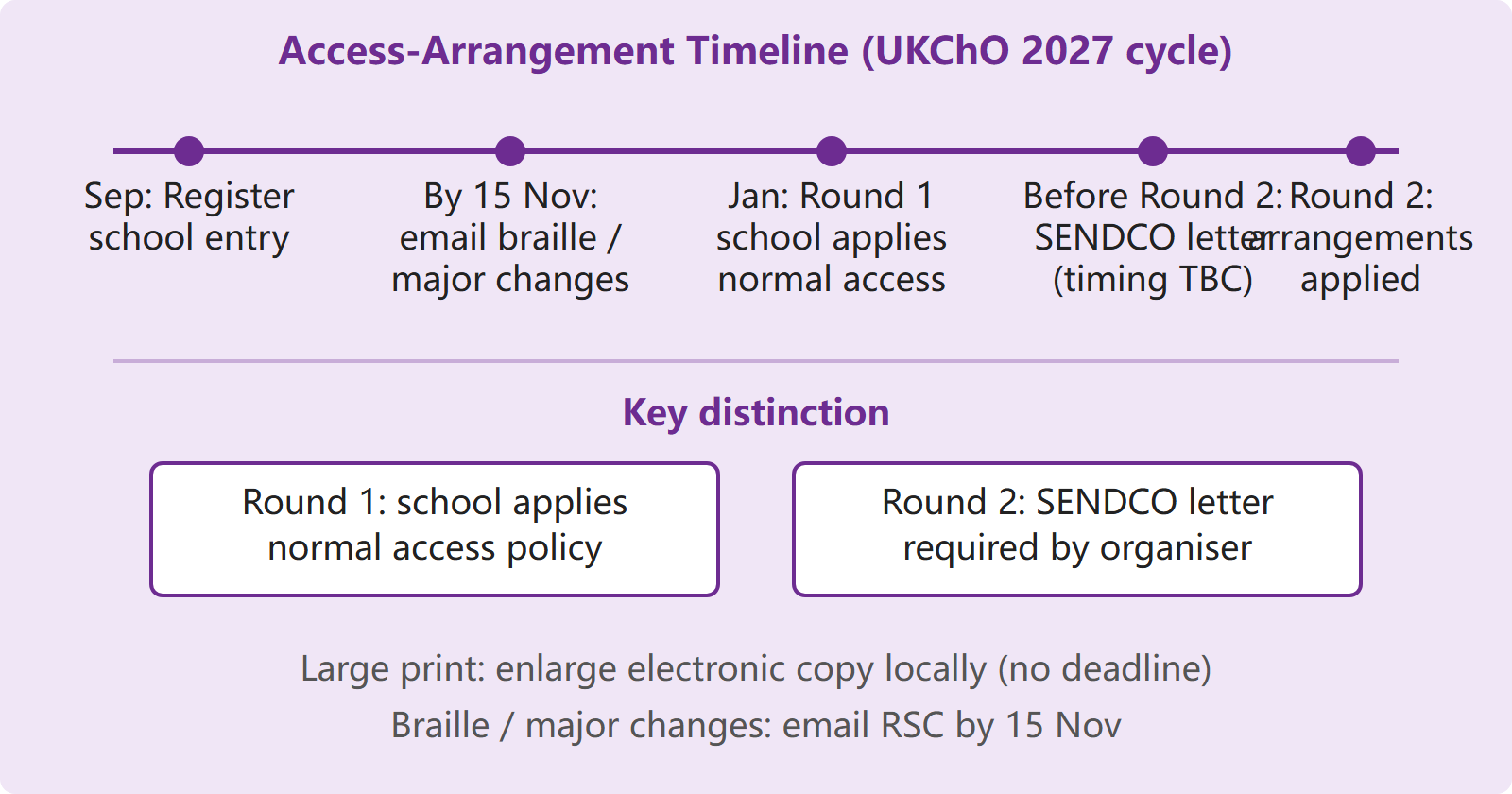
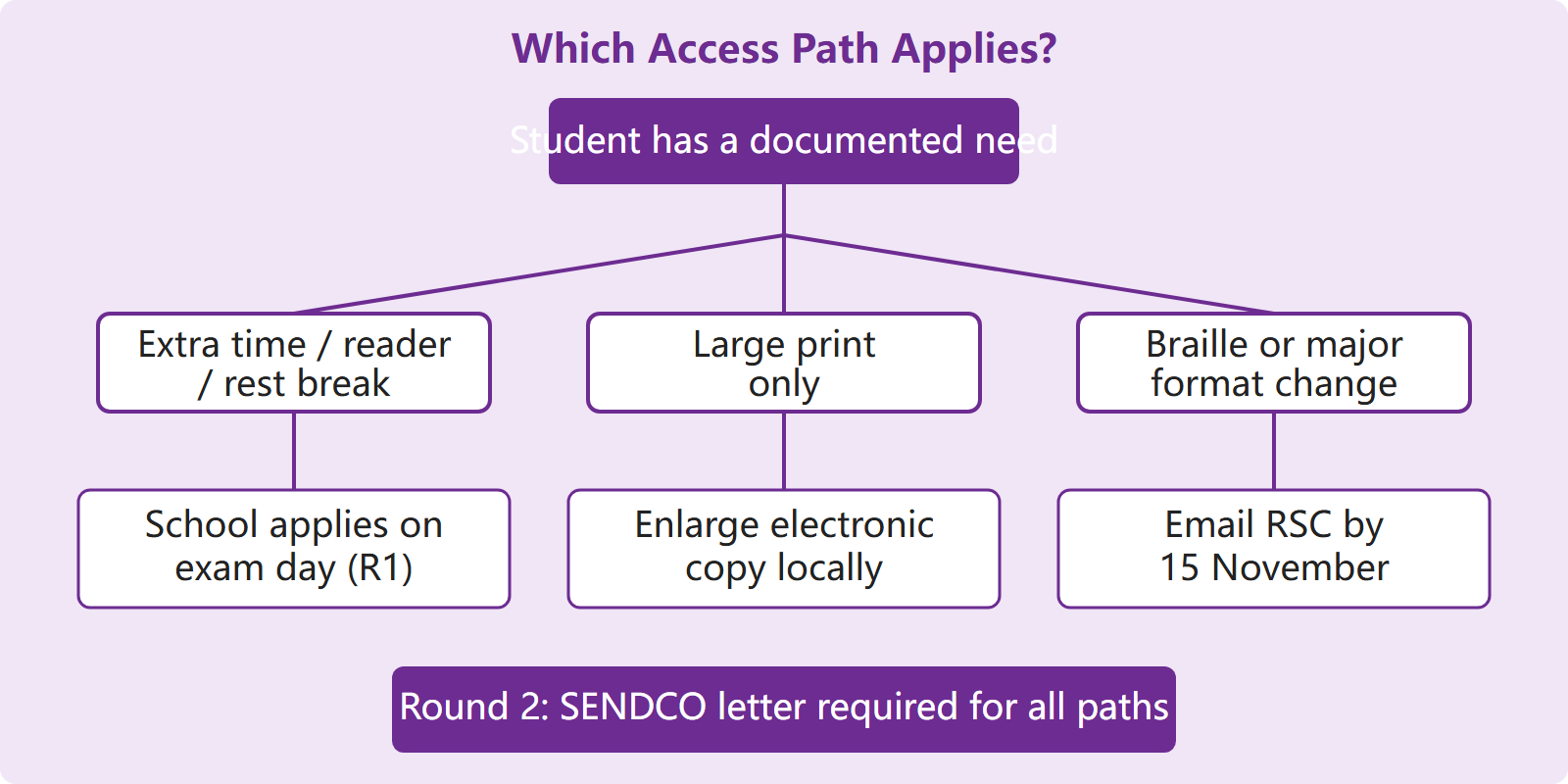
UKChO allows extra time in Round 1 whenever a student normally receives it for external examinations, and the school simply applies its standard access policy. Braille papers or significant accessibility modifications must be requested by email by 15 November. Round 2 adds a further layer: the organiser requires a SENDCO-agreed letter documenting the arrangement before it can be applied. This article traces the full path so nothing is missed between registration and the final assessment.
Why Access Arrangements Need a Separate Conversation
The UK Chemistry Olympiad is sat under conventional examination conditions with a responsible invigilator present. The Royal Society of Chemistry sets its own access policy for the competition, and the responsibility for activating arrangements falls on the school and, where relevant, the SENDCO, at specific points in the competition calendar. Teachers should confirm with the organiser how access arrangements are implemented for UKChO specifically, rather than assuming another examination body’s procedures apply automatically.
A student who assumes an existing access arrangement will carry over without any action risks sitting a two-hour paper under conditions that do not reflect their documented needs. Conversely, a teacher who waits until January to think about a braille paper will find the 15 November deadline has already passed. The rules are straightforward once mapped, but they are scattered across several FAQ entries on the RSC education page, which is why this guide consolidates them into a single sequence.
Round 1: The School Applies Its Normal Practice
The official position is concise. The Round One paper lasts two hours, and students who usually receive additional time for external exams may also use that additional time for the Round One paper. Beyond extra time, the RSC asks schools to apply the same exam access requirements for an individual student as they would for other exams taken in school. In practice this means:
- If a student has 25 percent extra time recorded for A-level chemistry, they receive 25 percent extra time for the two-hour UKChO paper, giving them an illustrative total of 150 minutes.
- If a student normally uses a reader, a scribe, a coloured overlay, or a rest break, the school provides the equivalent support on exam day.
- The RSC guidance does not describe a separate application step for these standard arrangements; the teacher should confirm implementation with the school’s existing exam-access policy.
The exam must still be taken in one sitting at school under supervision. The additional time does not change the invigilation requirement or the rule that the paper is sat on the designated date at a time of day the school schedules. Our earlier breakdown of how Round 1 is sat, marked and moderated covers the broader logistics; the access point to remember is that the school, not the RSC, is the operational decision-maker at this stage.
Accessible Formats: Braille, Large Print and the 15 November Deadline
Not every access need can be met by adjusting time or seating. Some students require the paper itself in a different format. The RSC distinguishes three situations:
| Format needed | Who acts | Deadline / method |
|---|---|---|
| Braille paper | School emails the RSC organiser | By 15 November before the January sitting |
| Significant accessibility changes (e.g. modified layout, specialist software file) | School emails the RSC organiser | By 15 November before the January sitting |
| Large print | School enlarges the electronic copy it receives | No separate request needed; handled locally on exam day |
The 15 November date is stated in the RSC guidance. Schools needing braille or significant accessibility changes should email the organiser by that date. The guidance does not specify what happens with late requests; teachers in this situation should contact the organiser directly to discuss options. Large print, by contrast, is a local task: the electronic copy the teacher receives can be printed at a larger font size without any external request.
Teachers coordinating entry for the first time may find it useful to review what to confirm before a school’s first UKChO entry, which includes the registration mechanics that precede any access conversation.
Round 2: The SENDCO Evidence Rule
Progression to Round 2 changes the administrative picture entirely. Round 2 is organised centrally by the RSC rather than invigilated in individual schools, so the organiser cannot simply rely on a teacher’s local knowledge of a student’s needs. The official rule states that the organiser will request a copy of the student’s exam access arrangements in a letter as agreed by the school SENDCO, and that required arrangements will then be applied during the Round 2 assessments.
This has three practical consequences:
- Documented evidence is mandatory. A verbal assurance from the chemistry teacher is insufficient. The SENDCO must confirm the arrangement in writing.
- The letter must be agreed before Round 2. The organiser initiates the request, and the school should respond in a timely manner. Teachers should confirm with the organiser what documentation is needed and by when, as Round 2 details are yet to be confirmed for the current cycle.
- The arrangement is applied, not merely noted. Once the letter is received, the organiser implements the access provision during the assessment itself.
Round 2 details for the 2027 cycle are listed as “to be confirmed” on the RSC page at the time of writing. Our guide to the Round 2 weekend, the practical exam and the road to IChO describes the typical structure from earlier cycles; whichever components the organiser ultimately confirms, the access principle remains that arrangements must cover every element of the assessment, not only the written paper.
China-Route Students: The ASEEDER Channel
International schools in China and other listed countries register for UKChO Round 1 through ASEEDER China rather than directly with the RSC. The official guidance is explicit: all schools and students who have registered through ASEEDER must direct any questions, enquiries or concerns to ASEEDER. The RSC states it is not responsible for handling such enquiries and will be unable to respond to or investigate matters arising from that participation.
For a student with an access arrangement, the operational channel runs through ASEEDER rather than the RSC directly. Students and teachers should confirm with ASEEDER what local procedures, deadlines, and documentation requirements apply to access arrangements for China-sitting entries. The RSC’s general access policy describes the principles for UK and Ireland schools, but the specific implementation timeline and format-request process for ASEEDER-registered schools may differ. Do not assume the RSC’s 15 November email deadline or Round 2 SENDCO-letter process applies unchanged to the China route; confirm directly with ASEEDER. Our side-by-side comparison of the RSC dates and the China-sitting dates highlights other calendar differences that compound this point.
Decision Checklist: Student, Teacher and SENDCO
The following checklist consolidates the actions by role. It is designed to be printed or saved before the registration window opens in September.
| Role | Action | When |
|---|---|---|
| Student | Confirm with school whether an access arrangement is already on file for external exams | Suggested: before September registration |
| Student | If braille or major format change is needed, tell the teacher immediately so the 15 Nov email can be sent | Suggested: by early October |
| Teacher / exam officer | Apply the student’s normal access arrangement on Round 1 day (extra time, reader, rest break, etc.) | January exam day |
| Teacher | For large print, enlarge the electronic copy before printing; no external request needed | January exam day |
| Teacher | Email the RSC organiser for braille or significant accessibility changes | By 15 November |
| SENDCO | If the student progresses to Round 2, prepare and agree the access-arrangement letter requested by the organiser | As requested by organiser (Round 2 details TBC) |
| ASEEDER-registered school | Direct all access queries to ASEEDER, not the RSC | Suggested: before and during registration |
The critical principle: assumptions should stop where documentation begins. If a student’s arrangement is not written into the school’s exam-access register, it does not automatically transfer to UKChO. If the SENDCO letter is not returned, Round 2 provisions cannot be confirmed. The rules are permissive—UKChO does accommodate access needs—but they require the school to act, not the student to hope.
Frequently Asked Questions
Does a student need to apply separately to the RSC for extra time in Round 1?
No. The RSC asks schools to apply the same exam access requirements they would for any other school exam. If the student normally receives additional time for external exams, the school grants it on UKChO day without any separate RSC application.
What is the deadline for requesting a braille paper or significant accessibility changes?
The school must inform the RSC organiser by email by 15 November before the January Round 1 sitting. Large print does not require this step because the school can enlarge the electronic copy it receives.
What evidence does Round 2 require that Round 1 does not?
For Round 2 the organiser requests a copy of the student’s exam access arrangements in a letter agreed by the school SENDCO, and the required arrangements will then be applied during the Round 2 assessments. For Round 1, the RSC asks schools to apply the same access requirements as for other school exams; the teacher should confirm locally what documentation, if any, the school needs on file.
This article is published by an independent educational site and is not affiliated with, endorsed by, or acting on behalf of the Royal Society of Chemistry. All procedural statements are drawn from the RSC’s publicly available UK Chemistry Olympiad page (edu.rsc.org) as checked on 23 September 2026. Schools should verify current-year details directly with the organiser, particularly Round 2 dates and SENDCO-letter timing, which are listed as “to be confirmed” at the time of writing.