UKChO Round 1 is a two-hour paper, taken in one sitting at your own school under normal exam conditions, with a member of staff invigilating. Your own teacher marks it and submits the score, and the RSC then calls in the highest-scoring scripts for moderation. Understanding that chain changes how you should write answers — and the mark arithmetic changes how you should spend the 120 minutes.
The rules of the room
Round 1 is not a centralised exam sat in a test centre. Per RSC guidance, the two-hour paper must be completed in a single sitting, under conventional examination conditions, with a responsible invigilator present — and that invigilator can be a class teacher or another member of staff. Schools have flexibility over when in the day they run it. The 2026 paper was sat on Wednesday 28 January.
| Rule | What the RSC states | What it means for you |
|---|---|---|
| Duration | Two hours, taken in one sitting | No splitting across lessons. Build your stamina on full two-hour runs, not 30-minute question sets |
| Venue | Sat in school, in person; online schools cannot take part | Your school must physically host and invigilate it — there is no individual remote option |
| Invigilation | A responsible invigilator, which may be a class teacher | Conditions are real exam conditions even though the room feels familiar |
| Who enters you | Schools and colleges register; student names are not needed at registration | You cannot enter yourself. Tell your teacher early — the RSC does not accept late registrations |
| Age | Aimed at students aged 16–19; the RSC recommends entrants be at least 16 | A confident Year 12 student is squarely in scope; GCSE-level students will likely find it too advanced |
| Access arrangements | At Round 1, the same arrangements a student already receives in school exams | Raise this with your exams officer well before January, not on the day |
One planning consequence deserves emphasis. Because entry is a school action with a hard cut-off — the 2026 window ran from 17 September 2025 to 14 January 2026 — the most common way to miss the UKChO has nothing to do with chemistry. It is nobody at your school registering in time. Our registration overview sets out what a school has to do and when; confirm the current window on rsc.org and put it in front of your teacher in September.
Who actually marks your paper
This is the part most students never learn, and it has direct consequences for how you write. Teachers mark their own students’ scripts in school and submit the scores to the RSC. The RSC then requests physical copies of the highest-scoring papers for moderation and spot-checking, and the Olympiad Working Group moderates the top scripts before Round 2 invitations are issued.
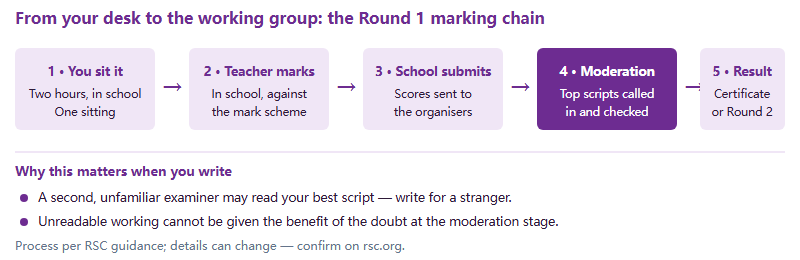
Three practical rules follow from that chain:
- Write for a stranger, not for your teacher. If you score highly, someone who has never seen your handwriting or your classroom shorthand may re-read your script. Notation that only your own teacher would decode is a liability precisely when you are doing well.
- Show the working, not just the answer. A bare number that is wrong earns nothing. A visible method with one arithmetic slip is a very different script to read.
- Do not rely on generosity. A familiar marker may be inclined to interpret a half-finished line kindly. A moderator checking consistency across schools has no reason to.
The arithmetic nobody does: what each award costs in minutes
Students routinely walk into Round 1 believing they need to answer most of the paper. They do not. The 2026 paper carried 84 marks across 120 minutes — about 1.4 minutes per mark. Set the published 2026 boundaries against that rate and the picture is startling:
| 2026 award | Marks needed (of 84) | Share of the paper | Roughly equivalent to |
|---|---|---|---|
| Bronze | 13 | about 15% | around 19 minutes of fully productive work |
| Silver | 23 | about 27% | around 33 minutes |
| Gold | 38 | about 45% | around 54 minutes |
The minute figures are our own arithmetic on RSC-published totals, and real papers never divide that cleanly — but the strategic point stands. In 2026 you could have left more than half the paper untouched and still taken Gold. The RSC is explicit that Round 1 questions are designed to be hard, and it reports that roughly two-thirds of participants earn a bronze, silver or gold certificate. Both facts point the same way: this is a paper you are meant to score partially.
Note too that the totals move. The 2024 paper was marked out of 82 with a bronze threshold of 10; the 2026 paper was out of 84 with bronze at 13. Never memorise a target score from a previous year as though it were fixed — we unpack the year-on-year movement in our 2026 Round 1 results analysis, and the score boundaries page tracks the published figures as they change.
A three-pass plan for the 120 minutes
The single most expensive mistake in Round 1 is linear behaviour: starting at question 1 and grinding forward until time runs out. Olympiad papers are not ordered by difficulty in the way school papers are, and a hard early part can swallow twenty minutes that were worth far more elsewhere. Work in passes instead.
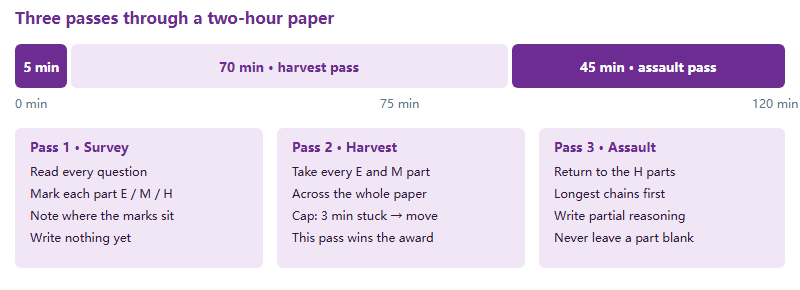
The five-minute survey feels like wasted time and is not. You cannot triage a paper you have not read, and the first three-mark part you skip because something later is worth more is the cheapest decision you will make all morning. During the harvest pass, enforce a hard rule: three minutes stuck on a part means you move on and come back. Emotional investment in one hard question is what turns a Silver script into a Bronze one.
How to answer a long multi-part context question
UKChO questions are built around real-world chemistry contexts, which means a single question can run for a page and a half before you write anything. Chinese international-school students often lose marks here for reasons that are linguistic and structural rather than chemical. Five habits protect you:
- Read the last part first. The final part usually reveals where the question is going, which tells you what to extract from the stem as you read it.
- Carry answers forward. If part (a) defeats you, invent a sensible placeholder value, state clearly that you are using it, and continue. Later parts usually depend on the method, not on your earlier number.
- Never leave a part blank. One line of correct reasoning — the relationship you would use, the species that must be limiting — is worth more than white space, and costs thirty seconds.
- State assumptions explicitly. Writing that you assume ideal gas behaviour or complete reaction shows the examiner your model rather than leaving them to guess it.
- Label everything with units. In a long chain, units are the only external check you have that you have not slipped between moles and concentration.
What to practise between now and January
The RSC’s own advice to teachers is unusually clear on this point: strengthening problem-solving is the most valuable thing to work on, more so than covering additional content. Its suggested routes include working through past papers alongside their mark schemes, running the competition through a STEM club, using olympiad questions as curriculum extension tasks, and using Cambridge Chemistry Challenge practice papers as a confidence-building step before the full UKChO paper.
Two additions from our own coaching experience. First, at least two of your practice runs before January should be genuine full two-hour sittings, timed, without notes and without pausing — because stamina and triage are what actually break down on the day, and neither shows up in 40-minute question sets. Second, mark your own script against the scheme afterwards and count how many marks you lost to method versus how many you lost to arithmetic and presentation. Most students discover the second number is larger than they expect, which is good news, because it is the faster one to fix.
For a structured way to run that practice loop, see our guide to using past papers properly; if you are still deciding whether the competition suits you, our introduction to the UKChO covers the structure end to end.
Frequently asked questions
Who marks the UKChO Round 1 paper?
Teachers mark their own students’ scripts in school and submit the scores; the RSC then calls in the highest-scoring papers for moderation.
How long is UKChO Round 1?
Two hours, taken in one sitting at your school under normal exam conditions, with a member of staff invigilating.
Do I need to answer the whole paper?
No. In 2026 Gold began at 38 marks out of 84, so under half the paper answered well was enough for the top award.
Can I enter the UKChO myself?
No. Schools and colleges register, and late registrations are not accepted, so speak to your chemistry teacher early in the autumn term.
This is an independent guide operated by Hanlin Education for China-based international-school students. It is not affiliated with, endorsed by, or sponsored by the Royal Society of Chemistry (RSC). Exam dates, entry windows, mark totals and boundaries change from year to year — always confirm current details on rsc.org. If you spot an error, we correct it within 7 working days.