With the 2027 season approaching, many students face a critical bottleneck: which UKChO past papers should they actually solve? The Royal Society of Chemistry (RSC) competition has a rich history spanning over 50 years, but not every archive is equally useful for short-term preparation. If you have ten weeks or fewer, your strategy must shift from volume to precision.
The modern UKChO Round 1 exam typically consists of 5–6 analytical questions totaling around 84 marks (based on the 2026 structure). This format demands deep application of chemistry to unfamiliar scenarios, rather than rote memorization. Therefore, older papers may lack the contextual complexity found in recent iterations. Here is how to prioritize your resources effectively.
Prioritizing Recent Archives
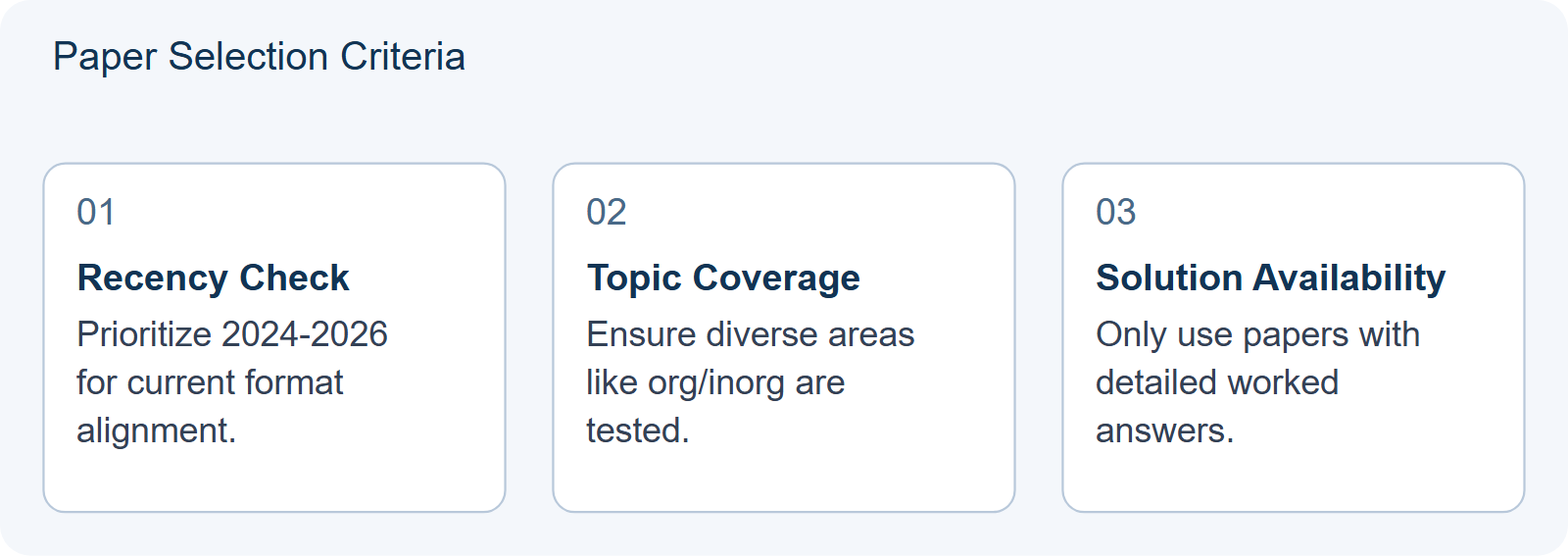
For students preparing for the 2027 exam, the 2024, 2025, and 2026 UKChO past papers are the highest-value resources. These sets reflect the current emphasis on real-world industrial and research contexts. The 2026 paper, in particular, serves as the primary diagnostic tool because it represents the most recent benchmark of difficulty and topic distribution.
| Priority Level | Years | Why Focus Here? |
|---|---|---|
| High | 2024–2026 | Matches current 84-mark structure and modern question styles. |
| Medium | 2020–2023 | Good for breadth, but check if mark schemes align with current expectations. |
| Low | Pre-2020 | Useful for specific topic drills, but less representative of overall exam flow. |
Do not assume a drastic structural break occurred in 2020. Sources indicate the competition has maintained its core philosophy of testing transferable skills for decades. However, the specific weighting of topics like electrochemistry or organic synthesis can vary. Using the most recent three years ensures you are calibrated against the current standard.
Strategic Study Plan for Ten Weeks
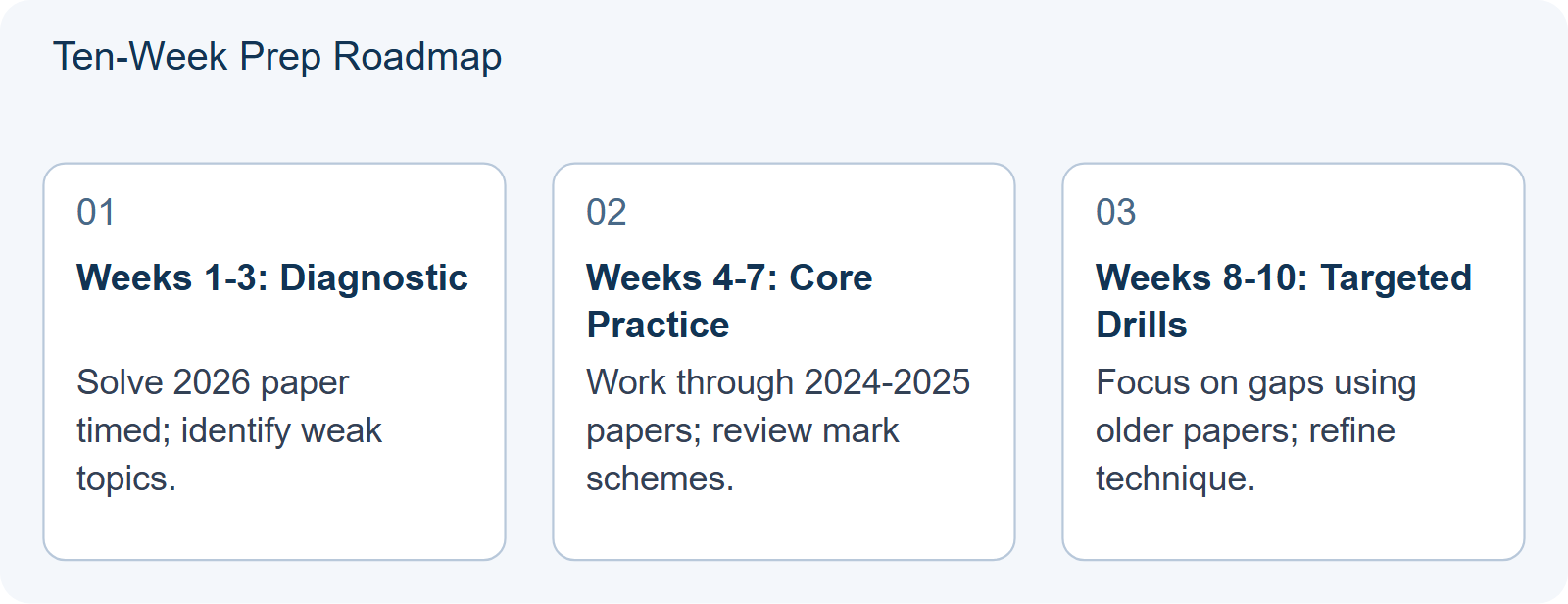
When time is limited, passive reading is ineffective. You need active problem-solving. Start by attempting the 2026 paper under timed conditions. This reveals immediate gaps in your ability to interpret unfamiliar data. After grading yourself, analyze where you lost marks. Was it calculation errors, missing units, or fundamental conceptual misunderstandings?
Next, rotate through the 2025 and 2024 papers. Do not just solve them; compare your answers to the official mark schemes. Pay attention to how partial credit is awarded. In UKChO, showing your working is often as important as the final answer. This approach helps you understand what examiners look for in ambiguous situations.
Finally, use older papers selectively. If you struggle with a specific topic, such as thermodynamics or kinetics, find relevant questions from earlier years to drill that concept. This targeted practice fills knowledge gaps without overwhelming you with irrelevant material.
Common Pitfalls to Avoid
One major mistake is ignoring the eligibility nuances. While Round 1 is open to students globally through their schools, Round 2 participation depends on specific routes, including British nationality or ASEEDER status. Ensure you understand your school’s registration process early. Another pitfall is relying solely on textbooks. UKChO questions often involve molecules or reactions you have never seen before. Practicing with UKChO past papers builds the resilience needed to tackle these unknowns.
Remember, the goal is not just to get the right answer, but to demonstrate chemical reasoning. Use the worked solutions provided in reputable packs to learn how to structure your responses clearly. This skill is crucial for maximizing scores in the remaining weeks.
Illustrative Decision: The “Thermodynamics Trap” in Week 3
To demonstrate how to apply the prioritization strategy, consider a hypothetical student named Alex. Alex has eight weeks remaining before the UKChO Round 1 exam and follows the advice to start with the most recent papers. After completing the 2026 paper under timed conditions, Alex scores poorly on Question 4, which involves calculating Gibbs free energy changes for an unfamiliar industrial process. Alex loses marks not because of arithmetic errors, but due to a fundamental misunderstanding of how entropy terms interact with temperature variables in non-standard conditions.
Alex now faces a critical decision regarding resource allocation for the next two weeks. Two plausible paths emerge. Option A is to immediately attempt the 2025 paper, hoping that exposure to more questions will naturally reinforce the concept through repetition. Option B is to pause full-paper attempts and drill specific thermodynamic questions from the pre-2020 archives, where the questions are often more direct and less cluttered with complex contextual data.
The article’s guidance suggests that while recent papers (2024–2026) are high-priority for overall structure, older papers (pre-2020) are valuable for targeted topic drills. In this scenario, Option A risks compounding the error. If Alex lacks the foundational understanding of the variable relationships, solving another complex, context-heavy question from 2025 may lead to frustration rather than learning. The cognitive load required to decode the new scenario distracts from mastering the underlying principle. Conversely, Option B allows Alex to isolate the skill. By selecting three or four straightforward thermodynamics problems from earlier years, Alex can focus exclusively on the mathematical and conceptual mechanics without the pressure of interpreting novel industrial narratives.
What changes the decision here is the nature of the gap identified during the diagnostic phase. If the loss had been due to simple calculation slips or time management issues, Option A would be superior because it maintains exam simulation fidelity. However, since the gap was conceptual, precision practice outweighs volume. Alex chooses Option B, spending five days working through isolated thermodynamic problems until the logic becomes automatic. Only after achieving consistency does Alex return to the 2025 paper to test if the improved foundation translates to better performance in a complex setting.
| Factor | Choose Recent Papers (Option A) | Choose Older Drills (Option B) |
|---|---|---|
| Error Type | Time pressure, careless mistakes, formatting. | Conceptual gaps, formula misapplication. |
| Goal | Simulate exam flow and stamina. | Isolate and repair specific knowledge deficits. |
| Risk | Reinforcing bad habits if basics are weak. | Losing touch with current question styles. |
This illustrative example highlights that “prioritizing recent papers” is not a rigid rule against using older materials. Instead, it establishes a baseline for calibration. When diagnostics reveal deep conceptual fractures, the strategy must pivot to surgical intervention using the broader archive. This approach ensures that preparation time is spent fixing root causes rather than merely practicing symptoms.
When prioritising past papers under tight deadlines, focus on high-yield topics like bonding questions and electrochemistry. These areas often appear frequently. Additionally, review examiners’ reports to understand common mark losses. This targeted approach ensures efficient preparation by addressing specific conceptual gaps rather than attempting comprehensive coverage of every year’s paper within the limited timeframe available.
Frequently Asked Questions
Did the UKChO syllabus change significantly in 2020?
No evidence supports a specific structural break in 2020. The competition has consistently tested applied chemistry for over 50 years. Focus on recent papers for current style, but older ones remain valid for topic practice.
Can I use the 2026 paper for 2027 preparation?
Yes, the 2026 paper is the most recent available resource. It reflects the current 84-mark structure and question types, making it ideal for diagnosing readiness for the 2027 season.
Are Chinese nationals excluded from UKChO?
No. Students worldwide can participate in Round 1 through their schools. Round 2 eligibility involves specific criteria related to UK residency or ASEEDER status, but Round 1 awards are accessible to international students.