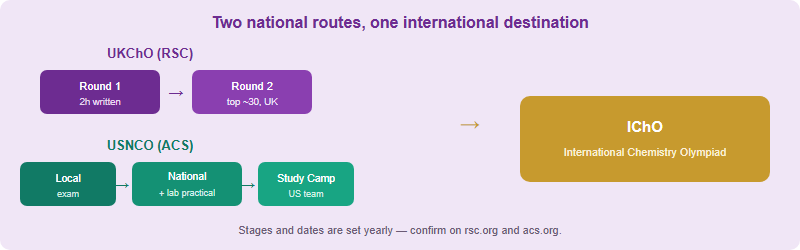
The UK Chemistry Olympiad (UKChO) and the US National Chemistry Olympiad (USNCO) are the two most-searched national chemistry olympiads in English — and for a China-based student weighing them, they differ in three ways that matter: structure, eligibility, and what you can actually do with each. UKChO is a single two-hour written paper run by the Royal Society of Chemistry (RSC); USNCO is a multi-stage American competition run by the American Chemical Society (ACS). The good news is that their chemistry overlaps so heavily that one serious block of preparation can serve both — even where you cannot sit one of them directly.
Side by side
| UKChO (UK) | USNCO (US) | |
|---|---|---|
| Organiser | Royal Society of Chemistry (RSC) | American Chemical Society (ACS) |
| First stage | Round 1: one 2-hour written paper, out of 84, sat in school (~January) | Local Exam, run through an ACS Local Section (~March) |
| Later stages | Round 2 (top ~30) at a UK university → UK IChO team | National Exam (multiple-choice + free-response + a lab practical) → Study Camp → US IChO team |
| A practical/lab element? | Round 2 adds practical work; Round 1 is written | Yes — the National Exam includes a lab practical |
| Feeds into | International Chemistry Olympiad (IChO) | International Chemistry Olympiad (IChO) |
| Entry route | Through a participating school; eligibility set by the RSC | US high-school students, via an ACS Local Section |
Treat every stage date and format detail as “confirm on the official site” — rsc.org for UKChO, acs.org for USNCO — because both are set year by year.
The eligibility answers are different — and honest about it
This is where China-based students most need a straight answer, and the two competitions do not give the same one:
- USNCO is for US high-school students. Entry is through an ACS Local Section, and a student in China cannot simply sign up to sit it. Its enormous public bank of past papers, however, is one of the best chemistry-prep resources anywhere — which is exactly how most international students use it.
- UKChO is entered through a school, and eligibility is set by the RSC. Whether a China-based student can sit it depends on their route, so it is a “confirm with the RSC and your school” question — not an automatic yes, and not an automatic no.
The honest takeaway: do not assume you can enter either from China without checking, and do not let the entry question stop you from using both. For the USNCO side of that picture, our sister guide covers the US National Chemistry Olympiad and how China-based students use its papers.
Why one preparation block serves both
Despite the structural differences, the underlying chemistry is largely the same: energetics, kinetics, equilibrium, bonding, periodicity, organic mechanisms, and multi-step quantitative reasoning at roughly the level of A-Level / AP plus early university. That overlap is the strategic point. A student who drills UKChO papers is, in most respects, also preparing for the USNCO written stages — and vice versa. The differences to plan around are format-specific, not content-specific:
- If you focus on UKChO, practise sustained, open-ended written problems in real-world contexts, and build two-hour stamina.
- If you add USNCO papers, get comfortable with a fast multiple-choice section and, for its national level, be aware it includes a lab practical you would only meet if eligible to progress.
Either way, keep an idea-log across both paper sets; a gap that shows up on a UKChO equilibrium question is the same gap that will cost you on a USNCO one. Our method for that is in using UKChO past papers without memorising answers, and the UKChO overview sets out the rest.

Which should a China-based student focus on?
There is no single right answer, but a useful default: lead with the one you can actually sit (confirm each with the RSC / ACS and your school), and use the other's past papers as extra preparation. If neither direct entry is available, treat both as what they undeniably are — two of the best free chemistry-stretching resources in the world — and let their overlap do double duty. The competition you can enter is a bonus; the chemistry you build is the real prize.
Frequently asked questions
What is the main difference between UKChO and USNCO?
UKChO (RSC, UK) is a single two-hour written Round 1 then a small residential Round 2. USNCO (ACS, US) is a multi-stage route — Local Exam, National Exam with a lab practical, then a Study Camp.
Can a student in China take the USNCO?
No — USNCO is for US high-school students entering via an ACS Local Section. China-based students use its public past papers to prepare rather than sitting it.
Can a student in China take the UKChO?
Eligibility is set by the RSC and depends on your route, so confirm with the RSC and your school. Do not assume yes or no.
Can I prepare for both at once?
Largely yes. The chemistry content overlaps heavily, so one strong preparation block — drilling both paper sets and logging your gaps — serves both.
This is an independent guide to the UK Chemistry Olympiad for China-based international-school students, operated by Hanlin Education. It is not affiliated with, endorsed by, or sponsored by the Royal Society of Chemistry (RSC) or the American Chemical Society (ACS), which run the UKChO and USNCO respectively and set all official rules, eligibility and dates — always confirm current details on rsc.org and acs.org. Confirmed errors are corrected within 7 working days.