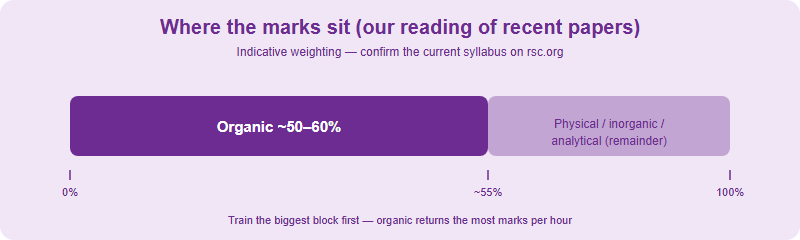
UKChO is won on organic chemistry. In recent papers, roughly 50–60% of the marks turn on organic reasoning — mechanisms, arrow-pushing and multi-step synthesis — far more than most school courses emphasise (this is our reading of recent papers; confirm the current syllabus on rsc.org). So if you train one thing well, train organic mechanism fluency. Here is a concrete method, anchored to how the paper actually rewards marks.
This is an independent guide by Hanlin Education; we are not affiliated with the RSC. If you have not met the contest yet, read what UKChO is first — this article assumes you know the basic shape and want to raise your organic score.
Why organic dominates UKChO
The 2026 Round 1 paper was marked out of 84 and sat on 28 January 2026 by a record 17,241 students. Across recent years, the largest single block of those marks — on our reading, about 50–60% — rests on organic chemistry. The remaining marks span physical, inorganic and analytical chemistry, but no other strand comes close to organic's share (we are not inventing a precise split for the rest; confirm the current weighting on rsc.org).
The important word is reasoning, not recall. UKChO rarely asks you to name a reaction you memorised; it hands you an unfamiliar molecule or sequence and asks you to work out how it must behave. That is why students with strong school grades but shallow mechanism understanding stall: they can recite reactions but cannot reconstruct them under pressure. The paper rewards the ability to reason from electron movement, and that is a trainable skill rather than a talent.
There is a structural reason this catches strong students out. Most school courses — A-level and IB alike — introduce organic chemistry as a catalogue: a list of reactions, reagents and conditions to remember, tested by questions that reward recall of the catalogue. UKChO treats the same chemistry as a system to reason about, and asks questions the catalogue does not contain. A China-based international-school student can therefore arrive with excellent grades and still find the organic sections alien, not because the chemistry is beyond them, but because nobody has yet asked them to build a mechanism rather than retrieve one. Closing that gap is the whole job.
The three organic skills the paper tests
“Get good at organic” is too vague to act on. Break it into the three concrete abilities UKChO actually probes, and train each deliberately.
| Skill | What it means | How UKChO tends to test it |
|---|---|---|
| Mechanism logic | Predicting how a reaction proceeds from electron behaviour | An unfamiliar substrate; explain or complete the mechanism |
| Arrow-pushing | Drawing curly arrows that show where electron pairs move | Marks awarded for correct arrows, not just the product |
| Synthesis logic | Chaining steps toward a target molecule | Multi-step problems; identify intermediates and reagents |
These three skills are not independent — they stack. Arrow-pushing is the notation that mechanism logic is written in, and synthesis logic is simply mechanism logic run several steps in a row toward a target. That is good news for your revision: every hour you spend making arrow-pushing automatic pays into the harder multi-step questions later, because you are no longer spending working memory on the notation. Train them in that order — logic first, then fluent arrows, then chains — and the multi-step problems that look intimidating in a past paper start to decompose into steps you already own.
A mechanism-training method that works
Reading organic chemistry does not build fluency; reconstructing it does. The loop below is designed to move you from “I recognise this” to “I can rebuild this from scratch under time.” Run it in short, frequent sessions rather than occasional marathons.
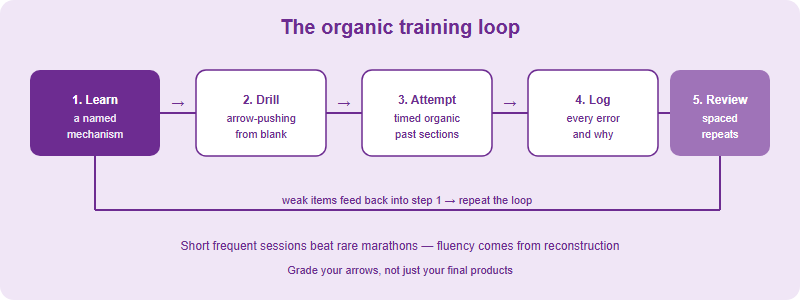
Two details make or break this loop. First, in step 2, draw mechanisms from a blank page, not by annotating a printed answer — if you can only follow along, you cannot yet do it. Second, in step 3, mark yourself on the arrows, not only the product. UKChO commonly awards credit for correct electron movement, so a right answer reached by a wrong mechanism is a fragile habit that will fail on an unfamiliar substrate. Pull your organic practice from timed past-paper sections so the difficulty and phrasing match the real thing.
Cadence matters as much as content. Three or four focused 30–40 minute sessions across a week will build more durable fluency than a single three-hour block on a Sunday, because mechanism memory consolidates between sessions, not within them. A practical weekly shape looks like this: one session to learn or relearn a mechanism family, two short drilling sessions where you reproduce those mechanisms cold, and one longer session on a timed past-paper organic section under exam conditions. Keep the error log open on every session so step 4 is never an afterthought — the log is what turns scattered practice into a curriculum.
It helps to be concrete about what “good” arrow-pushing looks like, because this is where marks are quietly won and lost. A curly arrow should start from an actual source of electrons — a lone pair or a bond — and end exactly where the new bond or lone pair forms; a double-headed arrow moves an electron pair, a single-headed arrow moves one electron. Vague arrows that begin near an atom rather than from its electrons, or that point at the middle of nowhere, read as guesswork even when the product is right. Training yourself to draw arrows that a marker could follow without your explanation is, in practice, the same thing as training yourself to understand the mechanism.
Common organic mistakes that cost UKChO marks
Most lost organic marks are not caused by not knowing the chemistry — they are caused by a handful of repeatable habits. Recognising them in your own work is half the fix, which is why the error log matters so much: it makes your personal pattern of mistakes visible. Watch for these five in particular.
- Product-first thinking. Writing the product and back-filling arrows to justify it — graders can tell, and unfamiliar substrates expose it.
- Sloppy curly arrows. Arrows that start from the wrong place or point to the wrong atom lose the marks even when the product is right.
- Ignoring conditions. Skipping over reagents, solvent or temperature cues that the question deliberately provides to steer the mechanism.
- Memorising instead of understanding. Relying on named reactions rather than electron logic, then freezing when the molecule is one you have not seen.
- No error log. Repeating the same mistake because you never wrote down why it happened.
Turning organic practice into a Gold-level score
Here is the reassuring part: you do not need to be perfect. In 2026 the Gold boundary was 38 out of 84 — under half marks (see the full 2026 boundaries). Because organic is the largest block, becoming reliable — not flawless — on organic reasoning moves your score more than any other single investment. Aim for consistency: secure the organic marks you can reason out, then bank whatever physical and inorganic marks come easily.
A sensible way to read your own progress is to score past-paper organic sections separately and track that number over time. When your organic sub-score alone is comfortably clearing the equivalent of the award band you want, the rest of the paper tends to carry you the rest of the way. Whoever you train with, keep the method the same: reconstruct, grade the arrows, log the errors, review. Fluency, not memorisation, is what the paper pays out for.
One final calibration point for anyone benchmarking against 2026. The Gold line of 38 out of 84 came from a record field of 17,241 students across 1,153 schools, so it reflects a large, realistic sample rather than a soft year. Boundaries are re-set every sitting and will differ in future, but the shape of the advice does not change: the organic block is where the marks concentrate, reconstruction is the skill it rewards, and consistency beats brilliance. Build the habit now and the score is a by-product — not a gamble on exam-day inspiration.
Frequently asked questions
How much of UKChO is organic chemistry?
On our reading of recent papers, roughly 50–60% of the marks turn on organic reasoning. Confirm the current syllabus weighting on rsc.org.
Do I get marks for the mechanism or just the product?
UKChO commonly credits correct arrow-pushing, not only the final product. Practise drawing mechanisms from blank and grade the arrows.
What mark do I need for Gold?
In 2026 the Gold boundary was 38 out of 84 — under half marks. Boundaries are re-set each year, so treat it as a guide.
Where should I get organic practice questions?
Work timed organic sections from gathered past-paper material so the difficulty and phrasing match the real paper; keep an error log.
This is an independent guide operated by Hanlin Education for China-based international-school students. It is NOT affiliated with, endorsed by, or sponsored by the Royal Society of Chemistry (RSC). The organic-weighting figure is our reading of recent papers — please confirm current syllabus and format details on rsc.org. Any error will be corrected within 7 working days.