The UK runs two well-known school chemistry competitions, and students routinely confuse them. The UK Chemistry Olympiad is run by the Royal Society of Chemistry and sat in January. The Cambridge Chemistry Challenge is run from the University of Cambridge and sat in June. They are different papers with different award systems — and, because of when they fall, they form a natural annual cycle.
Two competitions, two organisers, no relationship between them
The first thing to get straight is that these are entirely separate events. The UK Chemistry Olympiad (UKChO) is organised by the Royal Society of Chemistry, supported by a volunteer Olympiad Working Group, and its Round 1 leads through a selection round to the International Chemistry Olympiad. The Cambridge Chemistry Challenge, usually written C3L6, is set by the University of Cambridge, and its top award leads to a residential camp in Cambridge rather than to an international team.
Neither is a qualifying round for the other. Neither counts towards the other. A school can enter both, one, or neither. And this guide is independent of both: we are not affiliated with the Royal Society of Chemistry, nor with the University of Cambridge or the Challenge, and every date, fee and boundary below should be confirmed with the relevant organiser before you act on it. If UKChO itself is new to you, our overview of the competition is the place to start.
Side by side
| UK Chemistry Olympiad (UKChO) | Cambridge Chemistry Challenge (C3L6) | |
|---|---|---|
| Organiser | Royal Society of Chemistry | University of Cambridge, per c3l6.com |
| Who it is aimed at | The RSC states the questions are aimed at students in their last year of study before higher education and recommends entrants be at least 16; Year 12 students may take part | Lower Sixth students and below, per c3l6.com |
| When | Round 1 on Thursday 21 January 2027; registration 16 September 2026 to 11 January 2027 | A sitting window in June, with results published in the summer, per c3l6.com |
| The paper | Two hours in a single sitting. The 2026 paper was marked out of 84 across five questions carrying 8, 18, 19, 26 and 13 marks | A 90-minute written paper. The most recent paper was marked out of 62 and built from a small number of long, multi-part problems, per c3l6.com |
| Where and how marked | Sat in your own school under exam conditions with an invigilator; teachers mark, and RSC moderators spot-check and select students for Round 2 | Sat in school under supervision; teachers register, enter candidates, supervise the sitting and submit marks, per c3l6.com |
| Award structure | Gold, Silver and Bronze. In 2026: Gold from 38, Silver from 23, Bronze from 13, taken by 8.5%, 25.7% and 36.5% of entrants | Gold, Silver and Copper certificates to roughly the top 60%, published as about 10%, 20% and 30% of entrants, with Roentgenium above Gold for approximately the top 0.5%, per c3l6.com |
| What the top leads to | Round 2 for around 25 to 30 students — in 2026, thirty students at the University of Nottingham — and onward to the International Chemistry Olympiad | An invitation to a residential camp in Cambridge for approximately the top 0.5%, per c3l6.com |
| Entry | By school. Free to schools in the British Isles. RSC guidance also describes a registration route for international schools in a list of territories that includes China, administered with fees through ASEEDER China | By school, with teachers registering candidates. Schools outside the UK should ask the organisers what applies to them |
Read that table as a description of two different exercises rather than two difficulty levels. Two hours across five separate contexts asks for breadth and fast switching. Ninety minutes on a handful of long problems asks for a sustained chain of reasoning that does not break halfway. A student can be visibly stronger at one than the other.
Why a “Gold” from each is not the same currency
This is the part that causes real confusion when students compare results, and it is worth doing the arithmetic explicitly.
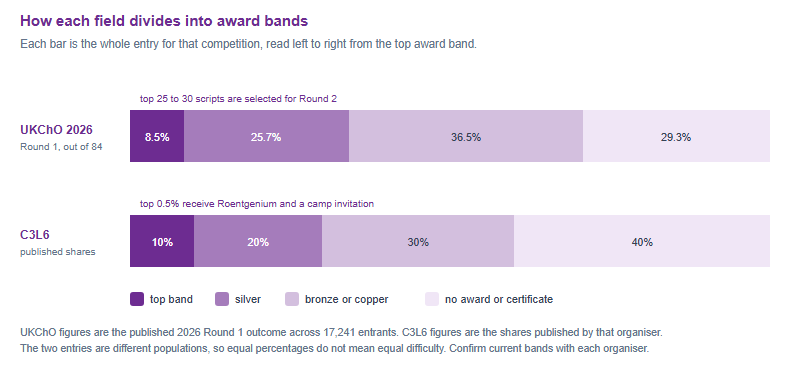
There is a further difference in how the bands are arrived at, and it is the more interesting one. C3L6 publishes its awards as proportions of the entry. UKChO publishes a raw mark boundary each year, and that mark moves: the Gold boundary sat around 29 to 30 in the two seasons before 2026, then rose to 38. Across those same seasons the share of entrants taking Gold stayed close to 8.5%. That is our observation from the published results rather than a statement from the RSC about method, but the practical lesson is solid: a UKChO mark is only meaningful against the boundary published for that year. Telling someone you scored 34 means nothing until you say which season. Our decode of the 2026 boundaries and the distribution behind them goes through this in detail.
The calendar case: January and June are not competing for the same weeks
The strongest practical argument for treating these as a pair is timing. Their demands land in different terms, and the feedback from the first arrives well before the second.
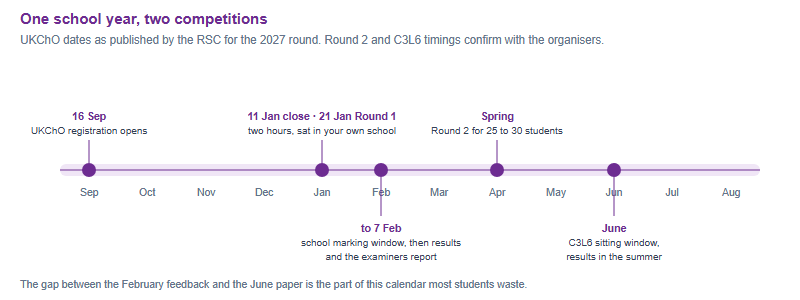
That February-to-June gap is the reason to think of them together at all. After UKChO you receive a score, a set of published boundaries and an examiners’ report describing where the whole field lost marks. Diagnostic information of that quality is rare, and it usually arrives at the end of a process rather than in the middle of one. Here it arrives with a second paper still ahead of you — which turns a January result from a verdict into a work plan. The method for converting that feedback into practice is the same one we set out for using past papers diagnostically: identify the failing operation, drill that, then retest.
Do they train the same things?
Partly, and the overlap is real enough to be useful without being complete.
- Shared: both reward applying A-Level chemistry to material you have not met, rather than recalling taught content. Both set problems where the necessary information is supplied and must be extracted. Both punish weak arithmetic hygiene and unstated assumptions.
- Distinct to UKChO: switching context five times in two hours, budgeting time across questions of very unequal weight, and staying accurate on routine marks — the 2026 Gold boundary of 38 out of 84 is under half the paper, so precision across the whole matters more than brilliance on one part.
- Distinct to C3L6: holding one long problem together. Where a paper is built from a small number of extended multi-part questions, an early error propagates much further, and stamina within a single line of reasoning counts for more.
The honest summary is that preparation transfers well but the papers are not substitutes. A student who has trained only on short-context switching may find a long problem exhausting, and one trained only on long problems may lose time in a five-context paper deciding where to start.
Entry routes: the part you must not assume
This is where students from international schools go wrong most often, because it is tempting to reason that one UK competition is entered like another. They are not. Each has its own registration process, run by its own organiser, on its own timetable.
For UKChO, the RSC publishes registration for the 2027 round as running from 16 September 2026 to 11 January 2027, with Round 1 sat on Thursday 21 January 2027 and free entry for schools in the British Isles. RSC guidance also describes a registration route for international schools in a list of territories that includes China, administered through ASEEDER China with fees applying, while British international schools elsewhere that meet stated curriculum criteria are directed to contact the RSC. Whether a particular school qualifies is a question for the organiser, not for us — confirm on rsc.org.
For C3L6, entry is likewise made by the school, with teachers registering candidates, supervising the sitting and submitting marks. What is available to a school outside the UK is a question for the Challenge organisers, and the answer does not follow from anything the RSC says about UKChO. Ask them directly before building a plan around it.
One last piece of advice that applies to both: whichever you enter, enter for the paper rather than the certificate. A January score that lands short of a boundary but shows you can decode an unfamiliar question is a better foundation for June than a certificate collected without learning anything, and it is far better than not sitting at all.
Is the Cambridge Chemistry Challenge part of the UK Chemistry Olympiad?
No. They are separate competitions with different organisers — the RSC runs UKChO, while C3L6 is run from the University of Cambridge.
Can I enter both UKChO and C3L6 in the same school year?
There is no clash in timing: UKChO Round 1 falls in January and C3L6 in June. Entry for each is arranged separately by your school.
Is a C3L6 Gold equivalent to a UKChO Gold?
No. The award bands cover different shares of different entries, so they are not interchangeable and should not be compared directly.
Can a school in China enter these competitions?
RSC guidance describes a route for international schools in listed territories via ASEEDER China. For C3L6, ask the organisers. Confirm before planning.
This is an independent guide operated by Hanlin Education for China-based international-school students. We are not affiliated with, endorsed by, or sponsored by the Royal Society of Chemistry (RSC), nor with the University of Cambridge or the Cambridge Chemistry Challenge. Entry eligibility, registration routes, fees, dates and award boundaries are set by the organisers and change from season to season — confirm current details on rsc.org, and with the C3L6 organisers, before acting on anything here. Any factual error brought to our attention is corrected within 7 working days.