Read in tiers, not in books. UKChO Round 1 is marked out of 84, and in 2026 the boundaries sat at 13, 23 and 38 — so the gap between Silver and Gold was fifteen marks, about one long question. Registration for the 2027 round opens on 16 September 2026, leaving roughly eighteen weeks. This is how to choose what you read, and what to leave alone.
Four tiers, and what each one is actually buying
Most students who ask “what should I read for the chemistry olympiad” are asking the wrong question. They picture a shelf: a thick physical chemistry text, a thicker organic one, a stack of past papers, and a plan to work through all of it. Eighteen weeks later they have read a lot and answered very little, and the paper does not care how much they have read.
A better model is a stack with four layers, each doing a different job. Tier 0 is your own course, known cold. Tier 1 is a thin layer of breadth beyond it. Tier 2 is problems in unfamiliar contexts — the bulk of your hours. Tier 3 is selective depth: individual sections of harder books, opened only when a specific lost mark sends you there.
The mark arithmetic tells you why the proportions matter. On the 2026 paper, 13 out of 84 was 15.5 per cent of the marks and earned Bronze; 23 was 27.4 per cent and earned Silver; 38 was 45.2 per cent and earned Gold. Bronze to Silver was ten marks. Silver to Gold was fifteen. Fifteen marks is not an extra textbook — it is one long question you currently abandon halfway. Reading rarely closes that gap on its own. Reading triggered by a specific failure does. The full 2026 distribution, including how the boundaries moved, is set out in our breakdown of the 2026 Round 1 results.
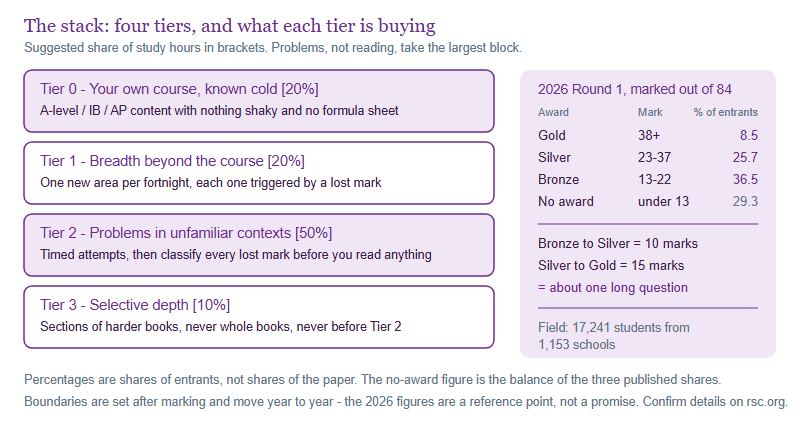
| Tier | What it is | Share of hours | What it buys | The mistake we see most |
|---|---|---|---|---|
| Tier 0 | Your own A-level, IB or AP course, with nothing shaky | 20% | The first 13 to 20 marks. In our own marking, most of them are course content in unfamiliar dress | Assuming it is already secure because the school test went well |
| Tier 1 | Breadth: the recurring areas your course stops short of | 20% | The middle of the paper, where the Silver band lives | Reading a new topic every week, so none of them stick |
| Tier 2 | Problems in unfamiliar contexts, attempted under time | 50% | Speed, recognition, and the habit of writing down the reasoning | Reading solutions instead of attempting questions |
| Tier 3 | Single sections of undergraduate texts | 10% | The last few marks on the hardest parts | Starting here, in September, cover to cover |
Tier 0: your own course, known cold
The uncomfortable finding when we mark scripts is how few of the lost marks are exotic. They are moles, limiting reagent, unit conversion, rearranging an equilibrium expression, an enthalpy cycle with a sign error, a mechanism arrow drawn from the wrong atom. All of it is on the reader’s own syllabus. It just arrived wearing a chemical name they had never seen, embedded in three paragraphs of context about a catalyst or a natural product.
“Known cold” is a specific standard, and it is higher than “I can do it in a test”. Try this definition: you can do it without looking anything up, in under three minutes, with correct units and a sensible number of significant figures, and you can say in one sentence why the method works. If any of those four fail, that topic belongs in Tier 0 for another week, and no amount of Tier 3 reading will compensate.
A cheap diagnostic: take any past-paper part-question, delete every proper noun and every unfamiliar formula, and replace them with letters. Now ask what course topic remains. If the answer is “a Kc calculation” or “a Hess cycle” and you still could not do it, the problem is Tier 0, not breadth. If you cannot even name the topic once it is stripped, that is a Tier 1 gap. If you are new to the competition entirely, start with our overview of what UKChO is and how it runs before you buy anything.
Tier 1: the breadth layer, and how thin it should be
Beyond the course there is a band of chemistry that keeps reappearing in olympiad-style problems. From our own reading of the papers we have gathered, the recurring areas are: thermodynamic cycles taken past Hess into Born-Haber, entropy and free energy; equilibrium done quantitatively, including acid-base equilibria and solubility products; kinetics, where a rate law has to be extracted from data and matched to a mechanism; redox and electrochemistry, including half-equations in alkaline conditions and standard potentials; transition-metal chemistry, including complex geometry, colour and ligand substitution; organic mechanism reasoning rather than reaction recall; and structure determination from formula and spectra.
Two cautions about that list. First, it is our reading, not an official scope statement — we have not found an exam-board-style topic list published for the competition, so treat anything scope-related as a question for rsc.org rather than for us. Second, the list is a menu, not a curriculum. Attempting all seven areas in eighteen weeks is how students end September confident and end December scattered.
The rule that works: one new breadth area per fortnight, and it must be chosen from your error log rather than from the list. If three of your last four lost marks were kinetics, the next fortnight is kinetics, and the transition metals wait. Depth of coverage should be “enough to answer a question”, not “enough to give a lecture”. A single well-written chapter, worked through with a pen, beats three chapters skimmed.
Tier 2: problems, and the read-to-answer loop
Half your hours belong here, and the reason is simple: reading builds recognition slowly and reasoning not at all. Attempting builds both, and it also generates the only information that makes the other three tiers efficient — a list of things you specifically cannot do.
Our own gathered pack of past papers is the raw material we use for this. It is a set we compiled ourselves, and it is honest about its limits: we have worked solutions for some years and not for every year, and we keep adding to what we have. How to use the papers as a diagnostic rather than a memory test is a longer subject that we have covered separately in our method for working through past papers. What matters here is the step that comes after the diagnosis: deciding what to read.
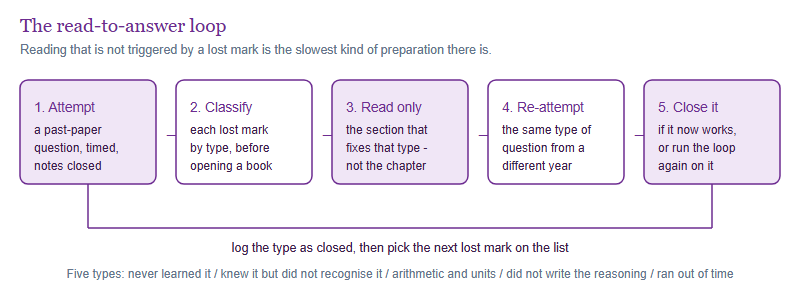
The five types matter because they have different fixes. Never learned it is the only one reading solves. Knew it but did not recognise it is fixed by more varied problems, not by re-reading the theory. Arithmetic and units is fixed by slowing the first line of working, not by content at all. Did not write the reasoning is a writing habit. Ran out of time is triage. Students who skip classification read for all five, which is why their reading feels endless and their score does not move.
Tier 3: sections, not books — and what to leave alone
There is a point where an A-level or IB textbook genuinely runs out, and an undergraduate text is the right tool: a full mechanistic treatment in an organic text such as Clayden, a proper thermodynamics or electrochemistry chapter in a physical chemistry text such as Atkins, coordination chemistry in an inorganic text such as Housecroft & Sharpe. These are examples of the level, not a prescription; whatever your school library has at that level will do.
The rule is that you open them at a page number, not at page one. In coaching cohorts, the single clearest predictor of wasted autumns is a student who bought a 1,200-page text in September and was on chapter four in December — de-identified, from our own records, and individual results vary. Two hours in the right eight pages, immediately after failing a question on exactly that, is worth more than forty hours of orderly progress through material you will not meet.
Things to leave alone, at least until after Round 1: international-round preparatory problem sets, which are pitched several stages further along the ladder; other countries’ national olympiad syllabuses treated as if they described this competition, since scope and level differ; and any book read cover to cover on the theory that completeness is the goal. Other countries’ papers are perfectly good as problem sources — they are just not a description of what you are sitting.
What the calendar does to your reading list
Reading has a deadline earlier than the paper does, and the 2027 dates make that concrete. On the RSC schedule, entry for UK school centres opens on 16 September 2026 and closes on 11 January 2027, with Round 1 sat on Thursday 21 January 2027 and marking running to 7 February. The China-region sitting, per the organising channel’s date-change notice, falls on Friday 22 January 2027, and its registration also closes on 11 January — so both routes now close on the same day but sit one day apart. Earlier notices describe the China sitting as an evening, computer-based session; the change notice gives the date only, so confirm the timing and format at booking. Neither calendar corrects the other, and which route applies to you — and whether you are eligible for it at all — is a question for rsc.org and for whoever books your sitting, not for us.
From 16 September to the sitting is about eighteen weeks, and your real figure is smaller: subtract your school’s winter break, your mock weeks, and any other January examinations. At three to five hours a week, eighteen weeks is 54 to 90 hours. Apply the tier shares to the middle of that range — say 72 hours — and you get roughly 14 hours of Tier 0 repair, 14 of breadth, 36 of problems and 7 of selective depth. Written down like that, it is obvious how little room there is for a book you have not opened yet.
Set one more internal deadline: new reading stops about three weeks before the sitting. The last block is timed papers and your own error log. Material introduced inside three weeks tends to arrive as half-formed recognition, which in an unfamiliar context is worse than not recognising it at all.
One last framing point, since students ask. A result from a competition like this does not act alone in an application; an admissions reader checks it against the transcript, the activity list and what the essays claim about you. A Gold that sits alongside strong chemistry grades and a genuine account of how you prepared corroborates the rest of the file — several results across one profile cross-validating each other is what makes the whole thing believable. That is a reason to keep an honest record of your preparation, not a reason to treat any single certificate as decisive.
Frequently asked questions
How many hours a week does this actually need?
Three to five hours a week over about eighteen weeks is 54 to 90 hours. Keep half of it on problems, not on reading.
Do I need an undergraduate textbook?
Only for sections that fix a specific lost mark. Reading one cover to cover before you attempt papers is the slowest route there is.
Is there an official syllabus to read against?
We have not found an exam-board-style topic list published for it. Treat our list as our own reading and confirm scope on rsc.org.
When should new reading stop?
About three weeks out. The final block is timed papers and your error log, not new material you cannot consolidate.
This is an independent guide operated by Hanlin Education for China-based international-school students. It is not affiliated with, endorsed by, or sponsored by the Royal Society of Chemistry (RSC). Dates, eligibility, entry routes, format and award boundaries are set by the organisers and change from year to year — confirm current details on rsc.org and with whoever books your sitting. Factual errors are corrected within 7 working days of being reported.