For a China-based student choosing a chemistry olympiad, the honest answer is that UKChO, USNCO and Canada's CCO reward three different kinds of thinking: UKChO is organic-heavy applied reasoning, USNCO tests breadth plus an experimental element, and the Canadian olympiad leans toward rigorous derivation. This guide compares their character — not just their names — so you can pick the one that fits how you think, with every official detail confirmed on each body's own site.
This is an independent guide by Hanlin Education; we are not affiliated with the RSC or any other olympiad organiser. If you are still deciding whether to attempt a chemistry olympiad at all, read what UKChO is first, then use this piece to place it next to the alternatives.
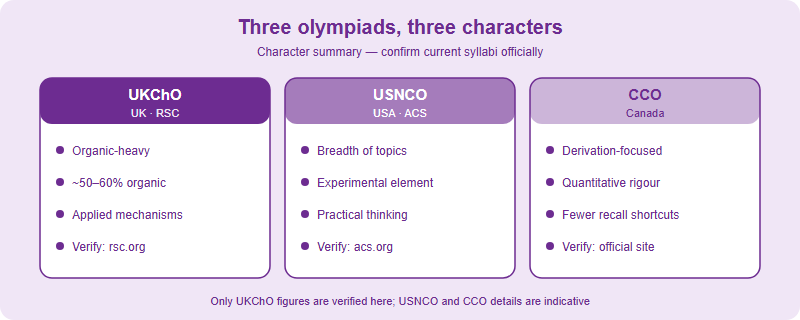
Three olympiads, three characters (at a glance)
Start with the shape of each contest. Only the UKChO figures below are verified in this guide; for USNCO and CCO, treat the character description as a planning summary and confirm the current format, eligibility and dates on each body's official site before you commit.
| UKChO (UK) | USNCO (USA) | CCO (Canada) | |
|---|---|---|---|
| Organiser | Royal Society of Chemistry | American Chemical Society (confirm on acs.org) | Confirm on the official Canadian site |
| Exam character | Organic-heavy applied reasoning (~50–60% organic, our reading) | Breadth across topics + experimental thinking | Derivation-focused, quantitative rigour |
| Verified anchor | Round 1 sat 28 Jan 2026, out of 84; record 17,241 students | Confirm on acs.org | Confirm on the official Canadian site |
| Where to verify | rsc.org / edu.rsc.org | acs.org | Official Canadian olympiad site |
One clarification worth making up front, because it trips up newcomers: these are three separate national competitions run by three different bodies, not three stages of one global contest. Each has its own national selection pathway that ultimately feeds a country's team for the International Chemistry Olympiad (IChO), and UKChO's own route runs from Round 1 through a Round 2 for the top 30 at the University of Nottingham and onward toward IChO. You do not “progress” from one country's olympiad into another's; you choose the national contest that fits you and, where eligible, prepare for that. Confirm each pathway on the relevant official site.
What each exam actually rewards
UKChO — organic reasoning. The defining feature of recent UKChO papers is how much weight sits on organic chemistry: roughly 50–60% of the marks turn on mechanisms, curly arrows and multi-step synthesis logic (our reading of recent papers; confirm the current syllabus on rsc.org). That rewards students who like reasoning from how a molecule behaves rather than memorising outcomes. The paper is written out of 84 marks and was sat on 28 January 2026 by a record 17,241 students — a big, well-benchmarked field.
USNCO — breadth plus experiment. The US contest is characterised by breadth across the syllabus and an experimental or practical dimension, so it rewards students who are comfortable ranging widely and thinking like a bench chemist as well as a problem-solver. We are deliberately not quoting a question count, timing or cut score here — those belong to the official ACS materials, and borrowing another contest's numbers is exactly the kind of error that misleads planning. Confirm the current format on acs.org.
CCO — derivation. Canada's national chemistry olympiad leans toward derivation and quantitative rigour: working results through from principles rather than pattern-matching to a known answer. That suits students who enjoy the mathematical spine of physical chemistry. Again, treat this as a character sketch and confirm eligibility, structure and dates on the official Canadian site.
Why does character matter more than a difficulty ranking? Because “which is hardest” is the wrong question — each contest is hard in its own dimension. A student who reasons fluently through organic mechanisms may find UKChO the most natural of the three and struggle with a derivation-heavy paper, while a mathematically minded student might feel the reverse. Choosing by character means choosing the contest that lets your existing strengths do the most work, and that turns preparation into deepening what you are good at rather than papering over what you are not.
The access question is different for each
Character is only half the decision; access is the other half. Each of these olympiads has its own national framework, and the rules for a student based in China are not the same across the three. UKChO Round 1 is sat through a participating school; whether and how a China-based international-school student can enter should be confirmed with the RSC on rsc.org rather than assumed. USNCO and CCO each run through their own national structures — confirm on acs.org and the official Canadian site respectively.
One of the three does have a specific published answer, and it is worth stating precisely because the loose version circulates widely. The ACS rules say that a student who does not meet the citizenship criteria may sit the Local Exam but cannot be nominated for the National Exam — so it is the national round and the Team USA route that require US citizenship or permanent residency, not the contest as a whole. Separate provisions cover US citizens studying at accredited American schools abroad. The full picture, case by case, is in our UKChO-versus-USNCO eligibility comparison; confirm the current wording on acs.org before you plan around it.
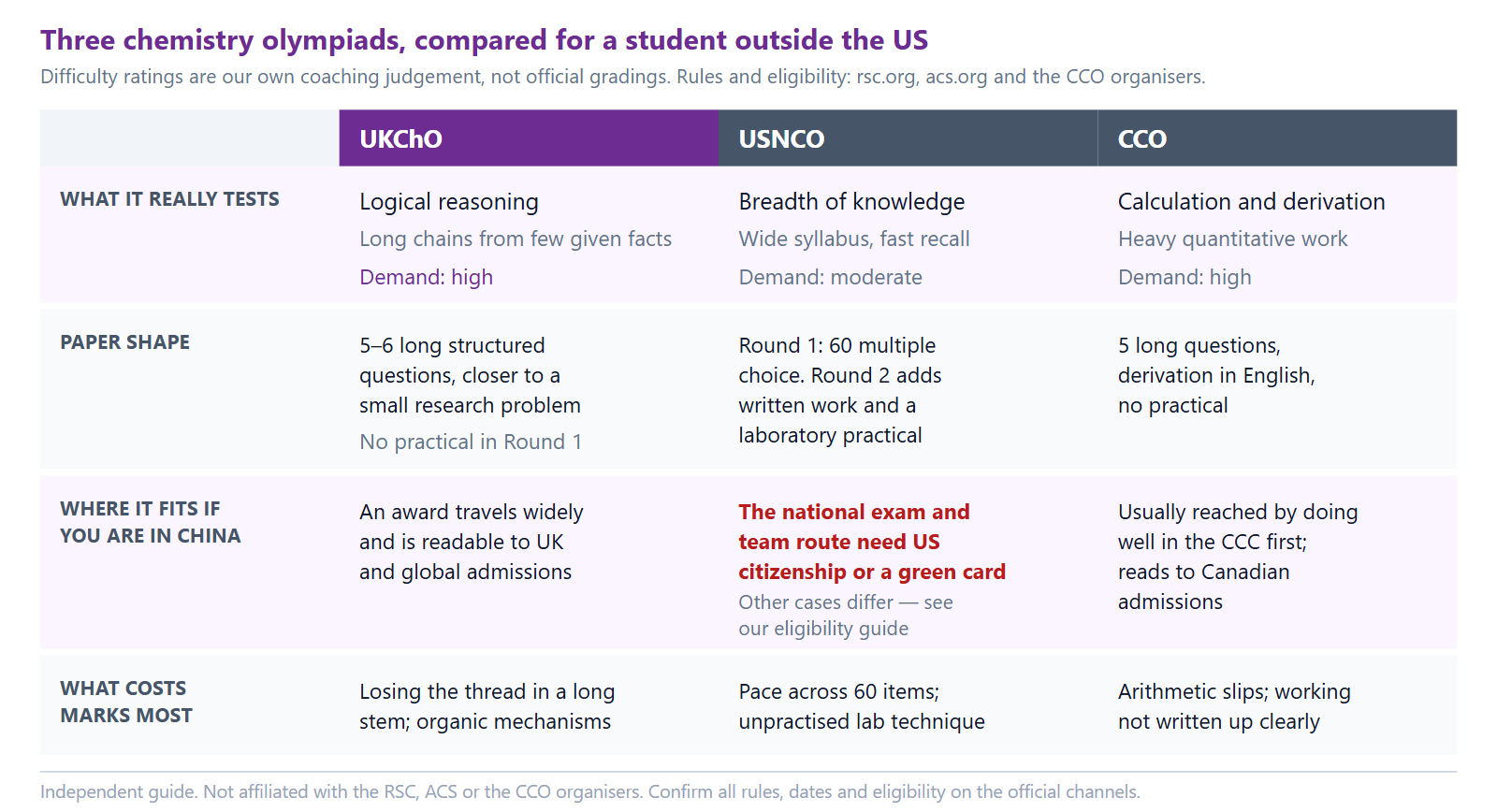
Two honest points follow. First, do not assume that being able to buy a textbook or download a past paper means you can enter a given contest from China — entry and preparation are separate questions. Second, even where direct entry to a particular contest is not open to you, its past materials can still be excellent preparation and a way to benchmark yourself. We treat the UK-versus-US eligibility mechanics in depth in a separate comparison; here the point is simply that access must be checked contest by contest.
There is a strategic reason to get this order right. Students sometimes fall in love with a contest's prestige, build a whole preparation plan around it, and only then discover that entry from their situation is unclear or closed. Reverse it: confirm on the official site which contests you can realistically enter, and only then let character and cognitive fit choose between the remaining options. A confirmed, well-matched Bronze is worth more than a prestigious contest you cannot actually sit — and it protects the many hours a serious preparation block costs.
Choose by how you think
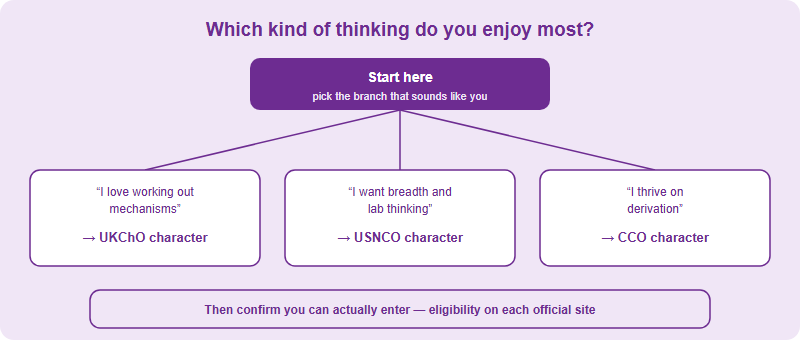
If access is open to more than one, let cognitive fit break the tie. Use the flow below as a starting point, then pressure-test it against a few real past questions from each contest — nothing beats trying the actual style.
Picture the three profiles concretely. The UKChO fit is the student who, shown an unfamiliar molecule, instinctively asks “where do the electrons want to go?” and enjoys chasing that logic through several steps. The USNCO fit is the wide-ranging student who is comfortable being tested on anything and thinks naturally about how an experiment would actually be run. The CCO fit is the student who reaches for a pen and derives — who is happiest when a problem can be worked through from first principles rather than recognised. Most people lean toward one of these, and the honest exercise is to notice which one describes you before the prestige of a name does.
Can one preparation block serve more than one?
Yes — and this is the practical reason not to agonise too long. The core of every chemistry olympiad is the same physical, inorganic and organic chemistry; the contests differ in emphasis and style, not in the underlying subject. Time spent building genuine understanding transfers, even if you switch targets later.
- Shared foundation: master the core chemistry once and it pays into any of the three.
- Style tuning: then bias your final weeks toward the contest you are entering — organic mechanism drills for UKChO, breadth and practical reasoning for USNCO, derivation for CCO.
- Past papers travel: working UKChO past-paper sections sharpens reasoning you can carry into the others; benchmark against the 2026 UKChO boundaries to see where you stand.
In short: choose the contest whose character fits how you think and whose access is open to you, prepare the shared foundation seriously, and tune the style at the end. The subject rewards understanding either way.
One caution on ambition: sharing a foundation is not the same as entering all three in one cycle. Each contest has its own timetable, style and admin, and spreading a single season across three targets usually means doing none of them justice. A better plan for most China-based students is to commit to one contest in a given year, build the shared foundation deeply while tuning to that contest's style, and only branch out in a later cycle once the core chemistry is secure. Depth on one contest reads better — and feels better — than a thin spread across three.
Frequently asked questions
Is UKChO harder than USNCO or CCO?
They are different, not simply harder or easier — UKChO leans organic, USNCO breadth plus experiment, CCO derivation. Check each official syllabus.
Can a China-based student enter all three?
Not necessarily; each has its own national access rules. Confirm eligibility on rsc.org, acs.org and the official Canadian site before assuming entry.
Which helps a UK application most?
UKChO is the UK-native contest and is named by UK universities; confirm current recognition on the university sites and see our UKChO admissions guide.
Do the three syllabuses overlap?
Yes — core physical, inorganic and organic chemistry overlaps heavily, so preparation transfers. Only the emphasis and exam style differ.
This is an independent guide operated by Hanlin Education for China-based international-school students. It is NOT affiliated with, endorsed by, or sponsored by the Royal Society of Chemistry (RSC), and it does not represent the American Chemical Society or any Canadian olympiad body. Please confirm current details on rsc.org, acs.org and each contest's official website. Any error will be corrected within 7 working days.