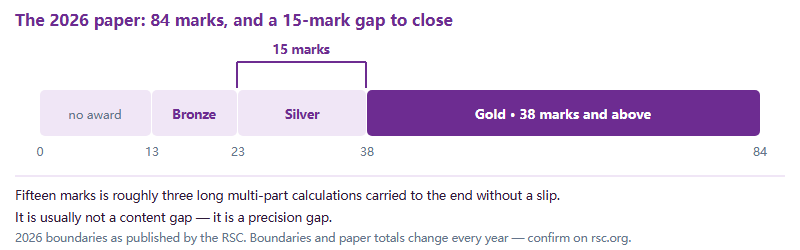
In the 2026 UKChO Round 1 paper, Silver started at 23 marks and Gold at 38, out of 84. That is a gap of fifteen marks. In our experience coaching international-school students, those fifteen marks are rarely lost to chemistry nobody has taught them — they are lost to units, mole chains, logarithms, premature rounding and misread data tables. The content is usually already known. The arithmetic discipline is not.
Where the Silver-to-Gold gap actually sits
Start with the published 2026 boundaries: Bronze from 13 marks (36.5% of entrants), Silver from 23 (25.7%) and Gold from 38 (8.5%), on a paper marked out of 84 and sat by 17,241 students. We analyse that distribution in full in our 2026 Round 1 results breakdown.
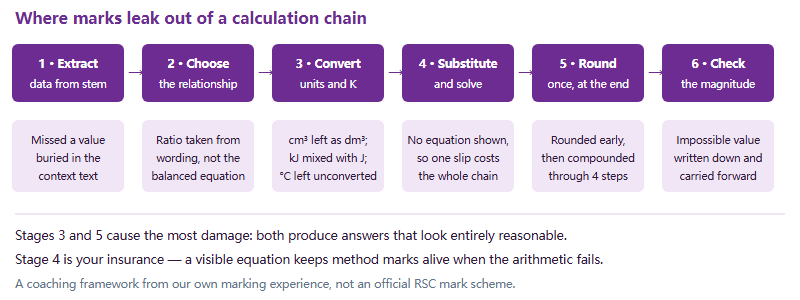
Here is the structural reason numerical discipline dominates that gap. UKChO questions are built around extended real-world contexts, so marks tend to arrive in chains rather than singly: extract a value, choose a relationship, convert, substitute, carry the result into the next part. A student who understands every concept in a chain but drops a factor of 1000 converting cm3 to dm3 does not lose one mark — they lose the tail of the chain. Conversely, a student with identical chemistry knowledge and clean numerical habits banks the lot. Same chemistry, fifteen-mark difference.
Six habits, and what goes wrong without them
| Habit | The classic failure | The fix that takes ten seconds |
|---|---|---|
| 1 · Units on every line | cm3 used where dm3 is needed; a 1000× error that looks plausible | Write the unit beside every number as you go, never at the end only |
| 2 · Energy consistency | Mixing kJ mol−1 with R in J K−1 mol−1, giving answers 1000× out | Convert everything to joules the moment R or a log relationship appears |
| 3 · Temperature in kelvin | Leaving °C in a thermodynamic or kinetic expression | Convert to K in the same line you write the value down |
| 4 · Round only at the end | Rounding an intermediate to 2 s.f., then compounding it through four more steps | Keep full precision in the calculator; round once, in the final answer |
| 5 · State the relationship first | Numbers appear with no visible equation, so a slip destroys the whole chain | Write the symbolic relationship, then substitute — method stays visible |
| 6 · Sanity-check the magnitude | An equilibrium constant of 1027 or a yield of 340% written down unquestioned | Ask before moving on: is this physically possible? |
None of these is difficult. All of them are habits, which means they are built by repetition under time pressure and not by reading about them once.
The mole chain, and the conversions that break it
Almost every quantitative UKChO question eventually passes through amount of substance. The three routes in are standard: mass and molar mass, concentration and volume, and the gas relationship linking pressure, volume and temperature. What separates a confident solver is not knowing those three — every A-level and IB student does — but moving between them without friction while the context is unfamiliar.
Three chain-breakers are worth drilling specifically:
- Volume conversion. Concentrations are conventionally in mol dm−3, while burette and pipette readings arrive in cm3. Divide by 1000 as you transcribe the number, not three lines later when you have forgotten.
- Stoichiometric ratio. The ratio belongs to the balanced equation, not to the question's wording. Write the balanced equation even when the question does not ask for it, and read the ratio off it deliberately.
- Back titration logic. You are measuring what is left over, so the quantity you want is a difference: total added minus what the titration accounted for. Students who set this up as a single direct proportion lose the whole question, and it is a common structure precisely because it tests reasoning rather than recall.
Percentage yield and atom economy deserve a mention because they are cheap marks that get thrown away. Yield compares your actual product to the theoretical maximum from the limiting reagent — and identifying the limiting reagent, rather than assuming it is the first reactant listed, is where the mark actually is.
Logs, gradients and the graph questions
The step from A-level or IB routine into olympiad numeracy usually happens the moment a logarithm appears. Three patterns cover most of it, and all three reward the same move: rearrange into the form of a straight line, then read the gradient.
- Acid–base work. pH as the negative logarithm of hydrogen ion concentration, and the relationships connecting pH, pKa and the ionic product of water. The frequent error is algebraic, not chemical: taking a logarithm of a value whose units have not been cleared.
- Kinetics. Plotting the natural log of concentration against time gives a straight line for a first-order process whose gradient carries the rate constant. Similarly, the Arrhenius relationship linearises into a plot of ln k against the reciprocal of temperature, where the gradient carries the activation energy divided by the gas constant. Note the sign, and note that the gradient gives you Ea/R — so you must multiply by R, in consistent energy units, before quoting an answer.
- Thermodynamics. The link between free energy change and the equilibrium constant is logarithmic, which is why a modest energy difference produces an enormous change in K. Getting a sign wrong here does not produce a slightly wrong answer; it produces one many orders of magnitude out. That is what habit 6 is for.
When a question supplies a table of values and asks you to determine a quantity, the intended route is nearly always: linearise, plot or compute a gradient, extract the constant. Recognising that pattern quickly is a trainable skill, and it converts long questions into short ones.
Reading supplied data as evidence
UKChO questions frequently hand you a data set and expect you to interrogate it. The discipline is to treat data as evidence requiring a stated inference, rather than as decoration to be mentioned. A few habits generalise well:
- Read the table headers and units before the numbers. Whether a column is in kJ mol−1 or J mol−1, or per gram rather than per mole, changes everything downstream.
- Convert ratios into counts. In spectroscopic data, relative integration values are ratios; converting them into an actual number of atoms requires the molecular formula. Students who skip that conversion routinely propose structures with the wrong number of hydrogens.
- Isotope patterns are arithmetic. Characteristic peak pairs separated by two mass units, in recognisable intensity ratios, indicate particular halogens. This is a counting exercise, not a memory test.
- Justify with the number, not the impression. Writing that an absorption occurs at a particular wavenumber and therefore indicates a specific bond earns credit; writing that the spectrum “looks like an alcohol” does not.
Where an answer requires structural reasoning on top of the data, our companion piece on what the UKChO tests overall sets the wider context.
A four-week drill to build the habits
Habits do not improve by being understood. They improve by being measured. This is a compact cycle we use with students who already know the chemistry but keep scoring below their ability:
| Week | Focus | Daily work (30–40 minutes) | What you measure |
|---|---|---|---|
| 1 | Units and conversions | Ten short quantitative parts; write units on every single line | Count of unit errors per session — target zero by day 7 |
| 2 | Mole chains | Five multi-step problems including at least two back titrations | How often you wrote the balanced equation unprompted |
| 3 | Logs and gradients | Linearise supplied data sets; extract constants from gradients | Sign errors and cases where you forgot to multiply through by R |
| 4 | Full integration | One timed two-hour past paper, then self-mark against the scheme | Marks lost to method vs marks lost to arithmetic and presentation |
That final measurement is the important one, and it is the reason the cycle works. Split every lost mark into two piles: chemistry you did not know, and chemistry you knew but executed poorly. Students are consistently surprised by how heavy the second pile is. It is also the pile that responds fastest to work, which is why numerical discipline is usually the highest-return thing a competent chemist can train in the autumn term. For a structured way to run the week-four sitting and get real diagnostic value from it, see our method for working through past papers.
None of this guarantees an award — boundaries move each year, the paper is deliberately hard, and Gold went to 8.5% of entrants in 2026. What it does is stop you losing marks you have already earned in every other sense.
Frequently asked questions
Why do strong chemistry students still miss Gold?
Usually execution, not knowledge: unit conversions, early rounding, sign errors in logarithms and unstated methods in long calculation chains.
How many marks separated Silver from Gold in 2026?
Fifteen. Silver started at 23 marks and Gold at 38, on a paper marked out of 84. Boundaries change annually — confirm on rsc.org.
Should I round intermediate answers?
No. Keep full precision through the chain and round only the final value, otherwise rounding errors compound across every subsequent step.
What if I cannot finish a calculation?
Write the relationship you would use and any partial reasoning. A visible method can attract credit where a blank space or a bare wrong number cannot.
This is an independent guide operated by Hanlin Education for China-based international-school students. It is not affiliated with, endorsed by, or sponsored by the Royal Society of Chemistry (RSC). Mark totals, grade boundaries and paper formats change from year to year — always confirm current details on rsc.org. If you spot an error, we correct it within 7 working days.