A UKChO result arrives as one word and one number, and most students read only the word. That is the wrong way round. The band tells you where you sat relative to a very large field; the number, set against the paper you actually sat, tells you what to do next. This is a method for extracting the second thing, and an honest way to decide whether to enter again.
What the 2026 bands actually meant
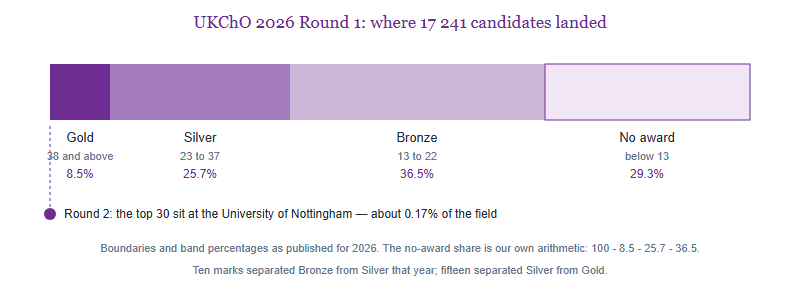
Round 1 was sat on 28 January 2026, marked out of 84, by a record 17 241 students across 1 153 schools. The published award boundaries were 38 and above for Gold, 23 to 37 for Silver and 13 to 22 for Bronze, covering 8.5%, 25.7% and 36.5% of candidates respectively. Doing the arithmetic ourselves on those published shares: roughly 1 465 students reached Gold, about 4 431 Silver and about 6 293 Bronze, which leaves about 29.3% — some 5 052 candidates — below the Bronze line.
Two things fall out of that distribution that are worth internalising before you judge your own mark.
The first is that Bronze is the largest band, not a consolation. More candidates finished in the 13-to-22 range than in any other, in a field that self-selects heavily — nobody sits a two-hour olympiad paper by accident. The second is that the Bronze line itself sits at roughly 15% of the available marks. That is not a low bar because the paper is easy at the bottom; it is a low bar because the paper is designed with a long tail of difficulty above it, so that the top of the field can be separated at all. A mark of 13 in that structure is not the same thing as 15% on a school test.
The 48-hour post-mortem, and why topics are the wrong unit
Do this while the paper is still in your head, ideally within two days of sitting it and certainly before results arrive. Waiting for the band tells you nothing you can act on; waiting until August compresses two hours of specific decisions into a single vague memory that it was hard.
Take a blank sheet and reconstruct the paper part by part as far as you can. Then, for every place you know or suspect you dropped marks, assign one cause, not a topic:
- Content. You did not know the chemistry and could not have derived it from what the question supplied. This is the only category that requires new learning.
- Transfer. You knew the underlying chemistry but did not recognise it inside an unfamiliar context, or could not apply it to material the question introduced. This is a practice problem, not a syllabus problem.
- Time. You could have done it and did not reach it, or reached it with four minutes left. This is a triage problem, and it is usually the cheapest to fix.
- Expression. You knew it, attempted it, and wrote something a marker could not credit — a description where an explanation was asked for, an unstated assumption, a missing unit, an answer to two significant figures the data could not support.
Sorting by cause rather than by topic is the whole trick, because the four categories have completely different remedies and wildly different costs. A student whose losses are two-thirds Time and Expression does not need another term of thermodynamics; they need timed papers and drilled answer patterns, and they can plausibly move ten marks in a few weeks. A student whose losses are two-thirds Content needs a genuine autumn of study and should plan accordingly. The two situations look identical on a results slip and are not remotely the same problem.
Where a mark scheme is available for the year you sat, use it to check your reconstruction rather than to admire the answers; availability varies from year to year, so work with whichever schemes you can get hold of. The review method itself — working the paper cold, then diagnosing rather than reading solutions — is set out in our guide to using past papers without memorising answers. We keep our own gathered pack of papers, with worked solutions for some years rather than all of them.
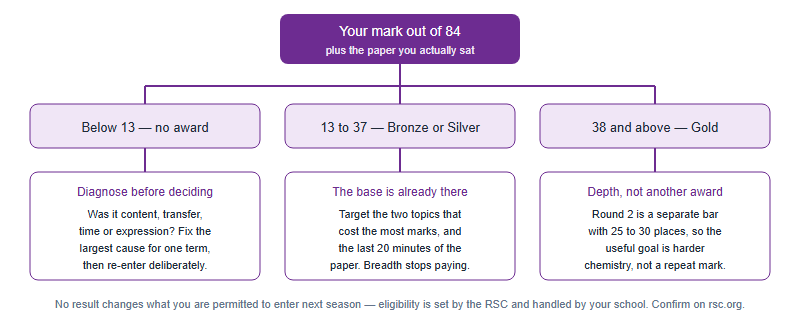
| Your 2026 mark | What it says | The honest next move | What not to conclude |
|---|---|---|---|
| Below 13 no award |
The paper was not yet legible to you under time pressure | Diagnose by cause. If Content dominates, this was a calibration entry — treat it as one | That you are bad at chemistry. About 29.3% of a self-selected field finished here |
| 13–22 Bronze |
You cleared the largest band in a field of 17 241 | Find the ten marks between you and Silver. They are usually Time and Transfer, not new content | That the gap to Silver is another year of study. It is ten marks |
| 23–37 Silver |
Your chemistry base is sound; the top of the paper is what is missing | Target the hardest two topics plus the last 20 minutes of the paper | That broad revision will close it. Above Silver, breadth stops paying |
| 38+ Gold |
You are in roughly the top 8.5% of the field | Work for depth. Round 2 is a separate bar with roughly 25 to 30 places, so confirm the current figure on rsc.org | That Gold implies a Round 2 invitation — roughly 1 465 Golds, 30 places |
The re-entry decision, made on evidence
Assuming another season is open to you — eligibility and entry are set by the RSC and handled by your school, so confirm on rsc.org before planning around it — the decision is not really “should I try again”. It is “do I have a specific, named thing to fix, and a term in which to fix it”. Repeat entries without a diagnosis tend to produce repeat marks, because nothing changed except the calendar.
A practical test before committing a term: can you write down, in one sentence each, the three specific things that will be different about your next attempt? “I will work harder” does not count. “I will finish every past paper inside two hours instead of stopping at ninety minutes”, “I will drill redox half-equations until building one is automatic” and “I will write explanation answers to a fixed claim-cause-link pattern” all count. If you cannot produce three such sentences, your post-mortem was not detailed enough — go back to the paper rather than forward to the calendar.
What actually moves a score between attempts
Across the students we work with, the changes that produce visible movement are consistently narrower than the ones people plan. Three patterns recur.
Finishing the paper is worth more than knowing more. Marks left unattempted are indistinguishable from marks answered wrongly, and candidates routinely leave a chunk of the back end untouched while polishing earlier parts that were already secure. Simply reaching every part you could plausibly attempt, and writing a partial answer where you cannot finish, converts nothing into something across several questions at once.
Partial credit is real and underclaimed. In our experience of these papers, a wrong number early does not necessarily poison what follows if your method is visible. Students who write only a final answer forfeit that; students who set out the method line by line keep it. This costs no additional chemistry knowledge whatsoever.
Depth beats breadth above Silver. Below the Silver line, gaps are usually broad and general revision helps. Above it, the remaining marks live in the hardest parts of a few topics, and another pass over material you already know reliably does nothing. This is the point at which most students should stop revising and start working harder problems.
One last note on how to talk about a result. A Bronze or a Silver, described honestly and with something specific attached — what you found hard, what you did about it, what you understood afterwards that you did not before — reads better than a Gold mentioned as a trophy and left there. No competition result guarantees any admissions outcome, and the value of the exercise is the chemistry you learn preparing for it. If you want the structure of the competition itself before planning your next season, start from our overview of what the UK Chemistry Olympiad is, and check the numbers against the 2026 results in detail.
Frequently asked questions
What did a Bronze mean in 2026?
Bronze started at 13 marks out of 84, and about 36.5% of the 17 241 candidates reached it. It was the largest award band.
What share of candidates got no award in 2026?
By our arithmetic on the published bands, about 29.3% finished below the Bronze boundary of 13 marks out of 84.
Is a Gold award enough to reach Round 2?
No. Round 2 takes only about 25 to 30 students from the whole field — in 2026 the top 30, at the University of Nottingham — while Gold covered roughly 8.5% of candidates. Confirm the current numbers on rsc.org.
Should I enter again after a low score?
Enter again if you can name the causes that cost you marks and have a term to fix them. Repeat entries without a diagnosis rarely move.
This is an independent guide operated by Hanlin Education for China-based international-school students. We are NOT affiliated with, endorsed by, or sponsored by the Royal Society of Chemistry (RSC). Competition dates, formats, eligibility, award boundaries and the availability of published materials change from year to year — confirm current details on rsc.org. Errors reported to us are corrected within 7 working days.