Two different questions get collapsed into one. “Can I enter UKChO?” is an eligibility question — the RSC sets the rules and your school makes the entry, so confirm both on rsc.org and with your chemistry teacher. “Should I enter this season?” is a readiness question, and nobody can answer it but you. This article is about the second one.
Eligibility is a school question; readiness is yours
Start by separating the two cleanly, because families routinely spend weeks on the wrong one. Entry routes, permitted year groups, deadlines and exam arrangements are all determined by the organiser; Round 1 is sat under exam conditions at school rather than entered as an individual, so your teacher and the current guidance on rsc.org are the only authorities that matter for those. If you are unclear on how the competition is structured before you plan around it, our overview of what the UK Chemistry Olympiad is covers the shape of the thing.
What that guidance cannot tell you is whether sitting the paper in a given season will produce a score you want on record. That depends on how much of the chemistry you have actually met, how fluent your arithmetic is under time pressure, and whether you can write a reasoned answer in English fast enough. Those are the variables you control, and they are the ones this article uses to decide which season is your target.
One number frames the decision. Round 1 in 2026 was sat on 28 January, marked out of 84, by a record 17 241 students from 1 153 schools. The award boundaries fell at 13 for Bronze, 23 for Silver and 38 for Gold. That is a field large enough that the paper does not adjust to how ready you happen to be; you either meet the bar in the two hours you are given, or the season is a data point rather than a result. Being honest with yourself about which of those you are signing up for is the whole planning problem.
Five gates that decide whether a season is worth spending
These are not knowledge checks. Every one of them is a fluency check, because the constraint in Round 1 is two hours, not information. A student who knows a topic but needs ninety seconds to set up each calculation runs out of paper long before running out of chemistry.
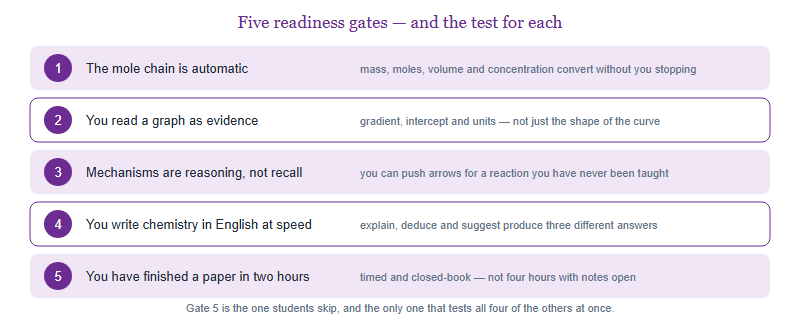
Take gate five seriously. It is common to reach January having worked through plenty of past-paper questions and never once having sat a whole paper in one sitting with the clock running. Those are different skills. Working questions builds chemistry; sitting the paper builds triage — the judgement about which part to attempt, which to leave, and when to stop polishing an answer that is already worth the marks available. Our diagnostic method for past papers sets out how to review a timed attempt so it produces information instead of a bruise. We keep our own gathered pack of papers, with worked solutions for some years rather than every year.
Calibration season and target season are different jobs
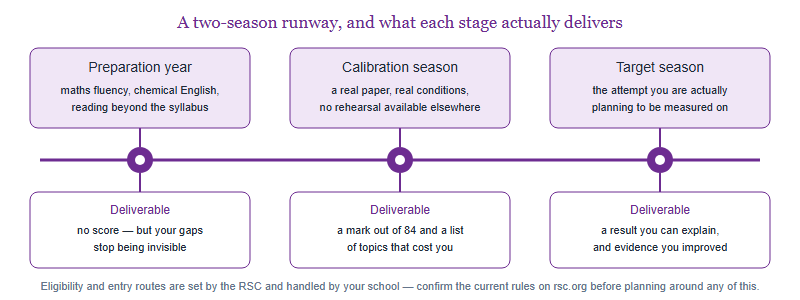
If your school can enter you in more than one season — again, confirm that with your teacher and on rsc.org — the two entries should not be treated as two attempts at the same thing. They have different purposes, and conflating them is why a first entry so often produces nothing but disappointment.
| Calibration season | Target season | |
|---|---|---|
| What you are buying | Information about yourself under real conditions | A result you intend to keep and talk about |
| Preparation load | Light — enough to make the paper legible to you | Heavy — a full autumn block on named weaknesses |
| Success looks like | You know exactly which topics cost you marks | Your mark clears the band you were aiming at |
| A low mark means | The experiment worked; you now have a target list | Diagnose before deciding anything else |
| The failure mode | Sitting it and never reviewing the paper afterwards | Preparing broadly instead of on the diagnosed gaps |
| Time cost | Two hours plus one review session | A term of consistent weekly work |
The row that matters most is the last-but-one. A calibration entry is only worth anything if you review the paper while you still remember what you were thinking — ideally within forty-eight hours, before the experience compresses into a single feeling about how it went. Reconstruct the questions you could not finish, sort your lost marks into causes rather than topics (did you not know it, not have time for it, or know it and write it badly?), and you walk out of a mediocre first entry with a genuinely useful list. Skip the review and you have spent an afternoon and learned that the paper was hard, which you already knew.
The preparation year: three things that compound
The year before your first entry is not the place for olympiad problem sets. It is the place to build the three capacities that make olympiad problem sets productive later, all of which improve slowly and none of which can be crammed in December.
Arithmetic fluency without a calculator crutch. Logs, powers of ten, ratio reasoning and unit algebra should be automatic. The test is not whether you can do them but whether doing them costs you attention you needed for the chemistry. Practise deriving units of a constant from an equation rather than recalling them, and practise estimating an answer before computing it so that an implausible result announces itself.
Chemical English as a technical register. If you learned chemistry substantially in Chinese, the vocabulary transfers long before the sentence patterns do. Being able to say what a species does is not the same as being able to write a two-mark explanation that a marker can credit: claim, then cause, then link to the data you were given. This is trainable in ten minutes a week by writing answers to explanation questions and comparing them against a mark scheme, and it pays off in every topic simultaneously.
Reading past the edge of your syllabus. Olympiad papers routinely open a question with chemistry you have never been taught, supply what you need, and ask you to use it. Students who have only ever read within the specification find this genuinely disorienting the first time. The habit worth building is reading a first-year university treatment of a topic you already know from school and noticing what the extra depth buys you — not memorising it, just becoming comfortable that unfamiliar notation is survivable.
None of this is glamorous, and none of it shows up in a score until it does. It also transfers: every one of the three helps in your school course, in other chemistry competitions, and in university interviews, which makes the preparation year the lowest-risk block of work in the whole plan.
Choosing your target, concretely
Put the pieces together into a decision you can actually make this month:
- Confirm access first. Ask your chemistry teacher whether the school enters candidates, and check current eligibility and entry arrangements on rsc.org. Everything below assumes the answer is yes; if it is no, that is the problem to solve first, and it is a conversation with your school rather than a study plan.
- Count your open gates. Three or more of the five, and this season can be your target. One or two, and treat this season as calibration and the next as your target — deliberately, with the review built in from the start.
- Fix your target band before you start, not after results. With 2026 boundaries at 13, 23 and 38 out of 84, the distance between where you are and where you want to be is a number of marks, not a feeling. That number tells you how much autumn work is required and whether it is available to you. The 2026 distribution shows what each band actually cost.
- Check the collision. Round 1 sat on 28 January in 2026, and the date moves from season to season. Whenever it lands, look at what else your school calendar puts in the same fortnight — mocks, coursework deadlines, application admin — and decide honestly whether you will have the attention available. A target season chosen into a crowded January is a calibration season that you have not admitted is one.
The strategic point underneath all of this is simple: the students who do well are rarely the ones who prepared hardest in the four weeks before the paper. They are the ones who chose a realistic target season a year out, spent a cheap first entry buying information, and then spent an autumn fixing the two or three things that entry identified.
Frequently asked questions
Who decides whether I can enter UKChO?
The RSC sets eligibility and schools make the entries. Ask your chemistry teacher first, then confirm the current rules on rsc.org.
Is it worth entering a season before I am ready?
Only if you review the paper afterwards. Without that review it is an afternoon spent rather than information gained.
When is UKChO Round 1 held?
Round 1 was sat on 28 January 2026. The date moves each season, so confirm the current one with your school and on rsc.org.
How many marks separated the 2026 bands?
Bronze started at 13 out of 84, Silver at 23 and Gold at 38, so ten marks separated Bronze from Silver that year.
This is an independent guide operated by Hanlin Education for China-based international-school students. We are NOT affiliated with, endorsed by, or sponsored by the Royal Society of Chemistry (RSC). Competition dates, formats, eligibility and score boundaries change from year to year — confirm current details on rsc.org. Errors reported to us are corrected within 7 working days.