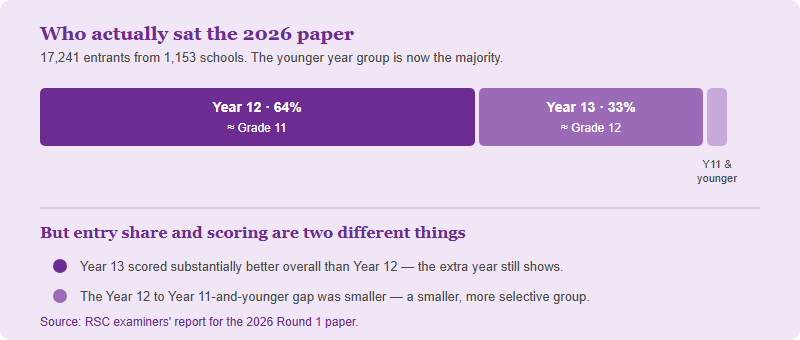
In the 2026 UK Chemistry Olympiad Round 1, 64% of entrants were in Year 12 and 33% in Year 13. The younger group is now the clear majority, and the RSC has responded by putting more early A-level material into the paper. If you are in Grade 11 at a China-based international school and assumed UKChO was something you sit in your final year, the field has already moved past that assumption.
The field flipped, and the organiser said so plainly
The examiners’ report for the 2026 Round 1 paper is explicit on two points that sit slightly in tension. The paper is still designed primarily with Year 13 students in mind. But ambitious Year 12 students have been entering in growing numbers for several years, that trend continued in 2026, and they now make up the majority of entries.
For readers using a US-style grade system, the usual mapping is Year 12 ≈ Grade 11 and Year 13 ≈ Grade 12.
| Segment of the 2026 Round 1 field | Share | What the examiners recorded |
|---|---|---|
| Year 12 (≈ Grade 11) | 64% | Now the majority of entries; a trend growing over recent years |
| Year 13 (≈ Grade 12) | 33% | The year group the paper is primarily written for |
| Year 11 and younger | a small number | Smaller and more selective; some very strong individual performances |
| State schools and colleges | ≈ 67% of centres | — |
| Independent schools and colleges | ≈ 33% of centres | — |
This matters more than a demographic curiosity, because the paper responds to it. The examiners record a deliberate effort in recent years to raise the proportion of accessible marks, aiming to include more questions drawing on A-level content that students meet earlier in the course — and they connect that decision directly to the rising number of Year 12 entrants. The paper is being written, in part, for you.
The honest counterweight: Year 13 still scores better
It would be easy to read the 64% figure as permission to treat a Year 12 entry as an equal shot. The same report closes that door. Year 13 students performed substantially better overall than Year 12 students, which the examiners describe as understandable. The extra year of A-level or IB content, and the extra year of exam maturity, still show up in the marks.
One nuance is worth noting. The gap between Year 12 and the Year 11-and-younger group was less pronounced, which the examiners attribute to that youngest group being smaller and more selective — the students entering two or three years early tend to be the ones who have gone looking for the material. That is a selection effect, not evidence that age does not matter.
The practical reading: entering in Year 12 is now completely normal rather than precocious, but you should expect your Year 12 score to sit below what the same effort would produce a year later. That is an argument for entering early and again, not for entering early instead. Our overview of what the UK Chemistry Olympiad is and how Round 1 works covers the structure that both attempts sit inside.
The 2027 window is published, and registration opens in September
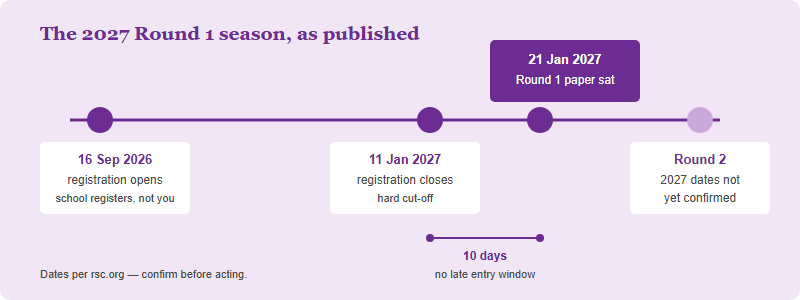
The RSC has published the dates for the next cycle. Unlike most of the planning guidance written before a season starts, these are stated figures rather than estimates — though they remain the organiser’s to change, so confirm them on rsc.org before acting.
| Milestone | Date | What it means for you |
|---|---|---|
| Round 1 registration opens | Wednesday 16 September 2026 | Your school can register from this point — not you personally |
| Round 1 registration closes | Monday 11 January 2027 | A hard administrative cut-off; missing it ends the season |
| Round 1 paper sat | Thursday 21 January 2027 | Ten days after registration closes — there is no late window |
| Round 2 | not yet confirmed for 2027 | In 2026 the top 30 scripts went to Round 2, held 9 to 12 April at the University of Nottingham |
The detail most students miss is the ten-day gap between the registration deadline and the paper. Registration closing on 11 January and the paper falling on 21 January means the administrative decision is effectively made in the autumn term, while the preparation runs through a period that overlaps mock examinations at most international schools. If your school has to be persuaded to enter at all, that conversation belongs in September and October, not January.
How entry works if your school is in China
Two structural facts govern this, and both are frequently misunderstood.
Entry is made by a school, not by a student. There is no individual sign-up route. A centre registers, administers the paper under its own supervision, marks it and submits scores. If your school does not enter, you cannot enter yourself, which is why the 182 first-time centres in 2026 matter more to an individual student than any revision plan does.
The RSC describes a regional route for schools in a defined list of territories. Its guidance states that the competition is open to secondary schools and colleges in the British Isles, with any entry fee to be confirmed on rsc.org, and separately sets out that schools in China, Hong Kong, Japan, Malaysia, Mongolia, the Republic of Korea, Singapore, Thailand and Vietnam may enter Round 1 with fees payable through ASEEDER China. British international schools overseas outside those territories are described as able to enter Round 1 where they teach in English on a British curriculum such as iGCSE, A level or IB, again with fees applying.
Three cautions belong with that:
- Confirm the current arrangement directly on rsc.org. Territory lists, fee levels and the administering partner are the organiser’s to change between seasons, and we do not restate fee amounts here because we have not verified a current figure.
- Round 1 access is not the same as Round 2 access. The published guidance addresses Round 1 entry for these schools. It does not, in the same place, spell out how overseas entrants relate to Round 2 or to a team selected to represent the United Kingdom. Do not assume the ladder continues automatically — ask the organiser.
- The age guidance is a recommendation, not a bar. The RSC notes that questions are aimed at students in their last year of study before higher education and recommends entrants be at least 16. Read alongside a field that is 64% Year 12, that reads as guidance about difficulty rather than a hard eligibility rule — but your school’s coordinator should confirm it.
The two-season strategy for a Grade 11 student
Put the composition data and the performance data together and a sensible plan falls out. Enter in Year 12 as a genuine attempt with a realistic target, then enter again in Year 13 as the peak attempt.
- Year 12: target Bronze or Silver, and treat the result as calibration. The median entrant across the whole field scored 18 out of 84 in 2026, which sits inside the Bronze band. A Year 12 student landing there is performing normally, not badly.
- Use the Year 12 paper to find your leak pattern. A first sitting under real conditions tells you more about your unit handling, your sign discipline and your time allocation than any amount of untimed practice. Our method for turning that into a plan is in our guide to using UKChO past papers diagnostically.
- Year 13: target the award band, not a mark. Because boundaries are set after marking, the stable target is a position in the field rather than a score. The 2026 boundary and participation data gives a sense of scale.
- If you are in Year 12 or below, the examiners point students in that range toward the Cambridge Chemistry Challenge later in the year as something aimed specifically at younger candidates. We do not set out its rules here; confirm them with that competition’s own organiser.
The version of this that goes wrong is the student who waits for Year 13 to make a single attempt, discovers their unit discipline in the one sitting that counted, and has no second season left. In a field where two thirds of entrants are already a year younger than that, waiting is no longer the cautious choice.
Frequently asked questions
Can a Year 12 student enter UKChO Round 1?
Yes — Year 12 made up 64% of the 2026 field. The RSC recommends entrants be at least 16; confirm with your school.
When is UKChO Round 1 in 2027?
The RSC lists Thursday 21 January 2027, with registration open from 16 September 2026 to 11 January 2027. Confirm on rsc.org.
Can a school in China enter UKChO?
RSC guidance describes a Round 1 route for schools in China and several other territories, with fees via ASEEDER China. Confirm on rsc.org.
Do Year 12 students score as well as Year 13?
No. The 2026 examiners recorded Year 13 performing substantially better overall, which is why a two-season plan works better.
This is an independent guide operated by Hanlin Education for China-based international-school students. We are not affiliated with, endorsed by, or sponsored by the Royal Society of Chemistry (RSC). Entry eligibility, registration routes, fees and dates are set by the organiser and change from season to season — confirm current details on rsc.org before acting on anything here. Any factual error brought to our attention is corrected within 7 working days.