Every one of the five offer files below contains a UKChO gold — and in none of them does the gold stand alone. These are trajectories from our own coaching records (initials only, as published in our offer reports): offers from Oxford, Cambridge, Imperial College, UCL and Yale, each anchored by the same award and each surrounded by different corroborating evidence — a second chemistry contest from another country, an adjacent olympiad, a research competition, a near-perfect predicted score. With UKChO 2027 registration opening on 16 September, this is the most useful lens we can offer on what the competition actually does inside an application: it does not open doors by itself; it makes the rest of the file believable.
Five files, one anchor award
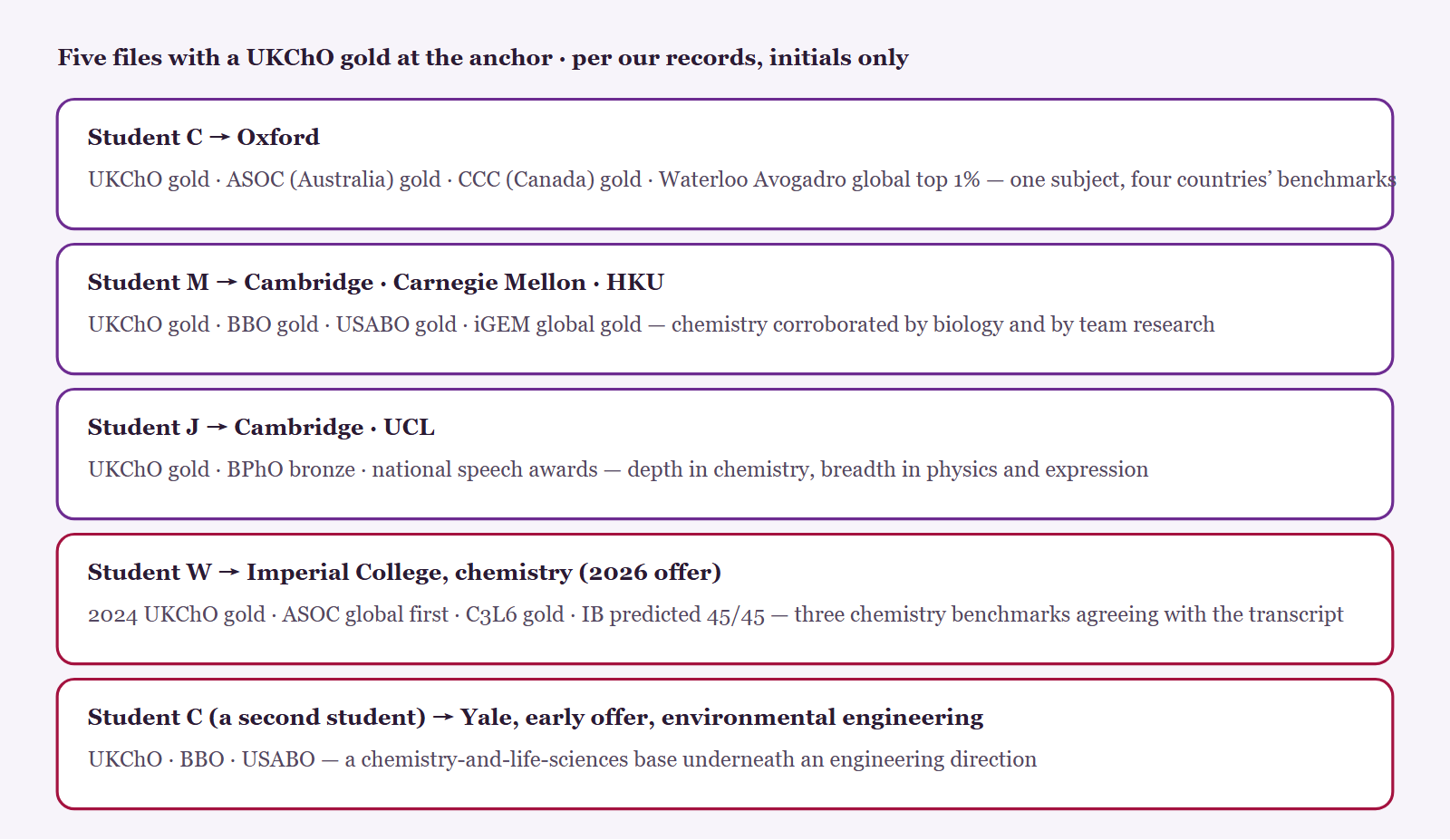
Read the right-hand halves of those rows, because that is where the pattern lives. Student C’s Oxford file pairs the UKChO gold with golds in the Australian and Canadian chemistry olympiads and a top-1% Avogadro result — the same subject measured by four different countries’ benchmarks, all agreeing. Student W’s Imperial file does it vertically instead: UKChO gold, ASOC global first and a C3L6 gold stacked on an IB predicted 45/45, so the competition results and the transcript tell one story about the same student (we covered how C3L6 and UKChO fit one school year in the two-competitions guide). Student M’s file reaches sideways — biology olympiads and an iGEM research gold around the chemistry anchor — while the second Student C runs the same chemistry-plus-life-sciences base under an environmental engineering application. Different architectures, same principle.
The cross-checking logic, made explicit
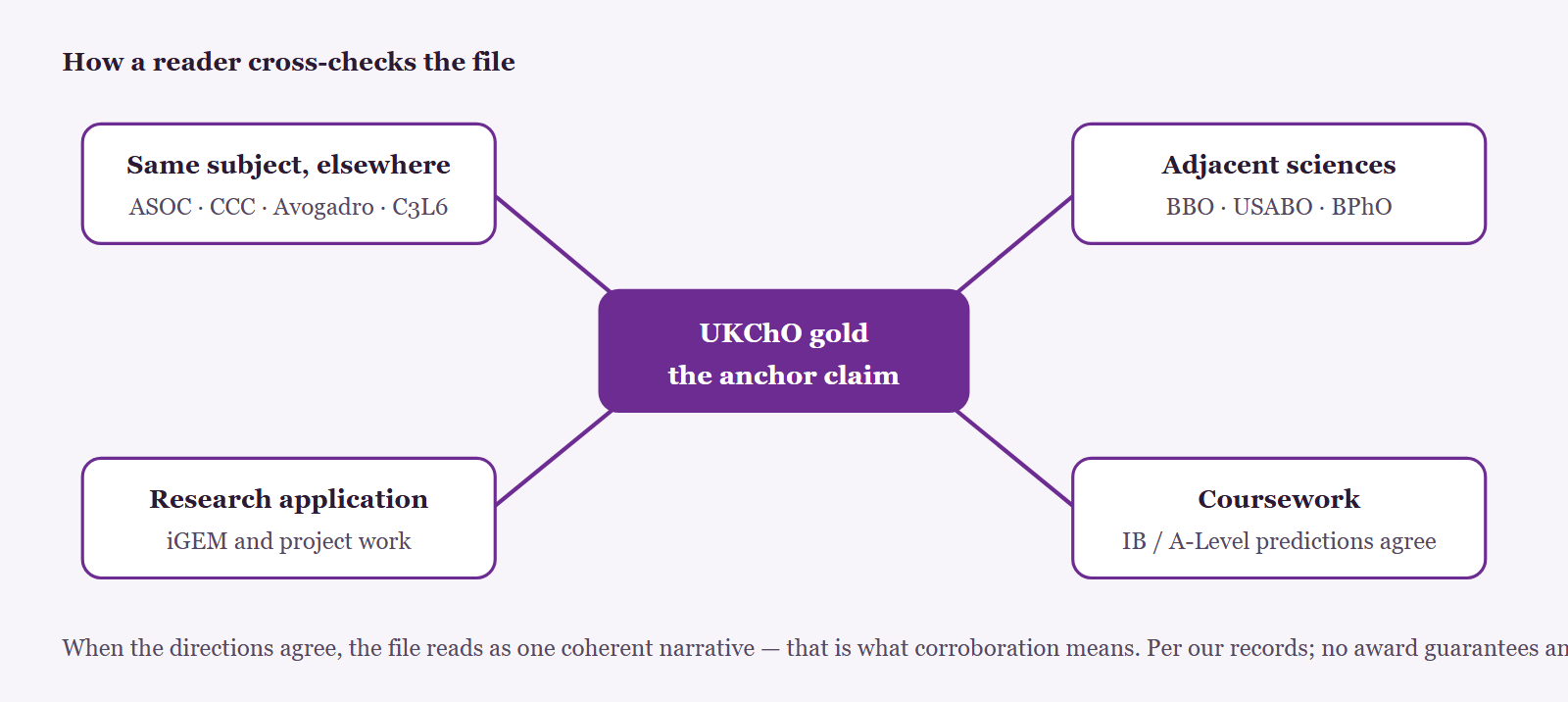
This is also why we would caution against reading these five trajectories as a formula. What an admissions reader responds to is not the count of golds but the agreement between independent pieces of evidence: a competition result corroborating a transcript, a second country’s benchmark corroborating the first, a research project showing the same subject applied rather than only examined. A student with one honest UKChO result and coursework that agrees with it has the beginning of the same structure. A student with five awards in five unrelated directions does not. Build agreement, not volume.
What this means for the 2027 cycle, starting this month
Registration opens 16 September, and the runway logic follows from the trajectories above. If chemistry is your subject, the UKChO Round 1 in late January is the anchor to plan around — the two-calendar guide covers the RSC and China-region dates and deadlines, and the gold-boundary analysis covers what last season’s 38-of-84 gold line says about the target. The corroborating pieces then slot around it by profile: a second same-subject benchmark if you want the Student-C architecture, C3L6 in June if you want Student W’s vertical stack, an adjacent olympiad if your direction is broader — the full ladder is mapped in the Round 1 to international guide. One year is enough time to build one agreement, not five; choose the corroboration that fits the story your file is already telling.
Frequently asked questions
Does a UKChO gold get you into Oxford or Cambridge?
No single award does, and we do not claim otherwise. What our records show is corroboration: in the five files above, the UKChO gold sat alongside independent evidence — same-subject contests from other countries, adjacent olympiads, research projects, near-perfect predicted grades — and the agreement between those pieces is what makes a chemistry narrative believable to a reader. The gold anchors the file; it does not carry it alone.
Which awards pair well with a UKChO result?
By architecture, from our records: same-subject benchmarks from other countries (ASOC, CCC, Waterloo’s Avogadro) make the chemistry claim internationally legible; C3L6 stacks a Cambridge-adjacent benchmark vertically on the same subject; adjacent olympiads (BBO, USABO, BPhO) broaden a science profile; and a research competition such as iGEM shows the subject applied. Choose one direction that fits your story rather than collecting all of them.
Are these real students?
Yes — these five trajectories are from our own coaching records and published offer reports, de-identified to initials. They are our records, not an official statistic from any organiser, and outcomes vary by the whole file: results like these describe what corroboration looks like, not a guaranteed path.
When should a 2027 candidate start?
Now. Registration opens 16 September 2026 and Round 1 sits in late January 2027 on both calendars, which leaves roughly nineteen weeks — enough for the anchor result plus one corroborating piece, chosen to agree with the rest of your file. The two-calendar guide on this site covers the exact dates and deadlines by entry route.
This is an independent guide. We are not affiliated with, endorsed by, or sponsored by the Royal Society of Chemistry. The five trajectories are from Hanlin’s own coaching records and published offer reports, de-identified to initials; they are our records, not organiser statistics. Competition dates per the RSC and the regional organising channel — confirm at registration. Corrections within 7 working days of notice.