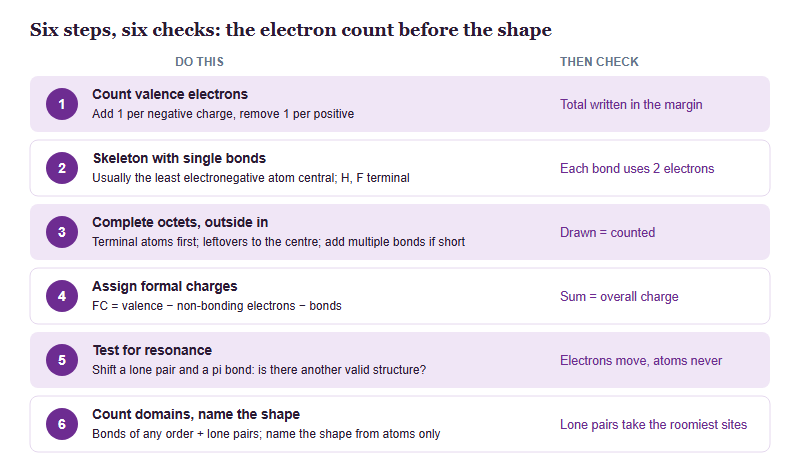
UKChO bonding marks are lost to bookkeeping, not to hard theory. The RSC’s examiners’ report on the 2026 paper records chlorine atoms drawn without a full octet, candidates in the isocyanide question unsure how many lone pairs there were or where they sat, and diazonium charges placed on the wrong atom. One written routine prevents all three: count valence electrons, place bonds, complete octets, assign formal charges, test for resonance, then read the shape from electron domains.
What the 2026 report says actually went wrong
Round 1 in 2026 was a two-hour paper marked out of 84, sat by a record 17,241 students. Gold started at 38, Silver at 23 and Bronze at 13 — so a handful of bonding marks is often the difference between bands. Our analysis of the 2026 Round 1 results shows how tightly those bands are packed.
The examiners’ question notes are unusually specific about bonding, and they point somewhere surprising. Shapes were not the weakness: on the opening question, molecular shapes were handled confidently even for unfamiliar species. The weakness was the counting that has to happen before a shape can be drawn.
| What the examiners recorded (2026, paraphrased) | The step that was skipped | The ten-second check that catches it |
|---|---|---|
| Incomplete dot-and-cross diagrams; chlorine atoms often drawn without a full octet (Q1) | Step 3: completing octets | Electrons drawn must equal electrons counted |
| In the isocyanide question, many candidates struggled with the number of lone pairs, their location, or both (Q2) | Steps 1 and 4: the count and the formal charges | The formal charges must add up to the overall charge |
| The examiners suggested that resonance and delocalisation may not be fully secure for all students (Q2) | Step 5: testing for resonance | Can a lone pair and a pi bond shift to give another valid structure? |
| Diazonium salt structures caused difficulty with bonding and charge placement; the topic has appeared in earlier papers (Q4) | Step 4: formal charges | Every charge label must agree with the formal-charge arithmetic |
| Molecular shapes handled confidently, even on unfamiliar species (Q1) | None — shape was the strength | Keep doing it, but only after the count is right |
Steps 1 to 3: the count and the octets
Start by writing the total number of valence electrons in the margin, before drawing anything. For main-group atoms that is carbon 4, nitrogen 5, oxygen 6, halogens 7 and xenon 8. Add one electron for each negative charge on an ion and remove one for each positive charge. This single number is what every later check is measured against.
Then build the skeleton. The least electronegative atom usually sits in the centre; hydrogen and fluorine are almost always terminal. Join the atoms with single bonds, complete the octets of the terminal atoms, and give whatever electrons remain to the central atom as lone pairs. Only if the central atom is still short of eight do you convert a lone pair on a neighbour into a multiple bond.
Take sulfur dichloride, SCl2, as an illustration. The count is 6 + 7 + 7 = 20 electrons. Two S–Cl bonds use 4. Each chlorine needs three lone pairs to reach eight, which uses 12 more. That leaves 4 electrons, which become two lone pairs on sulfur. Drawn, counted and checked: 20 = 20. Now look at the error the examiners saw. A diagram that shows the two bonds and sulfur’s lone pairs but leaves the chlorines bare accounts for only 8 electrons. The count in the margin exposes that immediately, however confident the drawing looks.
Two limits keep the octet step honest. Carbon, nitrogen, oxygen and fluorine never hold more than eight electrons — if your structure gives one of them ten, it is wrong. Atoms from period 3 onward can hold more than eight, as sulfur does in SF6, so an expanded octet on phosphorus, sulfur, chlorine or xenon is not a mistake in itself.
Steps 4 and 5: formal charge locates a charge, resonance spreads it
Formal charge is the bookkeeping that locates charges and settles which of two drawings is better. For each atom:
Formal charge = valence electrons − non-bonding electrons − number of bonds
Two rules decide between candidate structures, and their order matters. First, give every period 2 atom a full octet. Second, among structures that do, prefer the one with the fewest formal charges, with any negative charge on the more electronegative atom. Carbon monoxide shows why the order matters: the structure with a triple bond puts −1 on carbon and +1 on oxygen, while a double-bonded version has no formal charges but leaves carbon with only six electrons. The octet wins, so the triple-bonded structure is the better one, charges and all.
| Species | Better structure | Formal charges | The error to avoid |
|---|---|---|---|
| Diazonium ion, Ar–N2+ | Ar–N≡N, lone pair on the terminal N | +1 on the N bonded to the ring; 0 on the terminal N | Writing the + on the terminal nitrogen, where the arithmetic gives zero |
| Isocyanide, R–NC | R–N≡C, lone pair on carbon | +1 on N, −1 on C; overall neutral | Putting the lone pair on nitrogen, which belongs to the nitrile |
| Nitrile, R–CN | R–C≡N, lone pair on nitrogen | None | Treating it as interchangeable with the isocyanide |
| Carbon monoxide, CO | C≡O, one lone pair on each atom | −1 on C, +1 on O | Choosing C=O to avoid charges and leaving carbon with six electrons |
| Azide ion, N3− | N=N=N, two lone pairs on each end N | −1 on each end N, +1 on the centre; sum −1 | A drawing whose charges do not add up to the ion’s charge |
The diazonium row is worth walking through, because the examiners flagged it and noted the topic has appeared before. The nitrogen attached to the ring has four bonds and no lone pair: 5 − 0 − 4 = +1. The terminal nitrogen has three bonds and one lone pair: 5 − 2 − 3 = 0. So the positive charge belongs on the inner nitrogen. A student who writes the + on the terminal nitrogen while also drawing its lone pair has produced a label that contradicts the drawing — which is exactly what Step 4 is designed to catch.
The isocyanide and nitrile rows make the related point about lone-pair location. They contain the same atoms in a different order, and the order moves both the lone pair and the formal charges. Isocyanides also have a minor contributor, R–N=C with a lone pair on carbon, but it leaves carbon with only six electrons, so the triple-bonded form is the major one.
Step 5 is the resonance test. Whenever you can move a lone pair and a pi bond to produce another structure that passes Steps 3 and 4, the species is not described by a single diagram. The real structure is a hybrid of the contributors — it does not flip between them — and charge or electron density is spread over several atoms. Three rules keep resonance drawing legal: atoms never move, only electrons; every contributor has the same total number of electrons; and every contributor has the same overall charge.
The payoff is that resonance explains things a single structure cannot. Ozone has two identical O–O bonds, not one single and one double, because its two contributors put the double bond on either side. The two carbon–oxygen bonds in a carboxylate ion are identical for the same reason, as are the three N–O bonds in nitrate. In an amide, the nitrogen’s lone pair is delocalised into the carbonyl group, which gives the C–N bond partial double-bond character, keeps the nitrogen planar, and makes amides far weaker bases than amines. In aniline, the nitrogen lone pair is partly delocalised into the benzene ring, so aniline is a weaker base than a simple aliphatic amine.
That is why lone-pair location and resonance travel together: “where is the lone pair?” sometimes has the answer “spread across several atoms”, which only the second contributor reveals.
Step 6: shape from electron domains
Only now draw the shape. Count electron domains around the central atom: every bond counts as one domain whatever its order, and every lone pair counts as one. The number of domains fixes the electron arrangement; the shape is then named from where the atoms are, ignoring the lone pairs.
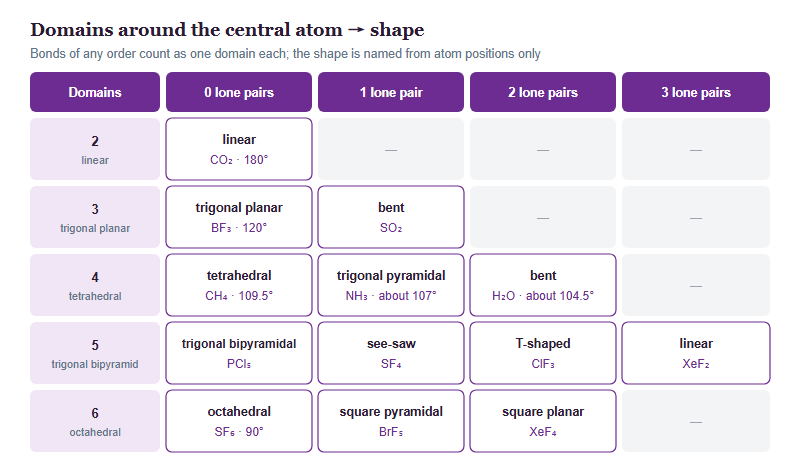
Three refinements turn the grid into marks. Lone pairs repel more strongly than bonding pairs, which is why the angle in ammonia is about 107° and in water about 104.5° rather than the tetrahedral 109.5°. In a five-domain arrangement, lone pairs occupy equatorial positions, where they have the most room — that single rule is what distinguishes see-saw SF4, T-shaped ClF3 and linear XeF2. And shape names describe atoms only: water has four electron domains but is described as bent.
If your course uses hybridisation, the labels line up with the domain count — two domains sp, three sp2, four sp3 — but the label is a description of the geometry, not a way to find it. Treat new orbital ideas the same way: the examiners report that a part of the 2026 paper introducing orbitals separated candidates effectively, with sequences written in the reverse order a common error. When a question teaches you a model, read its definitions slowly and apply them literally.
A three-week bonding drill you can mark yourself
Bonding is one of the few areas where you can self-mark with certainty, because every structure carries two arithmetic checks: electrons drawn must equal electrons counted, and formal charges must sum to the overall charge. Use that.
- Week 1 — counts and octets. Twenty species a session, mixing neutral molecules with ions such as NH4+, H3O+, BF4−, ClO− and CN−. Write the total in the margin first, every time, and draw every lone pair on every halogen.
- Week 2 — formal charges and resonance. Carbon monoxide, azide, ozone, nitrite, a diazonium ion, an isocyanide beside its nitrile, and an amide. For each, draw every valid contributor and state which is major and why.
- Week 3 — shapes, including expanded octets. SF4, ClF3, XeF2, BrF5 and the triiodide ion, I3−. Name the electron arrangement, the shape and any deviation from ideal angles in one sentence each.
Then return to real papers. Go through the practice pack and re-attempt every bonding part you previously dropped marks on, applying all six steps in writing even when the answer looks obvious. The past-paper pack we have gathered ourselves includes worked solutions for some years and not for every year; where no solution exists, the two arithmetic checks let you mark the structure yourself. Our guide to using UKChO past papers as a diagnostic explains how to log which step failed rather than just which question. If you are still getting your bearings on the competition itself, start with what the UK Chemistry Olympiad is.
With entry for 2027 open since 16 September on the RSC’s schedule and Round 1 in late January, this block fits before full-paper practice begins. By January the count should be a reflex, not a procedure.
Frequently asked questions
Does a terminal chlorine atom always need three lone pairs?
A chlorine joined by one single bond carries three lone pairs, giving eight electrons. Leaving them off was a common error in 2026.
Where does the positive charge sit in a diazonium ion?
On the nitrogen bonded to the ring. It has four bonds and no lone pair, so its formal charge is +1; the terminal nitrogen is 0.
Can period 2 atoms have more than eight electrons?
No. Carbon, nitrogen, oxygen and fluorine never exceed eight. Atoms from period 3 onward, such as sulfur in SF6, can do so.
Do lone pairs count when naming a molecular shape?
They set the electron arrangement, but the shape is named from atom positions only, so four domains with one lone pair is trigonal pyramidal.
This is an independent guide operated by Hanlin Education for China-based international-school students. It is not affiliated with, endorsed by, or sponsored by the Royal Society of Chemistry (RSC). Examiners’ comments are paraphrased from the RSC’s published report; dates, eligibility, paper format and award boundaries are set by the organisers and change from year to year — confirm current details on rsc.org. Factual errors are corrected within 7 working days of being reported.