Whether you need a UKChO coach depends on what is actually costing you marks, not on how hard the competition looks. Missing course chemistry is fixed with a textbook and your teacher; missing tempo with a timetable; unmarked reasoning with a reader who marks by method; freezing on unfamiliar contexts with guided exposure. Paid coaching adds most on the last two. Entry for 2027 opens on 16 September, so find your bottleneck in the next fortnight.
A disclosure before anything else: Hanlin Education, which runs this guide, also runs UKChO preparation courses. Read what follows with that in mind. We have tried to write the test we would want a family to apply to any provider — including us — and to say plainly where paying for help is poor value.
What the 2026 paper says about where marks go
Start from the paper rather than from the brochure. Round 1 in 2026 was sat on 28 January, lasted two hours and was marked out of 84. A record 17,241 students from 1,153 schools took part. Gold started at 38 (8.5% of entrants), Silver at 23 (25.7%) and Bronze at 13 (36.5%); our decode of the 2026 Round 1 results has the full distribution.
The RSC’s examiners’ report for that paper adds three facts that matter for this decision. The mean score was 20 and the median 18, so the typical entrant left most of the paper unscored. Roughly 29% of candidates scored between 0 and 12 and received no award. And the grade boundaries were set to give approximately the same share of each award as in previous years — which means a medal is a position within the field, not a fixed number any course can promise you.
The report’s question-by-question notes are even more useful. The recurring losses were not exotic chemistry: unbalanced equations, incomplete dot-and-cross diagrams, units and powers of ten, missing minus signs, joules confused with kilojoules, one tautomer drawn where the question left the number open, and a colour guessed despite a colour wheel on the data sheet. The examiners also state that where reasoning is not shown, moderators cannot award method marks or carry an error forward. Our reading of those notes is that much of what separates a Bronze script from a Silver one is written reasoning and bookkeeping — and that changes what kind of help is worth buying.
Five bottlenecks, five different fixes
“Coach or no coach” is the wrong first question, because different problems have different cheapest cures. In our own marking of practice scripts, a student’s lost marks usually cluster in one or two of five places. Identify yours before spending money or evenings.
| Bottleneck | What it looks like on a timed paper | Cheapest effective fix | Where a coach adds real value | Where a coach adds little |
|---|---|---|---|---|
| A. Course chemistry not secure | Blanks on parts that, stripped of their story, are ordinary A-level, IB or AP topics | Your own textbook, plus your school teacher checking a few answers | Deciding what to repair first | Re-teaching what your school already covers |
| B. Chemistry beyond your course | You cannot start parts built on ideas your syllabus never reached | A short, targeted reading list | Choosing which extra topics pay, and explaining them fast | Topics you could read alone in an evening |
| C. Reasoning that never reaches the page | Right idea, marks lost to signs, units, octets, missing working or one answer where several exist | A second reader who marks by method every week | Consistent, calibrated marking and written feedback | Nothing, if nobody ever marks your scripts |
| D. Stalling on unfamiliar contexts | You abandon a question as soon as the species or the story is new | A high volume of olympiad-style problems | Live challenge, and modelling how to read a long stem | Lectures that stay inside familiar examples |
| E. No timed tempo | You read and revise, but rarely sit silent, timed questions | A timetable, or a study group with a clock | Accountability, if sessions include timed work | Anything, if you do no timed work between sessions |
Notice what the table implies. Rows A and E rarely justify a paid course: they are fixed by hours and structure, which you can supply yourself. Rows C and D are where outside help earns its place, because both need a skilled second person — someone who can see the step you skipped, or ask the question that exposes it. Row B sits in between: a coach fits it well, but a well-chosen reading list often does the same job for less.
A two-hour test to find yours
You need one honest data point, not a feeling. Sit one complete past paper under exam conditions: two hours, silent, no notes, and only the equipment and data the real paper allows. Then mark it by method rather than by final answer. Where a worked solution exists for that year, mark against it; the pack of past papers we have gathered ourselves has worked solutions for some years and not for every year, so for other years agree what a full answer must contain before you mark.
Now do the part most students skip. Go back through every lost mark and give it one letter from the table. Do not classify by topic — “organic” tells you nothing about the cure. Classify by cause. A missing minus sign is C even if it sits in a thermodynamics question; a blank on a mechanism you have never met is B or D, depending on whether the chemistry or the unfamiliarity stopped you. Our method for using past papers as a diagnostic covers how to review a timed attempt so that it produces this kind of information.
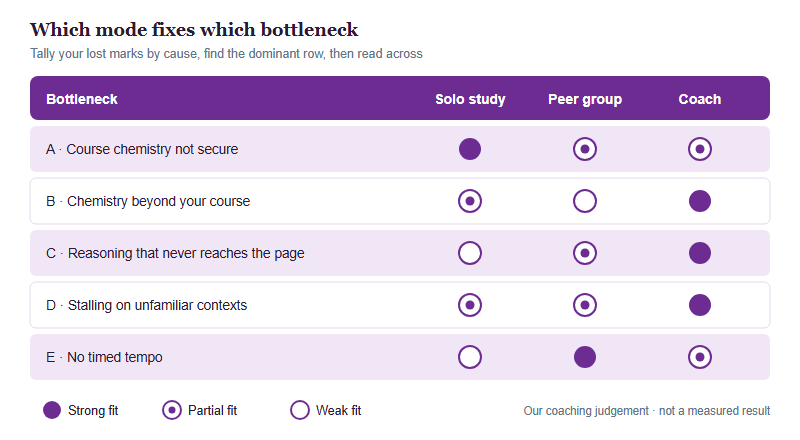
Then apply simple decision rules. If A dominates, a paid course is poor value this month: repair your own course first, because the cheapest marks on the paper live there. If E dominates, build a timetable or join a study group before buying anything. If C or D dominates — and particularly if nobody at your school will ever mark an olympiad-style script — that is the profile for which outside marking and challenge are worth paying for. If B dominates, try a targeted reading list for three weeks, then re-test.
Eight questions to ask any course, including ours
If the diagnostic points to outside help, vet the help. These questions are designed to be asked out loud, and a good provider should answer each one without discomfort.
- How much of each session is timed attempting rather than listening? A strong answer describes a substantial silent, timed block in most sessions. A weak answer is a lecture schedule with problems “set for homework” that nobody checks.
- Who marks my written work, how soon, and against what? Round 1 is marked by teachers in school and then moderated, and the 2026 examiners were explicit that unshown reasoning cannot earn method marks or error-carried-forward credit. You want marking by method, with written comments, returned before the next session. Checking final answers only is not marking.
- Which past papers will I work from, and which years have worked solutions? Good providers tell you exactly what their material covers and where it stops. Vagueness here usually means the marking in question 2 is vague too.
- Do you claim any official link to the RSC or to UKChO? The RSC runs the competition. An independent course — like this guide and like our own courses — should say plainly that it is independent. Check any “official” or “approved” claim against rsc.org before believing it.
- What exactly do you promise? Preparation, feedback and structure can be promised. A medal cannot: the boundaries are set each year from the whole field’s performance, and in 2026 only 30 students were invited to Round 2 from more than seventeen thousand entrants. Treat any guarantee of an award or a Round 2 place as a reason to walk away.
- Which sitting and deadline are you planning around? A good answer names your route. On the RSC’s schedule, entry runs from 16 September 2026 to 11 January 2027 and Round 1 is on Thursday 21 January 2027 for UK school centres; the RSC also says it cannot accept registrations from students directly, so your school registers. The China-region sitting, per the organising channel’s notice, is Friday 22 January 2027 and also closes on 11 January — an evening, computer-based session per earlier notices, with the timing to be confirmed at booking. Neither calendar corrects the other. A provider who is vague about which applies to you, or about who books your sitting, has not planned your season.
- Do you start from my diagnostic, or from chapter one? A course that ignores your bottleneck and starts every student at the same page is selling a syllabus, not preparation.
- What will I own at the end? Marked scripts, an error log and your own written explanations are the durable output. They also matter later: an admissions reader checks an award against the transcript, the activity list and the essays, and a record of how you actually worked is what lets those strands corroborate each other.
Two further signals are worth weighing. Class size matters less than whether every student attempts and is marked every week. And price matters less than hours of marked, timed work per pound or yuan spent — a cheaper course that is mostly lecture can cost more per useful hour than a dearer one that is mostly practice.
Three checkpoints to review your choice
The choice you make in September is a hypothesis, not a contract. Build in points where you check whether it is working, and switch if it is not. The dates on the right of the timeline below are published ones; the checkpoints on the left are our own advice.
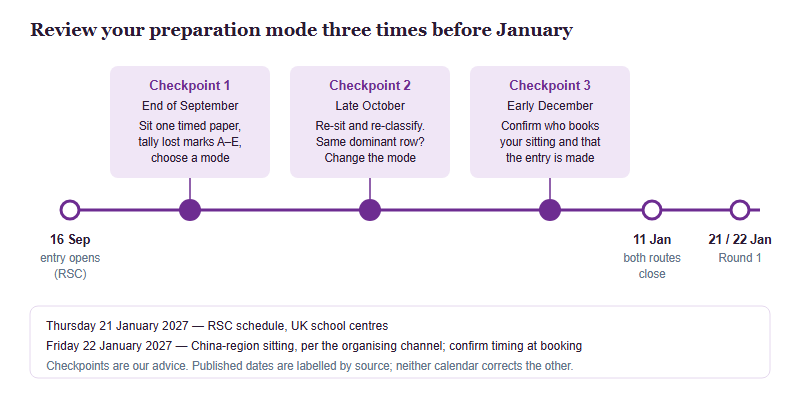
Checkpoint 2 deserves a rule of its own. Compare the letter tallies from September and October, not the total scores. A total can rise simply because the second paper suited you. A shift in which letter dominates — C shrinking, say, while B becomes the new largest row — is real progress and tells you what to change next. If the dominant letter is unchanged after six weeks of a mode, the mode is not working for you, whoever is providing it.
Keep the scale of the season in view too. The examiners’ report notes that the paper was designed primarily with Year 13 students in mind, while 64% of the 2026 entrants were in Year 12. A Year 12 student has a second season available, which lowers the stakes of this autumn’s choice; a Year 13 student does not, which raises the value of getting checkpoint 1 right. If you are still weighing whether to enter at all, begin with our introduction to the UK Chemistry Olympiad.
Frequently asked questions
Can a course enter me for UKChO?
On the RSC’s route, no: it takes no registrations from students directly, so your school registers. The China-region sitting is booked separately.
Can any course guarantee a UKChO medal?
No. Boundaries are set each year to give roughly the same share of each award, so they depend on the whole field, not on any course.
Is a study group enough without a coach?
Often, when tempo or course knowledge is the problem. When written reasoning or unfamiliar contexts cost you most, a skilled marker adds more.
When should I decide how to prepare?
Within two weeks of entry opening on 16 September, after one timed diagnostic paper. Then review the choice again in late October.
This is an independent guide operated by Hanlin Education for China-based international-school students. It is not affiliated with, endorsed by, or sponsored by the Royal Society of Chemistry (RSC). Dates, eligibility, entry routes, paper format and award boundaries are set by the organisers and change from year to year — confirm current details on rsc.org and with whoever books your sitting. Factual errors are corrected within 7 working days of being reported.