Most students prepare for UKChO by drilling organic mechanisms and physical calculations, then meet an inorganic question and discover they can state periodic trends but not explain them. Inorganic chemistry is where preparation is thinnest: it rewards causal explanation, oxidation-state bookkeeping and redox fluency rather than pattern recognition. This is what to fix, and how.
The part of the syllabus almost nobody drills
Ask a student what they have practised for an olympiad paper and you will usually hear mechanisms, moles and energetics. Ask them when they last wrote a balanced half-equation from scratch, or explained why the first ionisation energy of sulfur is lower than that of phosphorus, and the answer is often that they have not since they were taught it.
There is a structural reason for this. A-Level, IB and AP courses assess inorganic chemistry heavily through recall — state the trend, name the colour, recall the test. Olympiad-style questions ask you to do something with it: explain the trend from electronic structure, predict an unfamiliar analogue, or use a redox reaction quantitatively. The knowledge feels familiar, so it does not get revised; the skill was never built, so it fails under time pressure.
Before deciding how much time to give this, run an audit rather than trusting an impression. Take the papers in your practice pack, and mark every part you left blank or guessed with the topic family it came from. If inorganic parts cluster in that list, you have found the cheapest marks available to you. How much inorganic appears varies from year to year, and RSC states there is no published syllabus for the Chemistry Olympiad — judge coverage across several papers rather than inferring it from one.
| Inorganic area | What an olympiad-style question asks you to do | The exam-board habit that fails | The drill that fixes it |
|---|---|---|---|
| Periodic trends | Explain a trend, or account for an anomaly, from electronic structure | Reciting “increases across a period” with no cause | Write three-clause explanations: charge, distance, shielding |
| Ionisation energies | Deduce group or configuration from successive-value jumps | Treating values as facts to memorise | Given a list of successive values, locate the big jump and assign the group |
| Transition metals | Assign oxidation states, deduce coordination number and geometry | Recalling named colours without the underlying cause | Oxidation-state bookkeeping on unfamiliar complex ions |
| Redox | Balance half-equations in acid or alkali, then use them quantitatively | Relying on remembered overall equations | Build half-equations from scratch, five a week |
| Titration stoichiometry | Convert a titre into a quantity through a non-1:1 ratio | Assuming a 1:1 mole ratio by reflex | Practise ratios that are not 1:1 until the check is automatic |
| Ionic energetics | Construct a Born–Haber cycle and interpret a discrepancy | Learning the cycle as a diagram to reproduce | Build cycles from definitions, then explain a mismatch |
Periodicity: explaining trends, not reciting them
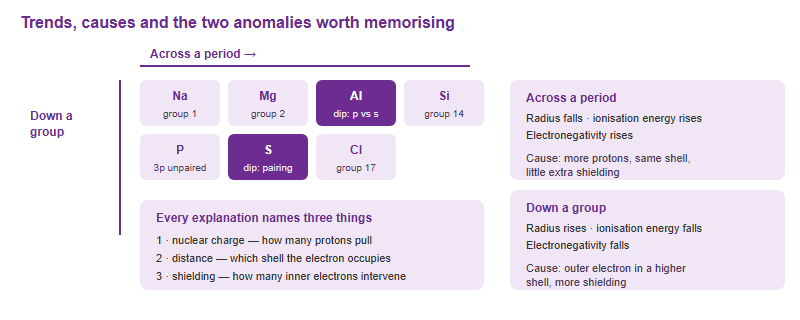
Almost every periodicity question that costs marks does so at the word “because”. The trend itself is usually easy; the explanation has a required shape, and it has three parts. Nuclear charge: how many protons are pulling. Distance: which shell the electron sits in. Shielding: how many inner electrons are in the way. A complete explanation names all three and says which one dominates.
So an answer such as “first ionisation energy increases across a period because the atoms get smaller” is only half an answer, and the half it gives is the consequence rather than the cause. The cause is that nuclear charge rises while electrons enter the same shell with essentially unchanged shielding, so the attraction on the outermost electron increases — and the atomic radius falls for the same reason.
The anomalies are where the marks concentrate, because they cannot be answered by a general trend at all. Two are worth being fluent in:
- The drop from group 2 to group 13 (magnesium to aluminium in period 3). The electron removed comes from a p sub-shell rather than an s sub-shell. A p electron is at slightly higher energy and is better shielded by the filled s sub-shell, so less energy is needed to remove it despite the higher nuclear charge.
- The drop from group 15 to group 16 (phosphorus to sulfur). In phosphorus the three p electrons are unpaired in separate orbitals; in sulfur one p orbital holds a pair. Repulsion between that pair makes the electron easier to remove.
The same three-clause discipline covers electronegativity, atomic and ionic radius, and the change in oxide character from basic through amphoteric to acidic across a period. Practise by writing the explanation before you look at the trend, so you are reasoning from structure rather than rationalising a remembered answer.
Transition metals: bookkeeping first, colour second
Transition-metal questions look intimidating because the species are unfamiliar. They are usually tractable because the reasoning is procedural. Almost all of it starts with oxidation-state bookkeeping, and that is a skill you can practise on species you have never seen.
The routine: assign the known oxidation states first (oxygen usually −2, halide ligands −1, neutral ligands such as water and ammonia contribute zero), then solve for the metal so the sum matches the overall charge on the ion. In a complex ion, count the ligands to get the coordination number, and let that suggest geometry — six ligands normally octahedral, four either tetrahedral or square planar.
From there, the standard themes become answerable:
- Variable oxidation state. The 4s and 3d sub-shells are close in energy, so several oxidation states are accessible for one element — which is why transition metals dominate redox chemistry and catalysis.
- Colour. Ligands split the d orbitals into groups of slightly different energy. An electron absorbs a photon of visible light to move between them, and the colour you see is what remains after that absorption. It follows that species with no d electrons, or with a full d sub-shell, are typically colourless — a prediction you can make about an unfamiliar ion.
- Ligand substitution. Replacing one ligand with another changes the splitting, which changes the colour. That is why these reactions are used as observations in questions.
- Catalysis. Accessible oxidation states let a metal accept and release electrons, or bind a substrate, offering a lower-energy route.
- Configuration exceptions. Chromium is [Ar] 3d5 4s1 and copper is [Ar] 3d10 4s1, because a half-filled or filled d sub-shell is a lower-energy arrangement than the naive filling order predicts.
Practise on ions you do not recognise. The point is not to accumulate more named complexes; it is to be able to take an unfamiliar formula, extract the oxidation state and coordination number in twenty seconds, and start reasoning — which is exactly what an olympiad paper builds unfamiliar context around.
Redox: build the half-equation, then use it quantitatively
Redox is where inorganic knowledge turns into marks in the calculation sections, and it is the single highest-yield drill in this article. Students who rely on remembered overall equations stall the moment a question uses a reagent they have not memorised. Students who can build a half-equation from an oxidation-state change never stall, because the procedure does not depend on recognition.
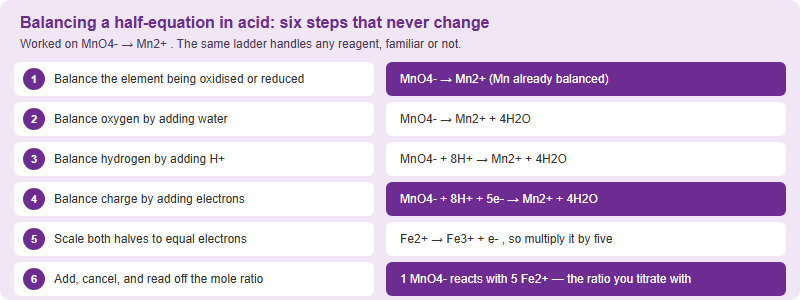
Step 6 is where marks are actually won and lost. The mole ratio that falls out of the balanced equation is the ratio you must use in the titration arithmetic, and it is frequently not 1:1 — one manganate(VII) ion to five iron(II) ions in the example above, and one iodine molecule to two thiosulfate ions in the classic iodine–thiosulfate titration. A candidate who assumes 1:1 by reflex gets an answer wrong by a factor of five while doing every other step correctly. Build in the habit of writing the ratio explicitly, in a box, before any arithmetic starts. The wider set of numerical habits that protect calculation marks is covered in our piece on using past papers as a diagnostic, which is the right way to find out which of these failures is yours.
One more area belongs here because it sits between inorganic and energetics: Born–Haber cycles. Build them from the definitions of each enthalpy change rather than memorising a diagram, because a question can start you at a different point in the cycle. And know what a discrepancy means: when the lattice enthalpy calculated from a purely ionic model differs from the experimental value, the bonding has covalent character — typically when a small, highly charged cation polarises a large, easily distorted anion. Being able to say that sentence in an exam is worth more than being able to redraw the cycle.
A four-week inorganic repair block
This is deliberately small. Inorganic is not where the majority of your preparation should sit; it is where a disproportionate number of cheap marks sit unclaimed. Four focused weeks at two to three hours a week will usually close the gap.
- Week 1 — explanation drills. Ten trend questions, each answered in three clauses (charge, distance, shielding). Include both ionisation-energy anomalies until you can produce them without hesitating.
- Week 2 — oxidation-state bookkeeping. Twenty unfamiliar species, assigning oxidation state, coordination number and likely geometry. Speed is the target: under twenty seconds each.
- Week 3 — redox construction. Five half-equations built from scratch each session, half in acid and half in alkali, then combined into overall equations with the mole ratio boxed.
- Week 4 — applied. Titration calculations with non-unity ratios, plus two Born–Haber cycles built from definitions with one discrepancy explained.
Then verify against real material rather than against your own confidence: return to the papers in your practice pack and re-attempt the inorganic parts you previously left blank. Our gathered past-paper pack includes worked solutions for some years but not for every year, so where none exists, check your half-equations by conservation of atoms and charge — both must balance, which makes redox one of the few areas you can self-mark with certainty.
Keep the payoff in proportion. Round 1 is a two-hour paper marked out of 84; in 2026 it was sat on 28 January by a record 17,241 students from 1,153 schools, with Bronze from 13, Silver from 23 and Gold from 38. Against that scale — ten marks between Bronze and Silver, fifteen between Silver and Gold — four or five recovered inorganic marks can decide the band for anyone sitting just below a boundary — and they are marks that require no new mechanism practice at all. If you are still mapping the competition as a whole, start with what the UK Chemistry Olympiad is; if you want to see how those boundaries were distributed, the 2026 Round 1 results decoded sets the benchmark.
Frequently asked questions
How much inorganic chemistry is on UKChO Round 1?
It varies by year, and RSC states there is no published syllabus for the Chemistry Olympiad. Audit several papers in your practice pack rather than looking for an official topic list.
Do I need to memorise transition-metal complex colours?
Understanding beats recall. Know why d-orbital splitting produces colour, so you can reason about complexes you have never seen before.
What is the highest-yield inorganic drill?
Building redox half-equations from scratch. It is reagent-independent, self-checkable by atom and charge balance, and feeds directly into titration calculations.
Why do students lose marks on titration questions they understand?
Assuming a 1:1 mole ratio. Ratios like one manganate(VII) to five iron(II) are common — write the ratio down before calculating.
This is an independent guide operated by Hanlin Education for China-based international-school students. We are NOT affiliated with, endorsed by, or sponsored by the Royal Society of Chemistry (RSC). Competition dates, formats, eligibility and score boundaries change from year to year — confirm current details on rsc.org. Errors reported to us are corrected within 7 working days.