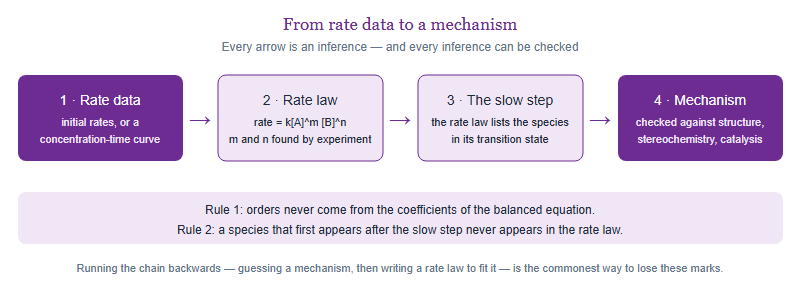
Kinetics questions look like arithmetic and are actually arguments. A table of initial rates is evidence; the rate law you extract from it names the species in the transition state of the slowest step; that composition rules mechanisms in and out. School courses usually stop at extracting the rate law. UKChO-style questions expect you to carry it one step further and say what it proves.
The gap between a rate law and a reason
Most A-Level, IB and AP chemistry courses teach kinetics as a procedure: read the table, compare experiments, write rate = k[A]m[B]n, calculate k, state the units. That procedure is worth real marks and you should be able to do it without hesitating. But it is the first third of the skill.
The part that separates a competent script from a strong one is the inference that follows. A rate law is an experimental fact about which species have already been assembled by the time the reaction passes through its highest energy barrier. It is the only routine experiment that lets you look inside a mechanism from the outside. When a paper gives you rate data for a reaction you have never seen — which is the normal case in an olympiad, not the exception — it is asking you to reason, not to recall.
Two consequences follow immediately, and both are commonly forgotten under time pressure:
- Orders are measured, never deduced from the equation. The coefficients in a balanced equation describe the overall bookkeeping of the reaction. They say nothing about which step is slow. A reaction written 2A + B → products can be first order in A, second order in A, or zero order in A. Only experiment decides.
- Orders are not restricted to 0, 1 and 2. Fractional orders appear in chain reactions; negative orders appear when a species inhibits the reaction by being consumed into an unreactive form. If your data gives you a half or a minus sign, that is information, not a mistake in your arithmetic.
Getting orders out of data: two methods, one check
There are only two routine ways to extract an order, and papers use both. The first is the method of initial rates: change one concentration, hold the others constant, and see what factor the rate changes by. Double a concentration and the rate doubles → first order. Double it and the rate quadruples → second order. Double it and nothing happens → zero order in that species.
Work an example properly, because the arithmetic is where careless candidates lose the marks they had already earned:
| Experiment | [A] / mol dm−3 | [B] / mol dm−3 | Initial rate / mol dm−3 s−1 | What it tells you |
|---|---|---|---|---|
| 1 | 0.10 | 0.10 | 2.0 × 10⁻⁴ | reference run |
| 2 | 0.20 | 0.10 | 8.0 × 10⁻⁴ | [A] ×2, rate ×4 → second order in A |
| 3 | 0.10 | 0.20 | 4.0 × 10⁻⁴ | [B] ×2, rate ×2 → first order in B |
So rate = k[A]2[B], overall order three. Substituting experiment 1: 2.0 × 10−4 = k × (0.10)2 × (0.10) = k × 1.0 × 10⁻³, giving k = 0.20. The units follow from the algebra, never from memory: mol dm−3 s−1 divided by (mol dm−3)3 leaves mol−2 dm6 s−1. Deriving the units each time takes ten seconds and catches an error in your order almost immediately — if the units come out absurd, your exponents are wrong.
The second method is the graphical one: take one concentration-time data set and find out which transformation of it gives a straight line. This is the method papers reach for when they hand you a single decay curve rather than a table of runs.
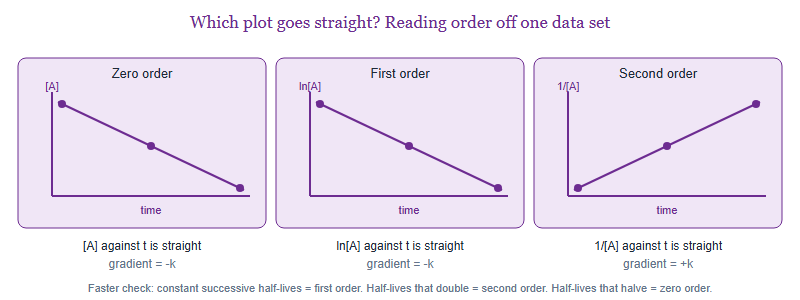
The half-life check underneath that figure is worth memorising because it turns a graph question into a ten-second inspection. For a first-order reaction, t½ = ln 2 / k and does not depend on concentration at all — so if the time to fall from 0.80 to 0.40 mol dm−3 equals the time to fall from 0.40 to 0.20, you have first order and you have it without plotting anything. If each successive half-life is twice the last, the reaction is second order. If each is half the last, it is zero order. A worked value: if k = 3.0 × 10⁻³ s−1, then t½ = 0.693 / 3.0 × 10−3 = 231 s, whatever concentration you start from.
The Arrhenius equation: what a temperature change is actually worth
k = A e−Ea/RT becomes useful the moment you take logs: ln k = ln A − Ea/(RT). That is the equation of a straight line if you plot ln k against 1/T, with gradient −Ea/R and intercept ln A. So Ea = −gradient × R, with R = 8.314 J K−1 mol−1. Two things go wrong here more often than anything else in physical chemistry: candidates forget that this Ea arrives in joules per mole and quote it as if it were kilojoules, and they use temperatures in degrees Celsius. Both are silent errors — the number still looks plausible.
When you are given two rate constants at two temperatures instead of a graph, use ln(k2/k1) = (Ea/R)(1/T1 − 1/T2). This form is also the fastest way to sanity-check the folk rule that a 10 °C rise roughly doubles a rate. Take Ea = 50 kJ mol−1 and warm a reaction from 298 K to 308 K: ln(k2/k1) = (50 000 / 8.314) × (1/298 − 1/308) = 6014 × 1.089 × 10−4 = 0.655, so k2/k1 = 1.93. Close to doubling, which is where the rule comes from. Now repeat it with Ea = 100 kJ mol−1 over the same ten degrees and the ratio is 3.7. The rule of thumb is not a law; it is a statement about reactions with activation energies near 50 kJ mol−1. Knowing why it works tells you when to distrust it, and that distinction is exactly the sort of thing an olympiad question is built around.
| Order in A | Integrated form | Straight-line plot | Gradient | Successive half-lives | Units of k |
|---|---|---|---|---|---|
| Zero | [A] = [A]0 − kt | [A] against t | −k | halve each time | mol dm−3 s−1 |
| First | ln[A] = ln[A]0 − kt | ln[A] against t | −k | constant | s−1 |
| Second | 1/[A] = 1/[A]0 + kt | 1/[A] against t | +k | double each time | mol−1 dm3 s−1 |
From rate law to mechanism: the inference that earns the marks
Here is the principle stated precisely, because a loose version of it will not survive a follow-up question. The rate law gives the composition of the transition state of the rate-determining step, counting everything consumed up to and including that step. It says nothing about geometry, and nothing about what happens afterwards.
Two standard consequences you should be able to deploy on sight:
- Species after the slow step are invisible. If a fast step follows the slow one, its reagents cannot appear in the rate law. A nucleophile that attacks a carbocation after the carbon-halogen bond has already broken does not affect how fast the reaction runs, which is precisely why an SN1 substitution is first order overall — rate = k[RX] — while an SN2 substitution, where bond-breaking and bond-making happen in one concerted step, is second order: rate = k[RX][Nu−]. That kinetic difference is evidence for the mechanism, independent of any stereochemical argument.
- Species in a fast pre-equilibrium are visible. Suppose step 1 is a fast equilibrium A + B ⇌ C with constant K1, and step 2 is the slow one, A + C → products, with rate constant k2. Then rate = k2[A][C], and because K1 = [C]/([A][B]) you can substitute [C] = K1[A][B] to give rate = k2K1[A]2[B]. The observed rate constant is a composite, k = k2K1 — and the predicted orders are second in A and first in B.
That prediction is exactly the rate law extracted from the table above. This is the whole game in miniature: data gave a rate law, the rate law was compared with what a proposed mechanism predicts, and the two agreed. A complete answer says so explicitly — the mechanism is consistent with the data. It is worth being disciplined about that phrase, because kinetics can never prove a mechanism, only eliminate the ones that contradict it. Writing “this proves the mechanism” is the kind of overclaim a careful marker notices, and the difference is a matter of scientific accuracy rather than style. If you want the sentence patterns that carry this sort of hedged-but-committed reasoning, our guide to what UKChO is and how its papers are built sets out the general shape of the exam these questions sit inside.
Four traps that cost marks on otherwise correct work
Trap 1: confusing zero order with pseudo-order. Genuine zero order means the rate does not depend on that concentration — typically because a catalyst surface or an enzyme is saturated, so adding more substrate cannot speed anything up. Pseudo-order is different and deliberate: an experimenter floods the system with a large excess of B so that [B] stays effectively constant, and rate = k[A][B] collapses to rate = k′[A] with k′ = k[B]. The reaction is still first order in B; the experiment has merely hidden it. Papers set this up as a trap by telling you one reagent was in “large excess” and then asking what the true order is.
Trap 2: thinking a catalyst shifts the equilibrium. A catalyst provides an alternative pathway with a lower activation energy. It accelerates the forward and reverse reactions by the same factor, so the system reaches the same equilibrium position sooner. It does not change ΔH, and it does not change K. If your answer implies a catalyst increases yield at equilibrium, it will be marked wrong however fluently it is written.
Trap 3: treating k as if it depended on concentration. The rate changes when you change concentration; the rate constant does not. k depends on temperature and on the presence of a catalyst. A candidate who recalculates k for every row of a table and reports three different values has usually made an arithmetic slip — consistent values across rows are a free check that your orders are right.
Trap 4: reporting more significant figures than the data supports. Rate data is usually quoted to two significant figures. An Ea written to five decimal places advertises that you copied a calculator display without thinking about the measurement behind it.
The efficient way to build all four reflexes is to work through kinetics parts from real papers rather than textbook exercises, because the olympiad versions embed the kinetics in an unfamiliar context and expect you to extract it. Our method for doing that without simply learning the answers is set out in how to use UKChO past papers as a diagnostic; we keep our own gathered pack of papers, with worked solutions for some years rather than all of them.
For scale on what these marks are worth: Round 1 is a two-hour paper marked out of 84, and in 2026 the award boundaries fell at 13 for Bronze, 23 for Silver and 38 for Gold, from a record field of 17 241 students across 1 153 schools. A single well-handled kinetics part can be a meaningful fraction of the ten marks that separated Bronze from Silver that year. The full 2026 distribution is here.
Frequently asked questions
How do you find the order of a reaction from data?
Compare initial rates by doubling one concentration and noting the factor the rate changes by, or find which plot of the data gives a straight line.
Why does the balanced equation not give the rate law?
Because the rate depends on the slowest step, not the overall equation. Orders are measured experimentally and can be fractional or negative.
What does the gradient of an Arrhenius plot give you?
Plot ln k against 1/T; the gradient is -Ea/R, so Ea equals minus the gradient times 8.314. Note that Ea then arrives in joules.
Does a catalyst change the position of equilibrium?
No. It lowers the activation energy and speeds the forward and reverse reactions equally, so the same equilibrium is reached sooner.
This is an independent guide operated by Hanlin Education for China-based international-school students. We are NOT affiliated with, endorsed by, or sponsored by the Royal Society of Chemistry (RSC). Competition dates, formats, eligibility, syllabus scope and score boundaries change from year to year — confirm current details on rsc.org. Errors reported to us are corrected within 7 working days.