Thermodynamics on a UK Chemistry Olympiad paper is not a harder version of school energetics. It is the same physics with the data moved: the question supplies numbers you have never seen, for species you have never met, and asks you to assemble them into a cycle. The chemistry is rarely the obstacle. The bookkeeping is.
Why olympiad energetics feels different from school energetics
In a school exam, an energetics question usually tells you which quantity it wants. It says calculate the enthalpy change of combustion, and the data table contains exactly the values you need, in the order you need them. Nothing is left over and nothing is missing.
A UKChO question does the opposite. It hands you a paragraph about an industrial process or an atmospheric reaction, drops a table of thermodynamic data into the middle of it, and asks a question that can only be answered by choosing a route through that data. Some of the values are there to be used. Some are there for a later part. Occasionally one is there to see whether you notice it does not apply.
That shift changes what you are actually being tested on. You are not being asked whether you know that enthalpy is a state function; you are being asked whether you can use that fact to construct a route between two things when nobody tells you which route to build. Everything else in this article is in service of that one skill. For the wider picture of how the competition is structured, start from our guide to what the UK Chemistry Olympiad is.
The four enthalpy currencies, and what each one can legally buy
Most thermodynamics errors at olympiad level are not calculation errors. They are category errors: a student uses a quantity for something it was never defined to do. There are four kinds of enthalpy data that recur, and each carries its own definition, its own sign convention, and its own restriction.
| Quantity | Defined as | What it can be used for | The trap |
|---|---|---|---|
| Standard enthalpy of formation, ΔfH° | One mole of the compound formed from its elements in their standard states | Any reaction, via ΣΔfH°(products) − ΣΔfH°(reactants) | Elements in their standard states are zero — but only in that state. Carbon as graphite is zero; carbon as diamond is not. |
| Standard enthalpy of combustion, ΔcH° | One mole of substance burned completely in excess oxygen | Reactions between combustible organics, via ΣΔcH°(reactants) − ΣΔcH°(products) | The subtraction runs the opposite way round to formation data. Reversing it is the single most common sign error in this topic. |
| Mean bond enthalpy | Average energy to break one mole of a bond homolytically, in the gas phase, across many compounds | Estimates for gas-phase reactions where no better data exists | Gas phase only, and averaged. If a reactant or product is a liquid or a solid, you owe the cycle a vaporisation or sublimation step before the bond enthalpies apply. |
| Lattice enthalpy | Formation of one mole of ionic solid from its gaseous ions, or the reverse process | Born–Haber cycles, and comparisons of ionic bonding strength | Two rival definitions are in circulation, one exothermic and one endothermic. Read which one the question has given you before you use it. |
Notice that three of the four traps are about direction or state, not about arithmetic. That is the pattern. A capable student who has never internalised these definitions will still get the numbers right and the sign wrong, which on an olympiad mark scheme is usually worth nothing.
Build the cycle in five moves
The reliable way to attack any energetics question — formation data, combustion data, bond enthalpies, or a full Born–Haber cycle — is to stop trying to see the answer and instead follow a fixed construction procedure.
- Move 1 — write the target equation, balanced, with state symbols. Not the equation the question describes in words: the equation whose enthalpy change you have actually been asked for. If you cannot write it, no amount of data will save you.
- Move 2 — list your data as arrows, not as numbers. Beside each value write the process it belongs to, in the direction it is defined. “+496 kJ mol−1” is a number; “Na(g) → Na+(g) + e−, +496” is a usable arrow.
- Move 3 — find the common meeting point. Every cycle works because two routes end in the same place. For formation data it is the elements; for combustion data it is the combustion products; for a Born–Haber cycle it is the isolated gaseous ions.
- Move 4 — sum around the loop, flipping the sign of any arrow you travel backwards. This is the only rule in the whole topic. If you use an arrow against its defined direction, its sign inverts.
- Move 5 — sanity-check magnitude and sign before you move on. Is an obviously exothermic process coming out positive? Is a lattice enthalpy coming out at 40 kJ mol−1 when real ones run into the hundreds? Ten seconds here recovers marks that would otherwise be gone.
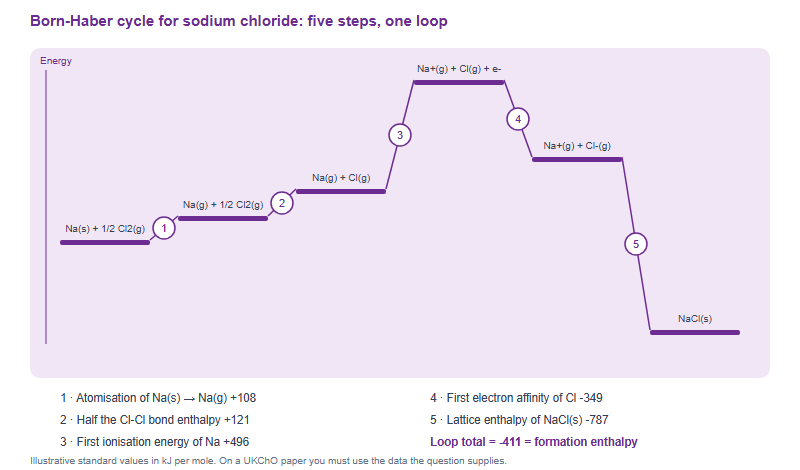
Two details in that cycle account for a disproportionate share of lost marks. The first is the factor of one half in step 2: chlorine exists as a diatomic molecule, so producing one mole of chlorine atoms costs half a mole of bond enthalpies, not one. The second is step 4. First electron affinities are exothermic and carry a negative sign; second electron affinities, where a second electron is forced onto an already negative ion, are endothermic and positive. A student who assumes all electron affinities are negative will build a cycle for an oxide or a sulfide that is wrong by several hundred kilojoules and looks perfectly tidy on the page.
Entropy and free energy: the second half of the argument
Enthalpy alone cannot tell you whether a reaction happens. UKChO knows this, and questions frequently pivot from “calculate ΔH” to “explain why this reaction proceeds only above a certain temperature” — a part worth several marks that many scripts leave blank.
The tool is Gibbs free energy, ΔG = ΔH − TΔS, and there are exactly three things that need to be automatic. First, the unit mismatch: entropy changes are conventionally quoted in J K−1 mol−1 while enthalpy changes are in kJ mol−1, so ΔS must be divided by 1000 before you subtract. Second, the crossover temperature: setting ΔG = 0 gives T = ΔH / ΔS, the temperature at which feasibility switches on or off. Third, the honest meaning of the result: a negative ΔG says a reaction is thermodynamically feasible, not that it is fast. A mixture can sit unchanged for years at a temperature where ΔG is comfortably negative, because the activation barrier has not been paid — which is why working through past papers diagnostically so often reveals students quietly conflating the two.
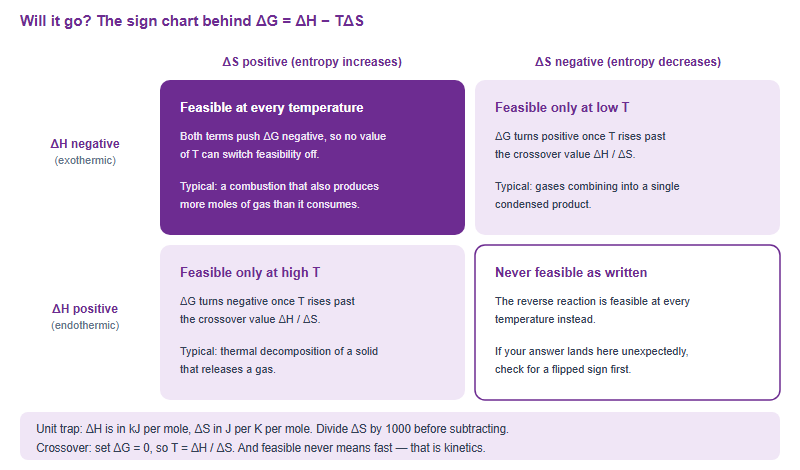
There is a second route to the same conclusion that UKChO papers like, because it exposes the physics rather than hiding it in a formula: total entropy. The entropy change of the surroundings is −ΔH/T, and a process is feasible when the entropy of system plus surroundings increases. This is worth practising alongside the free-energy form, partly because some questions ask for it explicitly, and partly because it makes the temperature dependence obvious instead of something you memorise from a chart. And once ΔG° is in hand, the bridge to equilibrium is ΔG° = −RT ln K — the point where energetics stops being a standalone topic and starts feeding the equilibrium calculations that appear elsewhere on the same paper.
Where these marks actually sit on a UKChO paper
It is worth being concrete about why this topic repays attention in the autumn rather than in January. The 2026 Round 1 paper, sat on 28 January 2026, was marked out of 84 across five questions carrying 8, 18, 19, 26 and 13 marks. The award boundaries came in at Gold from 38, Silver from 23 and Bronze from 13, from a record field of 17,241 students across 1,153 schools.
Run the arithmetic on those boundaries and the strategic picture changes. Gold at 38 out of 84 is a shade over 45% of the paper. Silver is 27%. Bronze is 15.5%. Nobody clears these thresholds by solving the hardest part of the hardest question; they clear them by not dropping routine marks across four or five different contexts. That matters more now than it did two years ago, because the Gold boundary had sat at 29 to 30 in the two previous seasons before jumping to 38. Our own reading of that jump — and it is our interpretation, not an RSC statement — is that the paper carried more accessible marks early, so the boundary rose without the subject getting harder. The practical consequence is that Gold has become a test of accuracy on the routine rather than heroics on the exotic. Cycles and free-energy arguments are exactly that kind of routine mark: mechanical, predictable, and entirely losable to a sign. The full 2026 results breakdown sets out the distribution behind those boundaries.
How to train it before January
Registration for the 2027 round opens on 16 September 2026 and closes on 11 January 2027, with Round 1 sat on Thursday 21 January 2027 — dates published by the RSC, which you should confirm on rsc.org before planning around them. That leaves an autumn of roughly four months, and thermodynamics is one of the few topics where a small, repeatable drill produces a measurable score change inside that window.
- Drill the construction, not the answer. Take past questions and stop after Move 4: write the target equation, list the data as arrows, identify the meeting point, and write the summation expression. Do not evaluate it. Twenty of these in an hour teaches more than four fully worked solutions.
- Keep a sign-error log. Every time a sign goes wrong, write one line: which quantity, which direction, why. Most students discover they have two or three recurring errors, not twenty.
- Practise the phase-change tax. Deliberately seek problems where bond enthalpies are offered but a species is liquid or solid, and force yourself to insert the vaporisation or sublimation step before using them.
- Write the sentence, not just the number. Feasibility parts are marked on the explanation. Practise finishing with “ΔG becomes negative above T = ΔH/ΔS, so the reaction is feasible above this temperature”, rather than with a bare figure and a full stop.
None of this is glamorous, and none of it is the chemistry that makes people fall in love with the subject. But it is a large part of what separates a Silver script from a Gold one, and it is almost entirely within your control before you ever see the paper.
Do I need to memorise thermodynamic data for UKChO?
No. The paper supplies the data it wants you to use. What you must own are the definitions, the sign conventions and the cycle construction.
Why do bond enthalpies give a different answer from formation data?
Bond enthalpies are averages across many compounds and apply to gas-phase species, so they give an estimate rather than an exact value.
What is the crossover temperature?
The temperature where the free energy change is zero, found from T = ΔH divided by ΔS. Feasibility switches either side of it, depending on the signs.
Does a negative free energy change mean the reaction will be fast?
No. It means the reaction is thermodynamically feasible. Rate is a kinetics question, governed by the activation barrier.
This is an independent guide operated by Hanlin Education for China-based international-school students. We are not affiliated with, endorsed by, or sponsored by the Royal Society of Chemistry (RSC). Entry eligibility, registration routes, fees, dates and paper format are set by the organiser and change from season to season — confirm current details on rsc.org before acting on anything here. Any factual error brought to our attention is corrected within 7 working days.