Almost every UK Chemistry Olympiad question opens with something you have never met — an unfamiliar molecule, an industrial process, a data set from a real study. Students who try to recall it stall. Students who treat the stem as a supply of information and reason from A-Level principles score. That decoding step, not the chemistry itself, is what the paper is really testing.
UKChO sets contexts, not topics
A school paper is organised by topic. You know before you turn the page that Section B is redox, so you arrive with redox loaded and you leave having done redox. A UKChO paper is organised by context. The 2026 Round 1 paper ran five questions carrying 8, 18, 19, 26 and 13 marks out of 84, and each was framed around a real situation rather than a syllabus heading — the first, for example, on contaminants in swimming pools.
That single structural difference produces most of the shock students report after their first attempt. Nothing on the page announces which chapter it belongs to. A question about a water-treatment plant may want oxidation numbers in one part, a shape in the next, a mole calculation after that, and an equilibrium argument to finish. You are not being asked to retrieve a topic. You are being asked to work out which of the things you already know applies to a situation that has been described to you.
The good news, and it is genuinely good news, is that this makes the paper far more predictable than it first appears. If the context is certain to be unfamiliar, then the examiners cannot be testing whether you have met it. They can only be testing whether you can operate on unfamiliar material — and that is a trainable skill with a fixed method. If you are new to the competition, our overview of what the UK Chemistry Olympiad is sets out the structure this article sits inside.
Closed-book, but open-content: the three jobs a stem does
Read a UKChO stem carefully and you will find that everything unfamiliar in it has been defined for you. That is not generosity; it is design. The examiners need the question to be answerable, so the exotic material arrives with instructions attached. What varies is which job a given piece of the stem is doing.
| What the stem gives you | Why it is there | What it is protecting | The failure mode |
|---|---|---|---|
| A definition or a structure — a named species, a diagram, an explanation of a linkage | To replace knowledge you are not expected to have | Every downstream part that depends on knowing what the species is | Skimming it, then trying to recall the species instead, and answering about the wrong thing |
| Numerical data — a table, a graph, a set of constants or potentials | To be used, in the units and conditions stated | The calculation marks, which are usually the largest single block | Substituting a remembered value for the supplied one, or ignoring the stated conditions |
| A constraint — “under acidic conditions”, “in the gas phase”, “assume complete reaction” | To narrow an otherwise open problem to one defensible answer | Balancing marks, mechanism marks, and any explanation mark | Writing a chemically reasonable answer that violates the stated condition and scores nothing |
| Surplus information — a value or fact you will need in a later part, or not at all | To stop the question telling you the method by elimination | Nothing directly; it tests whether you select rather than consume | Forcing every supplied number into the first calculation because it was offered |
The last row is the one people underestimate. In a school exam, unused data is usually a sign of a mistake. In an olympiad, unused data is normal, because the setters deliberately remove the crutch of “there are three numbers, so the formula must need three numbers”. Learning to leave a value on the table without panicking is part of the technique.
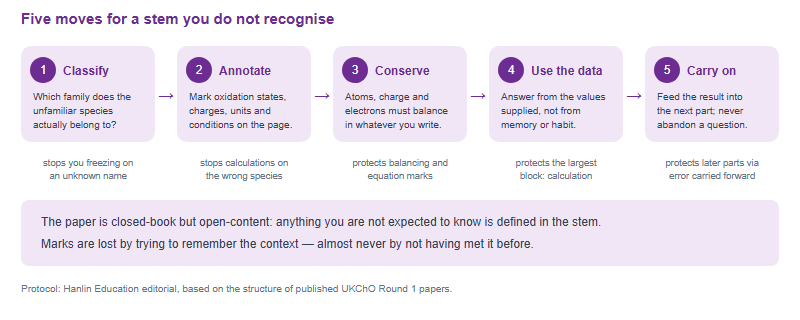
The five-move protocol for a stem you do not recognise
What follows is a fixed sequence. It is deliberately mechanical, because the moment a question looks alien is exactly the moment your judgement is least reliable and a procedure is worth most.
Two demonstrations, built from scratch
The examples below are ours, not reproductions of any past paper. They are chosen because each looks impossible to a student expecting recall and becomes routine to a student running the protocol.
Demonstration one: an ion you have never met. Suppose a stem introduces the peroxodisulfate ion, S2O82−, used as an oxidising agent, and tells you that it contains an oxygen–oxygen linkage. Then it asks for the oxidation state of sulfur. Move 1: it is an oxoanion of sulfur, so sulfate chemistry is the family. Move 2: annotate. Treating all eight oxygens as −2 gives 2x − 16 = −2, so x = +7 — which is impossible, because sulfur is in group 16 and cannot exceed +6. Move 3: conservation says the arithmetic must still balance, so the assumption is wrong, and the stem has already told you why. In a peroxide linkage each of those two oxygens is −1. Recount: six oxygens at −2 and two at −1 give −14, so 2x − 14 = −2 and x = +6. The impossible answer was the clue, not a dead end.
Push it one part further, as UKChO would. Ask for the half-equation for reduction to sulfate: S2O82− + 2e− → 2SO42−. Atoms balance, and charge balances at −4 on each side. Sulfur has not changed oxidation state at all; the electrons went to the peroxide oxygens, taking them from −1 to −2. A student running on recall looks for a sulfur oxidation-state change and cannot find one. A student running the protocol finds the answer in the bookkeeping.
Demonstration two: a shape you have never drawn. Suppose the stem mentions the IF4− ion. There is no point searching your memory. Count instead: iodine brings seven valence electrons, the negative charge adds one, giving eight; four of those are used in bonds to fluorine, leaving four as two lone pairs. That is six electron domains around the central atom, so the arrangement is octahedral, and with the two lone pairs taking opposite positions the ion is square planar. Nothing in that chain required you to have met IF4−. It required electron counting, which you already own.
Both demonstrations share a shape. The unfamiliar part supplies the setting; the familiar part supplies the reasoning; and the answer emerges from a constraint the stem handed you.
What you can revise, and what you cannot
Once you accept that the context is unrevisable, preparation changes character. You stop trying to broaden coverage and start trying to make a small number of operations automatic under pressure — because those operations are what you will actually be running while the clock ticks.
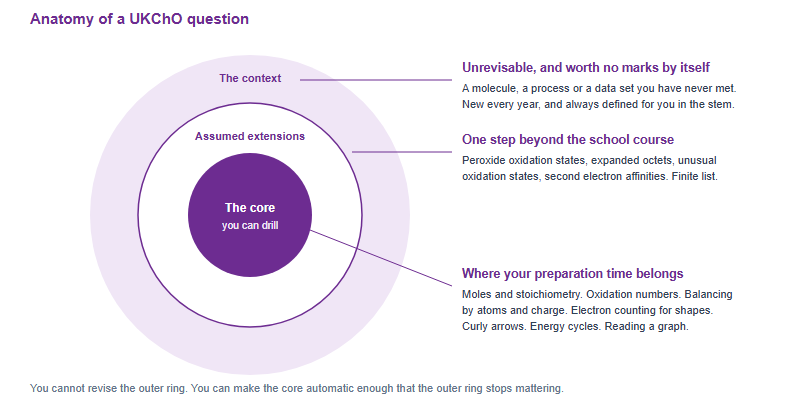
There is supporting evidence for this in the 2026 results. Across a record field of 17,241 students from 1,153 schools, the published examiners’ report for that paper singled out balancing equations and incomplete dot-and-cross diagrams among the recurring losses — core operations, not exotic content. Meanwhile the mean score was 20 out of 84 and the median 18, so the typical entrant left most of the paper unclaimed. We would not claim a single cause for that, but it is consistent with what we see in teaching: students stall at the decoding step, not at the chemistry step. The full 2026 breakdown has the distribution behind those figures.
How to practise decoding rather than answering
The trap in past-paper practice is that you can only be surprised by a paper once. After that, the context is familiar and you are no longer training the skill this article is about. Three adjustments keep the training honest.
- Do stem-only drills. Take a question you have never attempted, read the stem, and stop. Write down: what family is this, what has been defined for me, what constraint am I under, and what conservation law will I need. Then close the paper. Ten of these in twenty minutes trains the move that actually fails on the day.
- Cover the data table first. Read the question, decide what data you would need, and only then look at what was provided. If you asked for something that is not there, you have misread the route — and you found out for free.
- Deliberately read chemistry you were never taught. Any well-written account of an industrial process, an atmospheric reaction or an unusual oxidation state builds tolerance for unfamiliar material. The purpose is not to memorise it, but to stop unfamiliarity from feeling like a verdict on your ability.
- Mark yourself on process, not just score. Beside each lost mark write one word: decoding, chemistry, or arithmetic. Most students expect the middle category to dominate and discover it does not. Our guide to using past papers diagnostically sets out the full loop.
Registration for the 2027 round runs from 16 September 2026 to 11 January 2027, with Round 1 sat on Thursday 21 January 2027 according to dates published by the RSC — confirm them on rsc.org before you plan around them. That is enough time to make the core automatic, which is the only part of the paper you can control. The context will be new. It is supposed to be.
Do I need to know the chemistry in the UKChO question already?
No. Anything you are not expected to know is defined in the stem. The paper tests whether you can apply what you know to it.
What if I do not recognise the compound at all?
Classify it by family, annotate oxidation states and charges, then reason from conservation. Recognition earns no marks by itself.
Is unused data in a question a sign I went wrong?
Not on an olympiad paper. Surplus values are often placed there for a later part, or to stop you identifying the method by elimination.
Should I move on if a part defeats me?
Yes, but write your answer to the previous part first — later parts often build on it, and marks can still be carried forward.
This is an independent guide operated by Hanlin Education for China-based international-school students. We are not affiliated with, endorsed by, or sponsored by the Royal Society of Chemistry (RSC). Entry eligibility, registration routes, fees, dates and paper format are set by the organiser and change from season to season — confirm current details on rsc.org before acting on anything here. Any factual error brought to our attention is corrected within 7 working days.