You do not need a chemistry olympiad club to prepare for UKChO 2027 — you need three other students and ninety minutes a week. Four rotating roles, one timed question set, independent marking and a defence round will do most of what a coached club does. Registration opens on 16 September 2026 and Round 1 falls in late January, so the group has roughly eighteen weeks.
Why solo preparation stalls in the Silver band
Working alone is fine for building knowledge and poor at building the thing the paper actually rewards. On the 2026 paper, marked out of 84, Silver started at 23 and Gold at 38. Fifteen marks separated them, and when we mark scripts the majority of that gap is not missing chemistry. It is reasoning that stayed in the student’s head, working that stopped three lines early, and questions abandoned at the point where they stopped being familiar. The 2026 distribution is broken down in our analysis of the Round 1 results.
Those three failures share a feature: none of them is visible to the person committing them. Alone, you mark your own script and know what you meant, so a half-written argument reads as complete. Alone, nobody ever asks you why, so you never discover that the middle step of your explanation does not exist. Alone, you choose the questions, so you drift toward the chemistry you enjoy. A second reader fixes all three cheaply, and a group of four fixes them every week.
In cohorts we run, the first change we see is not the score but the tempo: students stop re-reading and start attempting, because a session with three other people in it has a clock and an audience. That observation is de-identified and drawn from our own coaching records, and individual results vary — but the mechanism is not mysterious, and it does not require us to be in the room.
This is a separate question from whether your school will enter a centre at all, which involves eligibility, a teacher willing to invigilate and an entry deadline, and which we have written about elsewhere. A study group can start this week regardless; whether and how you can actually sit the paper is a matter for rsc.org and for whoever books your sitting.
Four students, four rotating roles
The design principle is that everybody solves. The roles are jobs layered on top of solving, and they rotate every week, so across eighteen weeks each person does each role four or five times. That rotation is the whole point: the roles teach different things, and the one that teaches most is the one nobody volunteers for.
| Role | Work before the session | Work during the session | Why it teaches more than solving alone |
|---|---|---|---|
| Setter | Chooses the question set, times it honestly, and works it through in advance so they know what a full answer contains | Runs the clock; does not help during the timed block | You cannot set a question you do not understand. Preparing the answer first is the hardest and most useful hour of the week |
| Marker | Brings whatever solution or scheme exists for that set, or drafts a provisional one | Leads the marking; awards by method; writes the sentence that would have earned each lost mark | Marking is the fastest way to learn what an answer has to contain, because you see four different attempts at the same thing |
| Challenger | Nothing — deliberately, so one person arrives cold each week | Picks two answers and asks why until the reasoning chain is complete or it visibly breaks | Forces explanation out loud. Most half-understood chemistry survives silent revision and dies in the first two questions |
| Scribe | Reviews last week's log and pulls ten items for the recall sprint | Records each lost mark by type, topic, the fix, and the date it will be re-tested | The log is the group's memory. Without it the same error is rediscovered in October, November and January |
Four is the minimum that lets all four roles rotate. Five works comfortably. At six, the marking block runs long and the defence round becomes a lecture with an audience, which is the failure state this format exists to prevent.
The ninety-minute session, minute by minute
The shape matters more than the total. Ninety minutes split like this does something a three-hour unstructured session does not: it puts a silent, timed, exam-conditions block in the middle of every week from September onwards, which is the single hardest habit to build alone.
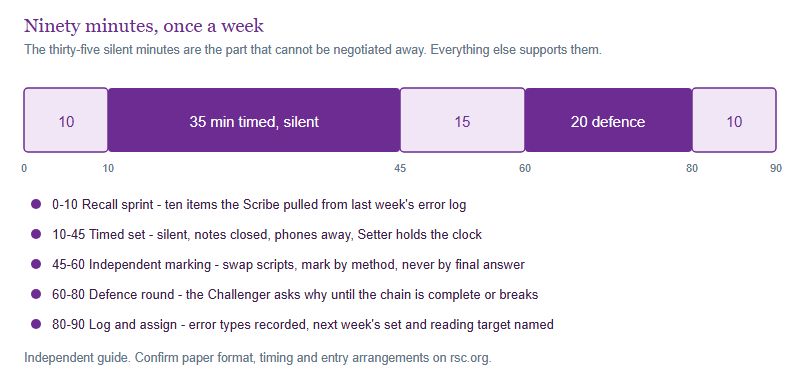
Two details make or break it. The Setter does not answer questions during the timed block, however reasonable the request — the moment help becomes available, the block stops being an exam. And the defence round is longer than the marking round on purpose: articulating why is where the learning is, and it is the part groups cut first when they run late.
Marking each other when you have no official scheme
This is the objection every group raises, and it is more solvable than it looks. Six rules cover almost every case.
- Marks attach to steps, not to the final number. A correct answer with no working scores what the working scores — which is nothing. Marking that rewards the right number teaches the wrong habit.
- Every mark must correspond to something you can point at. If the Marker cannot put a finger on the words that earn it, it is not a mark.
- Units and significant figures are marked, every time, from week one. They are the cheapest marks on any paper and the easiest to stop losing.
- Where a worked solution exists for that year, use it. The pack of past papers we have gathered ourselves includes worked solutions for some of the years and not for every year, and we keep adding to it — so plan for years where you have the questions and no solution.
- Where there is no solution, build a consensus scheme first, then calibrate it. The group agrees in advance what a full answer must contain, marks against that, and then — a fortnight later — runs a year where a worked solution does exist and compares its own standard against it. Groups routinely discover they have been more generous than the worked solution allows — in our own cohorts, that is the usual finding.
- Apply the stranger test. Would a chemist who was not in the room follow this answer without asking a question? If not, the reasoning is incomplete, whatever the marker knew the writer meant.
The deeper method for using papers diagnostically rather than as a memory test — which questions to repeat, and what a repeated error actually tells you — is set out in our guide to working through past papers. Read it before the group’s third session, not after its tenth.
An eighteen-week cadence around two fixed dates
Two dates anchor the autumn, and they are not the same for everyone. On the RSC schedule, entry for UK school centres opens on 16 September 2026 and closes on 11 January 2027, with Round 1 sat on Thursday 21 January 2027 and marking running to 7 February. The China-region sitting, per the organising channel’s date-change notice, is Friday 22 January 2027, and its registration also closes on 11 January — the same closing day, one day apart on the sitting. Earlier notices describe the China sitting as an evening, computer-based session, but the change notice gives only the date, so confirm the timing and the format at booking. Neither calendar corrects the other; work out which route applies to your group, and confirm eligibility on rsc.org rather than assuming. If the competition itself is new to some of your four, our introduction to UKChO is the right first session’s reading.
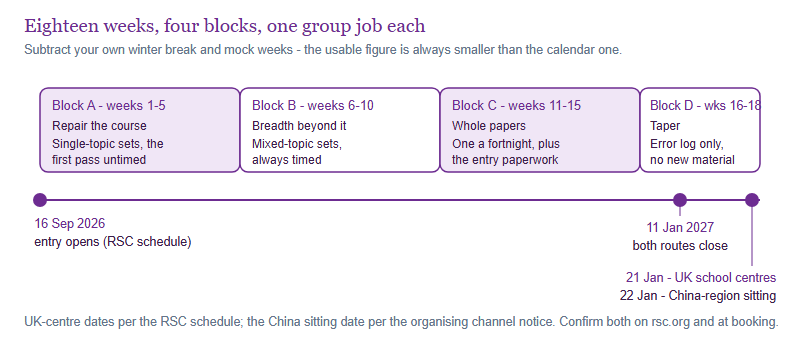
Two scheduling notes the group should decide in week one rather than in December. Entry closes ten days before the UK sitting and eleven before the China sitting, and December is exactly when a group is most likely to assume somebody else handled it — so put the paperwork inside Block C as a named task with a named owner, not as a background intention. And Block D is a taper, not a sprint: one full paper about ten days out, then nothing new. Material introduced inside three weeks arrives as half-formed recognition, which in an unfamiliar context is worse than no recognition at all.
The six ways these groups die
Every one of these is predictable, so each has a rule attached.
- It becomes a talking shop. Chemistry gets discussed; nothing gets attempted. Rule: the thirty-five silent minutes happen first and are never shortened, even when the group is late.
- The strongest student solves and the others watch. Rule: everyone attempts cold, and the Marker role rotates so the strongest student regularly has to mark rather than perform.
- Marking drifts generous. Everyone knows what everyone meant. Rule: the stranger test, plus a calibration against a year with a worked solution every fortnight.
- Reading replaces attempting. The group agrees to “go away and read the chapter” and returns no better. Rule: one reading target per person per week, chosen from the log, not from a textbook contents page.
- The log dies around week six. Rule: the Scribe role rotates, the log is one page per week, and the recall sprint is read straight from it — so a dead log is visible within seven days.
- Everyone peaks in November. Rule: Block B is deliberately not full papers. Save the whole-paper work for Block C so that the last month feels like consolidation rather than collapse.
One closing note on why the record is worth keeping. An award from a competition like this is not read in isolation: an admissions reader checks it against the transcript, against what the activity list claims, and against what the essays say about how you work. A group log gives you the raw material for that — the specific problem that took three weeks to crack, the error you kept repeating and how you stopped. Several strands of a profile corroborating each other is what makes the whole file believable, and a group produces that evidence as a by-product of preparing properly.
Frequently asked questions
How many students should the group have?
Four is the minimum that lets all four roles rotate. Five works well. Six starts to dilute the timed set and the marking.
What if nobody is strong enough to mark?
Mark by method against a worked solution where one exists for that year. Otherwise agree a scheme first, then calibrate it later.
Does the group need a teacher?
No. But a teacher who sanity-checks one marking session a month is worth far more than a weekly lecture nobody attempts anything in.
When should the group stop new material?
About three weeks out. The last block is timed papers and the error log, with one full paper roughly ten days before the sitting.
This is an independent guide operated by Hanlin Education for China-based international-school students. It is not affiliated with, endorsed by, or sponsored by the Royal Society of Chemistry (RSC). Dates, eligibility, entry routes, paper format and award boundaries are set by the organisers and change from year to year — confirm current details on rsc.org and with whoever books your sitting. Factual errors are corrected within 7 working days of being reported.