Round 2 of the UK Chemistry Olympiad is a residential selection event, not another school exam. Around thirty of the highest-scoring Round 1 students spend four days and three nights at a UK university, sit a four-hour practical examination and a four-hour theory paper, and on the final morning four of them are named as the UK team for the International Chemistry Olympiad. The Royal Society of Chemistry weights the theory paper at 60% and the practical at 40%.
How you get invited — and why Gold is not enough
Round 1 papers are marked in school, but the story does not end there. According to the RSC, the highest-scoring scripts are moderated by the Olympiad Working Group (OWG), and around thirty students are then invited to progress. Invitation is a selection decision made centrally, not an automatic consequence of crossing a boundary.
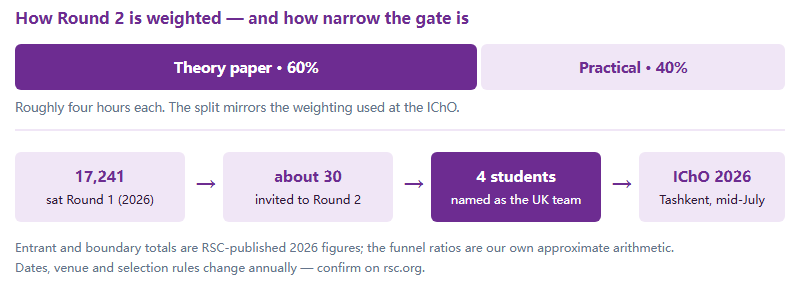
That distinction matters, and the 2026 numbers make it concrete. A record 17,241 students from 1,153 schools sat Round 1 on 28 January 2026. The paper was marked out of 84, with Gold awarded from 38 marks upward — 8.5% of entrants. Run the arithmetic on those published figures and the shape of the funnel becomes obvious:
- 8.5% of 17,241 is roughly 1,460 Gold certificates.
- Round 2 has room for about 30 students.
- So a Gold is roughly a 1-in-12 outcome among entrants, while a Round 2 invitation is closer to 1 in 570 — and only about 1 in 49 Gold winners gets one.
That is our own arithmetic on RSC-published totals, and it is approximate, but the conclusion is robust: Gold is an excellent result in its own right, and Round 2 is a far narrower gate sitting well above it. If you want the full boundary picture for 2026, we broke the distribution down in our 2026 Round 1 results analysis. If you are new to the competition structure, start with our overview of what the UKChO is.
The pre-reading: where Round 2 questions actually come from
The single most useful thing to understand about Round 2 is that its syllabus is not an extension of A-level. Students invited to Round 2 are sent a copy of Chemical Structure and Reactivity by Keeler and Wothers (ISBN 9780199604135) and given specific chapters to read before they arrive. The RSC states that the choice of reading is driven by the preparatory problems set for the forthcoming International Chemistry Olympiad, which the host country releases each year in late January.
Two consequences follow. First, the content of Round 2 changes every year, because the international syllabus changes every year. Second, the competition is explicitly testing whether you can absorb unfamiliar university-level material quickly and then use it under exam conditions — the RSC says the design intent is to identify students who can assimilate and apply information gathered in a short training window.
Day by day: what the residential actually involves
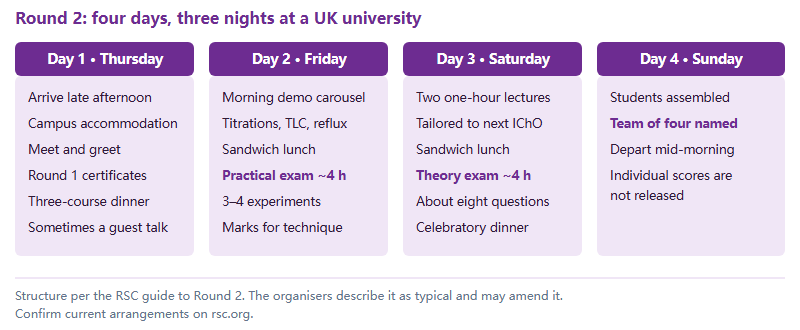
| Day | Main activity | What it is really for |
|---|---|---|
| Thursday | Arrival, meet and greet, Round 1 certificates, three-course dinner (no dress code; smart casual is common) | Settling in. Nothing is assessed, but you meet the working group and the other finalists |
| Friday | Morning carousel of demonstrations in undergraduate teaching labs, then the practical examination in the afternoon | The demonstrations cover the specific techniques needed that afternoon — some may be new to you |
| Saturday | Two one-hour lectures from the working group, then the theory examination after lunch | Tests whether you can learn something in the morning and deploy it the same day |
| Sunday | The team of four is announced mid-morning; students depart | Selection is final and individual scores are not published |
Practical details worth knowing in advance: students stay in university accommodation for the duration, and the RSC reimburses domestic travel expenses only, encouraging public transport where possible. For 2026 the event was reported as taking place 9–12 April at the University of Nottingham, though the RSC has listed dates and venue as subject to confirmation in the past — check rsc.org for the current cycle.
The practical exam: marks for how you work, not what you calculate
This is the part that surprises strong students most, and it is where a China-based candidate is most likely to be underprepared. The practical examination typically lasts four hours and consists of three or four experiments that must be run alongside one another, testing whether you can carry out several different practical activities simultaneously.
Crucially, the RSC states that unlike school practicals, the vast majority of marks are awarded for how the practical was performed rather than for the calculations that follow. Examiners look at the percentage yield and the purity of any organic product you make. In titrations, marks are not given for concordant results — only for a reported value that is close to the true value. You can be beautifully self-consistent and still score badly if your technique has a systematic flaw.
The invigilation policy reinforces this. During the examination the working group will step in only for safety reasons or if you cannot find a piece of equipment. They will not intervene if they can see you making a mistake in how you are running your experiment. Nobody is going to rescue your method.
The demonstration carousel gives an honest preview of the technique list. It varies year to year but has included volumetric analysis such as redox titrations and back titrations, observational tests for compounds and ions, thin-layer chromatography, organic synthesis, purification of a solid by recrystallisation, biphasic workups, and reflux and distillation. If you are studying at an international school with limited independent bench time, that list doubles as a self-audit: how many of those have you personally performed, start to finish, without a teacher standing over you?
The theory exam and the 60/40 split
Saturday begins with two one-hour theoretical lectures, delivered by members of the working group and tailored to topics identified for the coming IChO. Those topics are then assessed in the written paper that afternoon. The theory exam typically runs four hours and contains about eight questions, drawn from the pre-reading you were sent and from the material taught that morning.
Topics change with the international syllabus each year, but the RSC lists a representative spread: advanced organic synthesis; thermodynamics, including the second law and the temperature dependence of the equilibrium constant; complex equilibria; kinetics, including the steady-state approximation and integrated rate laws; quantum mechanics at the particle-in-a-box level; solid-state structures; electrochemistry; and NMR spectroscopy.
Three rules govern how those two papers are combined:
- Weighting. Theory accounts for 60% of Round 2 marks and the practical for 40% — deliberately mirroring the weighting used at the IChO itself. The practical is not a tie-breaker; it is two-fifths of the decision.
- Anonymity. Students write under pseudonyms on their Round 2 papers to protect impartiality.
- No extra time. The RSC states that no student receives extra time at Round 2, even where extra time is granted in their school exams, because this matches IChO policy. Access arrangements at Round 1 follow your normal school provision, so the change at Round 2 is worth knowing early — confirm the current policy on rsc.org.
The RSC is also candid that Round 2 is substantially harder than Round 1, and that it does not share examination scores. You will learn whether you are on the team, not where you placed.
What a China-based student should take from this
Two honest points first. Entry to Round 1 is made by an institution rather than by an individual student, and RSC guidance indicates that schools in a number of Asian territories, China among them, can enter Round 1 through ASEEDER China with fees applying. What the RSC does not spell out in the same place is how overseas entrants relate to Round 2 and to a team that represents the United Kingdom. Do not assume a pathway in either direction — confirm eligibility and progression with rsc.org or your school before you build a plan around it. We keep that question separate from preparation on purpose.
Now the useful part. Round 2 hands you something rare: a published, specific picture of what elite chemistry preparation looks like, which you can use whether or not you ever attend. Three things transfer directly:
- A reading target. Keeler and Wothers is the text the RSC sends to finalists, and the preparatory problems set for each IChO cycle mark the ceiling above it. We keep a Round 2 reading and preparatory-problem pack — the chapters that matter, plus the problem sets we have gathered and worked through ourselves — and can send you the current edition; it is far more informative than a generic reading list.
- A lab checklist. Redox and back titrations, TLC, recrystallisation, biphasic workups, reflux and distillation. Booking bench time to run these unsupervised is one of the few preparation moves that a Chinese international-school student can make that almost nobody else bothers with.
- A training habit. Learn something unfamiliar in the morning, use it in a problem the same afternoon. That is the skill Round 2 is built to detect, and it is trainable at home — the same discipline we describe in our guide to working through past papers.
The blunt summary: Round 1 rewards a strong, fast chemist working alone for two hours. Round 2 rewards someone who can read university-level material, stand at a bench for four hours without supervision, and absorb a lecture and use it before dinner. Those are different skills, and only one of them is being trained in most classrooms.
Frequently asked questions
How many students go to UKChO Round 2?
Around thirty of the highest-scoring Round 1 students are invited, after the top scripts are moderated by the Olympiad Working Group.
Is the Round 2 practical marked on results or technique?
Mainly technique. The RSC says most marks reflect how the practical was carried out, judged by outcomes such as yield, purity and titration accuracy.
How long are the Round 2 exams?
Both typically last about four hours: a practical of three or four simultaneous experiments, and a theory paper of roughly eight questions.
Can a student in China take part in Round 2?
Entry is made by schools and the team represents the UK. Confirm eligibility and any progression rules directly with rsc.org before planning.
This is an independent guide operated by Hanlin Education for China-based international-school students. It is not affiliated with, endorsed by, or sponsored by the Royal Society of Chemistry (RSC). Competition dates, formats, eligibility and selection procedures change from year to year — always confirm current details on rsc.org. If you spot an error, we correct it within 7 working days.