Electrochemistry is the part of redox that sits just past most school courses, and it is where UKChO marks quietly accumulate. A table of standard electrode potentials predicts direction, feasibility and disproportionation; it predicts nothing about rate. Add the Faraday arithmetic for electrolysis and you have a compact, drillable block of chemistry that few of the candidates we coach have automated before the January paper.
Why this block is worth a fortnight
This article assumes one thing: that you can already build a half-equation from an oxidation-state change and get the mole ratio out of a balanced equation. That ladder, and the titration arithmetic that follows it, is the foundation and we have written about it separately. What follows starts where most school courses stop — at the table of potentials itself.
The reason it pays is structural. Electrode potentials are one of very few areas where a small, fixed procedure answers questions about substances you have never met. You are handed data; you apply a convention; you get a defensible prediction. That is exactly the shape of an olympiad question, and it is why, across the papers we have gathered ourselves, the topic recurs in disguise — inside a transition-metal question, inside an energetics question, inside a page of context about a battery or a corrosion process.
It is also worth the time in mark terms. On the 2026 paper, marked out of 84, the step from Silver at 23 to Gold at 38 was fifteen marks. A block like this — a table convention, one cell calculation, one disproportionation test and one Faraday chain — is realistically worth a few marks on the papers we have gathered, for perhaps ten hours of work. That is a better exchange rate than a fifth pass through organic mechanisms. The 2026 boundary distribution is set out in our decoded Round 1 results, and if the competition itself is new to you, start with our overview of what UKChO is and how far it goes.
Reading a table of standard potentials
Four conventions do most of the work, and getting them wrong costs more marks than not knowing the chemistry.
- Everything is written as a reduction. Every entry is electrons on the left. If you need the oxidation, you reverse the equation and reverse the sign of the value.
- Standard conditions are defined. 298 K, solution species at 1 mol dm−3, gases at 100 kPa (older tables use 1 atm), and an inert electrode where no metal is involved.
- The hydrogen electrode is the zero. 2H+ + 2e− → H2 is assigned exactly 0.00 V by definition. Every other value is a comparison against it, not an absolute quantity.
- More positive means a better oxidising agent. The species on the left of a high-value entry takes electrons readily. The species on the right of a very negative entry gives them up readily.
| Half-cell, written as a reduction | Electrons | Typical E° / V | What the value is telling you |
|---|---|---|---|
| F2 + 2e− → 2F− | 2 | +2.87 | Among the strongest common oxidising agents |
| H2O2 + 2H+ + 2e− → 2H2O | 2 | +1.78 | Strong oxidant in acid; hydrogen peroxide also appears as a reductant in other couples |
| MnO4− + 8H+ + 5e− → Mn2+ + 4H2O | 5 | +1.51 | Eight H+ on the left: strongly pH-dependent, and much weaker outside acid |
| Cr2O72− + 14H+ + 6e− → 2Cr3+ + 7H2O | 6 | +1.33 | Fourteen H+: the same warning, more so |
| Ag+ + e− → Ag | 1 | +0.80 | A useful mid-table reference point |
| Fe3+ + e− → Fe2+ | 1 | +0.77 | Sits below permanganate, so permanganate oxidises iron(II) |
| I2 + 2e− → 2I− | 2 | +0.54 | Low enough that many oxidants liberate iodine from iodide |
| Cu2+ + 2e− → Cu | 2 | +0.34 | Positive, so copper is not attacked by non-oxidising acids |
| 2H+ + 2e− → H2 | 2 | 0.00 | Zero by definition — the reference, not a measurement |
| Zn2+ + 2e− → Zn | 2 | −0.76 | Negative, so zinc metal reduces H+ and displaces copper |
| Al3+ + 3e− → Al | 3 | −1.66 | Very negative, yet aluminium is famously unreactive — see the kinetics warning below |
Building a cell: the arithmetic, and the trap inside it
To combine two half-cells, identify which one runs as a reduction (the cathode) and which is forced to run backwards as an oxidation (the anode). Then:
E°cell = E°(cathode, as a reduction) − E°(anode, as a reduction)
A positive E°cell means the reaction as written is favourable under standard conditions. The bridge to energetics is the relation ΔG° = −nFE°cell, with the Faraday constant F = 96,485 C mol−1 and n the number of electrons transferred in the balanced overall equation.
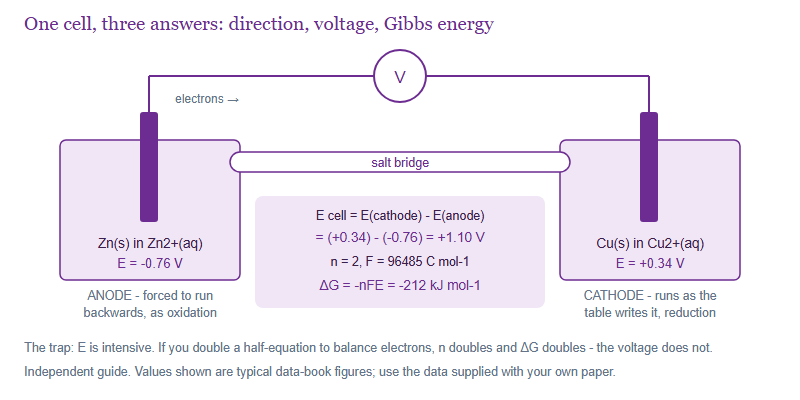
The trap in that box is the one we see most often when marking. Electrode potentials are intensive quantities: they do not scale. When you multiply a half-equation by three to balance electrons, you change n and therefore change ΔG°, but the potential stays exactly where the table put it. Multiplying the voltage is the single commonest arithmetic error in this topic, and it is invisible to the candidate because the answer still looks like a number of the right size.
A second worked case, using the table above: permanganate against iron(II). E°cell = (+1.51) − (+0.77) = +0.74 V, positive, so permanganate oxidises iron(II) under standard conditions. Five electrons transfer, so ΔG° = −5 × 96,485 × 0.74 = −357,000 J, or about −357 kJ mol−1. Notice that the +0.74 V did not change when the manganese half-equation was written with five electrons; only n did.
What E° can and cannot tell you
Three limits first, because questions are frequently built on precisely these — then one thing the table predicts unusually well.
It says nothing about rate. A potential is a thermodynamic statement. Aluminium sits at −1.66 V and should react vigorously with water; it does not, because an adherent oxide film blocks the reaction. If a question asks why a thermodynamically favourable process does not happen, “kinetically hindered” with a named barrier is the answer, not a recalculated voltage.
It applies only at standard conditions. Change the concentrations and the potential moves. Qualitatively, increasing the concentration of the species on the left of the reduction shifts the equilibrium right and makes the potential more positive; the reasoning is Le Chatelier applied to a half-cell, and you can argue it in a sentence without any equation. Quantitatively, the Nernst equation gives E = E° − (RT/nF) ln Q. Whether the quantitative form is expected of you is a scope question, and scope questions belong on rsc.org — but the qualitative direction is always fair game and costs nothing to learn.
pH is hiding in the half-equation. This is the point students miss most. Look again at MnO4− + 8H+ + 5e− → Mn2+ + 4H2O. Eight hydrogen ions appear on the left, so the oxidising power of permanganate collapses as the solution becomes less acidic — and in alkaline conditions the reduction goes to manganese(IV) oxide instead, a different couple with its own tabulated value. Whenever H+ or OH− appears in a half-equation, the potential is a function of pH, and a question that changes the pH is testing whether you noticed.
Disproportionation: the two-line test it does predict
A species disproportionates when it oxidises and reduces itself. The test is mechanical. Find the two couples in which the species appears — one where it is the oxidised form, one where it is the reduced form — and compare them. If the potential for reducing it is greater than the potential for oxidising it, the combination is favourable and it disproportionates.
Copper(I) is the standard illustration. Cu+ + e− → Cu has E° = +0.52 V; Cu2+ + e− → Cu+ has E° = +0.15 V. Because +0.52 exceeds +0.15, the cell built from them is positive: E°cell = 0.52 − 0.15 = +0.37 V, giving 2Cu+ → Cu2+ + Cu. That is why simple copper(I) salts in aqueous solution are not stable, and why the copper(I) species you meet are stabilised as insoluble solids or as complexes. Being able to produce that argument from a table — rather than remembering the conclusion — is what the question is actually testing.
Electrolysis: the Faraday chain
Electrolysis questions are a fixed five-link chain, and every link is a place to lose the mark. Learn the chain, not the examples.
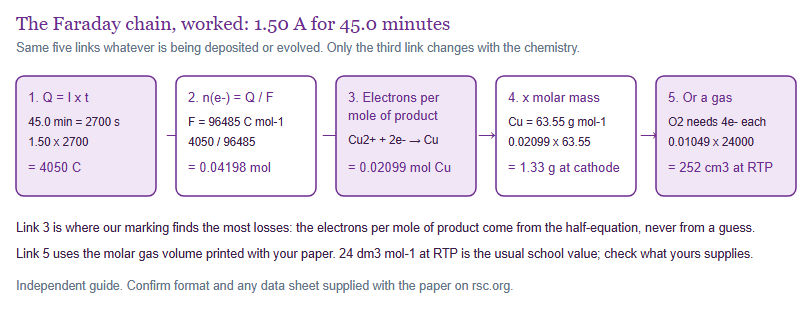
Two refinements worth carrying into the exam. First, a question that asks about the other electrode uses the same charge but a different half-equation, and therefore a different divisor — the charge is shared, the stoichiometry is not. Second, if two cells are in series the current is the same through both, so the same n(e−) applies to each and only the products differ. Both of those are one-line observations that turn a hard-looking part-question into the chain you already know.
Where the marks leak, and a two-week drill
From our own marking of scripts in coaching cohorts — de-identified, and individual results vary — the recurring losses in this topic are narrow enough to list:
- Multiplying E° when scaling a half-equation. The voltage never scales.
- Getting the subtraction backwards, so a favourable reaction is reported as unfavourable.
- Quoting remembered potentials instead of the values supplied with the paper.
- Arguing feasibility from E° for a system that is kinetically blocked, when the question was asking exactly that.
- Ignoring the H+ in a half-equation and treating a strongly pH-dependent oxidant as if it worked equally well at any pH.
- In electrolysis, dividing by the wrong number of electrons because the half-equation was never written down.
A fortnight is enough to close all six. Week one: read the conventions once, then do nothing but build cells from a table — twenty pairs of couples, each one answered with direction, E°cell, n and ΔG°, until the four lines come out automatically. Week two: ten disproportionation tests and ten Faraday chains, half of them asking for the anode product rather than the cathode. Then find the topic inside real questions rather than in a textbook exercise — our method for working through past papers as a diagnostic is the right frame for that, and the papers we have gathered ourselves are the material. We have worked solutions for some of those years and not for every year, so where there is no solution, check your reasoning against the conventions above rather than against a remembered answer.
Frequently asked questions
Do I need to memorise standard electrode potentials?
No, provided data is supplied with your paper — confirm that on rsc.org. Memorise the sign convention and the routine for using a table, not the numbers.
Why does a positive cell potential not guarantee a reaction?
Because it is a thermodynamic statement only. It says the reaction is favourable, not that it is fast. Kinetics can block it entirely.
Do I multiply the potential when I scale a half-equation?
No. Electrode potentials are intensive. Scaling changes the electrons in the balanced equation, and so changes n, never the voltage.
How do I tell whether a species will disproportionate?
Compare the two couples it appears in. If the potential for reducing it exceeds the potential for oxidising it, it disproportionates.
This is an independent guide operated by Hanlin Education for China-based international-school students. It is not affiliated with, endorsed by, or sponsored by the Royal Society of Chemistry (RSC). Dates, eligibility, entry routes, paper format, the data supplied with the paper and award boundaries are set by the organisers and change from year to year — confirm current details on rsc.org and with whoever books your sitting. Factual errors are corrected within 7 working days of being reported.