Some of the marks students lose in UKChO are not chemistry errors at all. They are answers that describe when the question asked you to explain, that hedge when the question asked you to commit, or that use a word too loosely to be credited. The verb at the start of each part tells you the shape of the answer it wants. Read it, then write that shape.
The marks you lose without getting the chemistry wrong
If you work in English at an international school but think about chemistry in another language, there is a specific failure mode that has nothing to do with how much you know. You understand the chemistry, you assemble it into English under time pressure, and what reaches the page is a sentence a marker cannot credit. It happens in three recognisable ways.
The first is answering a different verb. The question says explain; you describe what happens. Everything you wrote is true, and none of it addresses the question, because a description contains no cause. The second is vagueness that cannot be marked. “The reaction goes faster because the particles have more energy” sounds like an explanation, but leaves out which particles, more energy than what, and why that changes the rate — so a marker has nothing definite to credit. The third is hedging. Sentences such as “maybe it could be because of the structure” read as a refusal to commit; olympiad papers reward a stated position with reasoning attached, even when you are uncertain.
The scale is worth being blunt about. Round 1 is a two-hour paper marked out of 84, and in 2026 the award boundaries fell at 13 for Bronze, 23 for Silver and 38 for Gold — the full distribution is in the 2026 Round 1 results, decoded. Ten marks separate Bronze from Silver in 2026, and fifteen separate Silver from Gold. Recovering four or five of them by writing what the verb asked for is the cheapest improvement available to most candidates, because it needs no new chemistry.
The command words, decoded
Wording varies between papers and between years, so treat this as a working glossary rather than an official list: check the verbs actually used across the papers in your own practice pack, and confirm anything about marking policy on rsc.org. What does hold across papers is that these verbs are not interchangeable, and that the reasoning verbs carry the marks.
| Verb | What it demands | What a scoring answer contains | The common trap |
|---|---|---|---|
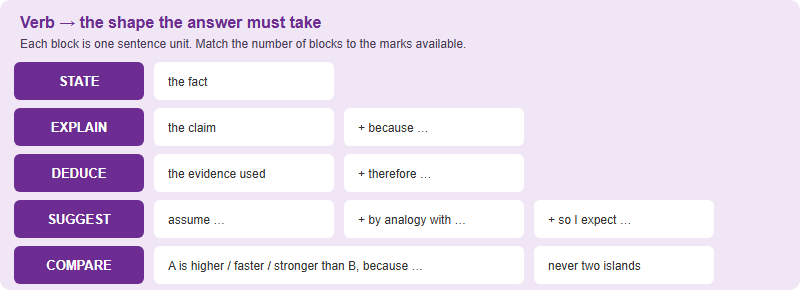
| State / Give / Name | Recall, nothing more | One short clause. No reason needed | Writing a paragraph and losing time you needed elsewhere |
| Describe | Say what happens or what is observed | The observable change, in sequence | Explaining why when only the what was asked |
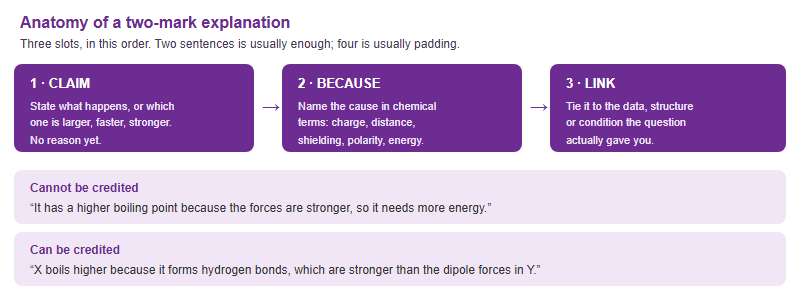
| Explain / Account for | Give the cause | Claim plus a because-clause naming a chemical cause | Restating the observation in different words |
| Deduce | Reach a conclusion from given information | The evidence you used, cited explicitly, then the conclusion | Stating the conclusion with the evidence left in your head |
| Suggest | Apply known chemistry to something unfamiliar | A stated assumption, reasoning by analogy, then a commitment | Reading it as a licence to guess, or to write nothing |
| Compare | Relate two things to each other | Comparative language in every sentence: higher than, faster than | Two separate descriptions with no comparison between them |
| Predict | Say what will happen, with justification | The outcome plus the principle it follows from | An outcome with no principle attached |
| Justify / Comment on | Evaluate, including limits | A position, the supporting reason, and the caveat | Agreeing with the statement and stopping there |
One practical habit converts this table into marks: before writing anything, underline or circle the verb in the part you are answering. It costs a second and it prevents the single most expensive error in the paper — writing a good answer to a question that was not asked.
The word pairs that quietly cost marks
Chemistry English contains pairs of words that are close in everyday speech and strictly different in the subject. If you learned chemistry partly through translation, some of these pairs may collapse into a single familiar word, and the distinction disappears silently — you never notice you have written the wrong one. These are the pairs worth auditing in your own writing.
- Rate versus extent. Rate is how fast; extent is how far. A catalyst changes the rate and not the position of equilibrium. Writing that a catalyst “increases the yield” is a chemistry error produced by a vocabulary slip.
- Strong versus concentrated. Strong describes how fully an acid dissociates; concentrated describes how much is dissolved per unit volume. A dilute strong acid and a concentrated weak acid are both ordinary things.
- Bond versus intermolecular force. Boiling separates molecules by overcoming forces between them; it does not break covalent bonds within them. This is the most frequently penalised sentence in all of physical chemistry.
- Amount versus concentration. Amount is in moles; concentration is moles per unit volume. Titration answers go wrong at exactly the point where these two are used interchangeably.
- Stable versus unreactive. Stability is a thermodynamic statement about energy; unreactivity is often a kinetic one about activation energy. A compound can be energetically unstable and perfectly unreactive at room temperature.
- Atom, molecule, ion, particle. “Particle” is the vaguest word available. Naming the species precisely is often the mark itself.
The fix is an audit rather than a vocabulary list. Take three of your own marked answers, and highlight every general noun — particle, thing, force, it. Replace each with the most specific correct term. Most students find their explanations get shorter and score better at the same time.
Writing a reasoned answer when you are not certain
Olympiad papers deliberately present chemistry you have not been taught, and “suggest” is the verb that signals it. Students who have been trained by exam-board practice often treat an unfamiliar stem as a signal to leave the space blank, because they are waiting for recall that is never going to arrive. That is the wrong instinct: these parts are answerable by reasoning, and they are written to be.
Use a three-move structure. State the assumption you are working from — for example, that an unfamiliar element behaves like the one above it in its group. Reason by analogy to chemistry you do know, naming the analogy explicitly. Then commit to an answer. A wrong commitment supported by visible reasoning is a fundamentally different object from a blank space, and it is also the honest way to write chemistry: assumption, argument, conclusion.
The same logic applies when you are certain but running out of time. One complete sentence in the claim-plus-because shape is worth more than three fragments circling the topic. If you can only write one thing, write the cause.
This reasoning-under-uncertainty habit is not only a Round 1 technique. The same disposition — take unfamiliar material, state what you assume, argue from it — is what the top 30 candidates invited to Round 2 at the University of Nottingham are asked to do with lectures on topics they will not have met at school, and what the international olympiad rewards beyond that. If the structure of the competition is still new to you, what the UK Chemistry Olympiad is sets it out.
A ten-minute weekly drill
Language habits change through rewriting, not through reading advice. Once a week, take one past-paper question you have already attempted and run this loop:
- Minute 1–2. Circle the verb in every part. Write next to each the shape it required, using the matrix above.
- Minute 3–6. Rewrite two of your own answers to match the shape. Do not improve the chemistry; only change the form. This isolates the variable, so you can see how much of your loss was language.
- Minute 7–8. Highlight every vague noun in the rewrite and replace it with a specific one.
- Minute 9–10. Compare against a worked solution where one exists. Our gathered past-paper pack has worked solutions for some years but not for every year; where none exists, mark yourself on form alone — did each answer contain the blocks its verb required?
Two months of that is roughly eight rewritten questions, which is enough to change a habit. Pair it with the diagnostic approach in how to use UKChO past papers without memorising answers, and you will be able to separate the two questions that matter most when reviewing a practice paper: did I not know this, or did I know it and fail to say it? Those two problems have completely different fixes, and most students spend their time on the first while losing marks to the second.
Frequently asked questions
What is the difference between explain and describe?
Describe says what happens or is observed. Explain gives the cause. An explanation without a because-clause is a description in disguise.
What does suggest mean on an olympiad paper?
Apply known chemistry to unfamiliar material. State your assumption, reason by analogy, then commit — it is not an invitation to leave it blank.
Do I lose marks for imperfect English in UKChO?
Precision matters more than fluency. Naming the specific species or interaction is what gets credited — confirm any marking policy on rsc.org.
How long should a two-mark explanation be?
Usually two sentences: the claim, then the cause linked to the data you were given. Extra length rarely adds marks and costs time.
This is an independent guide operated by Hanlin Education for China-based international-school students. We are NOT affiliated with, endorsed by, or sponsored by the Royal Society of Chemistry (RSC). Competition dates, formats, eligibility and score boundaries change from year to year — confirm current details on rsc.org. Errors reported to us are corrected within 7 working days.